Saturday, November 19, 2011

Kitchen Sink Expeditions: Lightspeed -- Part III

Think Space Wars vs. Space Trek. That's the ticket, yeah...
As I mentioned in Part I, there were several iterations of Lightspeed that came out before the current version. In those versions, there were some expansions and supplements that eventually got folded into the final Core Book of Lightspeed you see today. Some stayed in, some didn't make it, but all can give you a feel for the original dimensions of this particular Kitchen Sink Setting.

ESPERS

One of these expansions tackled ESPERs (known as wielders of Psionics and Mental Abilities and Super Powers in other settings).

Inspired, no doubt, by anime shows like Cosmo Police Justy and Dragon Ball, this aspect of the setting posited that high-powered ESPERs existed in the universe. Now don't think Counselor Troi of Star Trek or even the uplifted Telepaths of B5 -- think Goku and his friends, deputized by the AstroPol going out to fight other similarly powered villains.

Any GM worth his salt is going to sense that such a setting element would raise terrible questions in terms of the viability of SF setting plausibility, unless a Legion of Super-Heroes vibe is evoked. So that would mean ditching this particular aspect of the setting, unless the PCs themselves were all ESPERs of that class.

However, I did feel that the complete removal eliminated the potential PSI Judge, Jedi, PsiCorps, Mentat, or Lensman element to the series and wish it could be brought back somehow.

RACES, RACES, RACES

There's no shortage of races in Lightspeed, and there's certainly enough space to add your own in. Some of them come across as homages to certain well-known SF properties, while others take on a more archetypal feel:
  • Argesians: smart, great with technology, pacifistic. Star Trek Vulcans with a dash of the Known Universe Puppeteers.
  • Heshans: a race of ascetics who believe in non-violence, they do have the potential to ignite into a Battle Rage. Star Trek Vulcans crossed with Dragon Ball Z Saiyans (without the planet destroying power levels)
  • Hunters: xenophobic race that uses cloaking devices and prefers hand to hand weaponry when hunting all other races. Predators with the numbers filed off.
  • Krung: a tall, swarthy warrior race. Klingons, man.
  • Mronians: cat-people from outerspace. Chanur, anyone?
  • Nerfel: short, furry mammalian species that is very cute. Ewoks.
  • Yuzri: tall, furry bestial humanoids. Wookies.
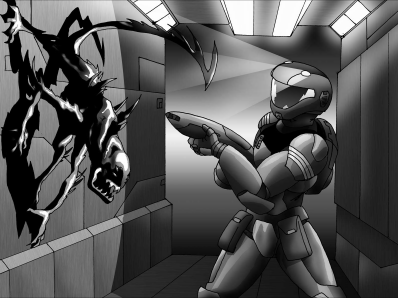
  • Saure: an alien species that tends to hibernate in deep space until they encounter another races, then they awaken, hunt, and breed. Hated by the Hunters. Aliens (vs. Predators) to be sure.
  • The Robot Nexus: Think the Borg mixed with the AI Virus of Traveller.
SHIPS

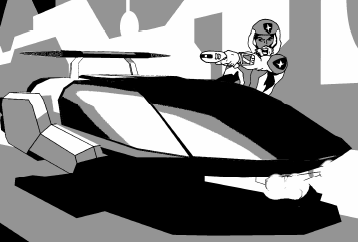
Lightspeed has a lot of ship designs in their art, and even released a supplement on ships of the galaxy. Now while the ships of the Pan-Solar Empire have a distinctive Star Wars feel in the art, the Interstellar Federation doesn't seem to be quite as a Star Trek inspired. If I ran the campaign, I'd definitely make their ships more Trek-ish so contrast with the Empire, and (in my own opinion) the more Babylon 5 meets Firefly feel of the Old Earth Empire ships.

And I think that you'd have to hammer out the balances between the ship designs to make sure that questions wouldn't arise like: why doesn't the Federation wipe out the Empire in one afternoon and then warp back for tea?

To be fair, the author may have balanced out the ship designs, but I never really delved deep enough to figure out if the various factions were an even match for one another despite differences in technological paths.

Up Next: Wrapping things Up


Monday, November 14, 2011

Kitchen Sink Expeditions: Lightspeed -- Part II


In Part I, we explored the background of Lightspeed and the broad strokes of the setting. In this Part, I hope to tackle the major elements of the setting, and show how they can be used as the homages that they are.


The Interstellar Federation


This is clearly the Star Trek Federation equivalent, but its origins lie in an alliance of colonies that threw off the yoke of Old Earth Empire exploitation. It is governed as an interstellar republic with almost 1000 Member Worlds, 10,000 Associate Worlds and over 15,000 Colonies and is protected by military and civilian forces known as StarForce and AstroPol respectively.


AstroPol is a star-spanning law enforcement agency, with many different arms to help create many different law enforcement campaign frames. There are the equivelent of Police Departments, Rangers for the borders, and Agents that are the equivalent of FBI/CIA operatives working of the good of the Federation.

StarForce is clearly a StarFleet equivalent, and the military structure and several other existents certainly do little to dispel that notion. The main difference is that StarForce is primarily concerned with defending against the machinations of the Pan-Solar Empire. Therefore, while there can be equivalents of Klingons, Romulans, and the Borg, the primary border of concerns is likely to be the one shared with the Empire.

Basing your campaign in the Interstellar Federation give you a chance to adventure in a stable, progressive space republic. It's not a utopia as the presence of AstroPol and StarForce makes clear, but it is perhaps, a society that believes that such a utopia is possible, despite the difficulties and opposition of rivals in the cold blackness of space.

Speaking of rivals...

The Pan-Solar Empire

The Emperor has a fondness for these insect
inspired designs.
This is the Star Wars equivalent, also originally part of the Old Earth Empire diaspora. The Emperor, a former general, staged a military coup in his quadrant and became the ruler of his corner of the galaxy. Since then, he has subjected himself to many life extension treatments and looks forward to eternal rule.

Opposing him are the Anti-Imperial Rebels -- outnumbered and outgunned at every turn, they fight valiantly to throw off the yoke of Imperial rule. Using guerilla tactics, old colonial spacecraft and secret bases, these Rebels manage to push forward in their efforts through covert financial and supply support from three main sources: aristocratic families that went into hiding after the Emperor came into power, the Interstellar Federation, and friendly Old Earth Empire factions.

There is a distinct lack of a Jedi equivalent in the setting -- which would actually work out well given the tendency of everyone and his mother wanting to play the supposedly extinct Jedi in a Rebellion Era Star Wars setting. There is also no Force in the setting, but older iterations of the Lightspeed may have a solution for that: ESPERs (which will be tackled in Part III).

Without ESPERs, however, the Rebellion will have to find other sources of technology and resources, and those may be found in the troubled birthplace of humanity...

The Old Earth Empires

The Corporation won't be happy about this...
So what is the point of the Old Earth Empires? This part of the setting is meant to capture different versions of a space-based future.

Most visible is the MegaCorporation-dominant vision, as reflected in Blade Runner (and revisited in Anime like Bubblegum Crisis), and the Alien / Aliens series of films. Cyberpunk campaigns and gritty space dramas can unfold in this corner of the galaxy, with protagonists eking out whatever small amount of happiness they can.

However, the MegaCorporations aren't necessarily the only game in town. Countries other than the U.S. have managed to retain their sovereignity and are reaching for the stars themselves. Japan's Space Defense Force, inspired by the Interstellar Federation, is an example of this; other countries in the world have managed to maintain and grow their interstellar holdings. In this setting, the European Union is a sad shadow of its former self, as most of its interstellar holdings were lost to the Pan-Solar Empire centuries ago.

Next Up: notable inclusions and possible additions

Saturday, November 12, 2011

Kitchen Sink Expeditions: Lightspeed -- Part I

Looking for a Science Fiction setting that is a mix of Star Wars, Star Trek, and other SF properties with a little Anime thrown into the mix? Look no further than the Lightspeed RPG by Christian Conkle.

Background

I first encountered Lightspeed back in the days when Fuzion was a still a thriving RPG system, and the first iterations of the game and setting were available for free on the internet. Even in those days, the intent to create a kitchen sink setting was not only apparent, it was stated as a goal by the author:

"If elements of Lightspeed seem familiar, that is intentional. Lightspeed attempts to be all inclusive, drawing inspiration from many Science Fiction films and novels and putting them together into a coherent whole. The purpose of this is to make Lightspeed as generic as possible, allowing players and gamemasters to set their characters and stories against any backdrop they desire. Within you’ll find elements of Star Trek, Star Wars, Aliens, Bladerunner, XFiles, Predator, Japanese Anime, Cyberpunk fiction, Lovecraftian fiction, and other Science Fiction games."

Broad Strokes

Intent is one thing, but how was the execution? To understand the broad strokes of the setting, it's best to take a look at the map of the Galaxy and how it was broken up -- it gives out the clearest visual idea of the approach taken with the setting.


Major elements of the setting include the Interstellar Federation with the StarForce Officers and the Federation Rangers; the PanSolar Empire ruled by the Emperor; and the remnants of the Old Earth Empires, filled with powerful mega-corporations and nations locked in cold and hot wars.

Next Up: A closer look at the major elements of the setting.

Thursday, November 10, 2011

Kitchen Sink Expeditions: The Lineup

I'm going to try to do a regular series of posts (again), that require mostly reading and critique instead of coming up with stuff. The series will be called Kitchen Sink Expeditions, and has nothing to do with Kitchen Sink press or any other entity or organization with the phrase Kitchen Sink in it.

Anyway, having already mentioned several RPGs and settings that I've noted are kitchen sink settings -- settings that have sufficient depth and breadth, along with pretty hard to miss homages, to handle a variety of genres, subgenres, and characters/gear/organizations from many sources in the course of play -- I think that I should alternate coverage between the already mentioned and the unmentioned.

My current planned listing is as follows:
  • Lightspeed by Christian Conkle
  • Code: Black by BTRC
  • Fading Suns by Holistic Games (now under Redbrick)
  • RIFTS by Palladium
  • "The Hero Games Setting Timeline" or "I got your meta-meta-meta-plot right here" by Hero Games (Steve Long)
  • Astral Empires by Port Nova Media
  • D&D by some company named TSR
And we'll see where we go from there. As for what I'll be talking about: it'll primarily be things that interest me about the way each setting's "kitchen sinkiness" was handled. I seem drawn to settings that do this well, and so I'd like to figure out why through this exercise. Given that each one seems to be huge (by the very nature of kitchen sink settings), I can only tackle what interests me -- hoping to discover some reason as to why I enjoy them.

Wednesday, November 9, 2011

Lone Wolf board game?


In my early gaming career, I didn't get to play or GM much. And so I relied on the Fighting Fantasy books and the Lone Wolf series of Gamebooks!

I'm carefully archiving the copies available at Project Aon, for laptop play. However, I did read from the blog that there's a Lone Wolf board game in the works.

Here's a quick look at the figurines:


Gary Chalk (original illustrator of the books) is involved in the game creation, and I think that dude with the winged helmet is meant to be Prince Pelathar -- charging to meet his fate against the lizard-like Gourgaz.

Monday, November 7, 2011

Inspiration: Jungle Zombies


With shows like The Walking Dead and movies like Shaun of the Dead, and the upcoming World War Z flick sure to fan the flames of zombie mania, an indie film concerning the same subject matter may seem like a rehash of the same subject matter.


However, this movie -- Di Ingon 'Nato -- seems to suggest otherwise.

Based on the trailer above (subtitled for people like me who don't speak Bisaya -- the local language spoken in Cebu in addition to Filipino and English) it seems to really showcase some of the inherent differences that a change in location -- particularly a non-first-world country -- will make to the basic zombie formula, such as:
  • lots of trees that block sight (some of which are mango trees -- Cebu has some of the sweetest mangoes in the world)
  • reliance on both science and syncretic beliefs (religion, superstition, and magic)
  • lack of a lot of modern conveniences (the lady in orange shown carrying a large corrugated metal pan with clothes in it is going to wash her clothes at the local water source)
  • roads that don't go straight, but follow the curvature of the land, resulting in many blind spots
  • communication issues (cellphone signals blocked by mountains, phone cables to expensive to roll out to the poor rural areas because of the lack of a paying user base)
  • and so on.

What will it inspire? Well, aside from an obvious Romero zombie-inspired campaign, perhaps a different look at how monstrous infestations might be handled in places that are familiar with the modern world but don't have access to all its conveniences.

As a quick aside, Di Ingon 'Nato is translated in the disseminated materials as meaning "Not Like Us". The connotations of the phrase, however include spirits, ghosts, and demons. In fact, some I've talked to actually think of it as a noun, rather than a phrase, used to indicate that there are inhuman things lurking in a given place.

Saturday, November 5, 2011

On the Radar: Pelgrane Press's entry into OSR Westerns

This post by Pelgrane Press indicates that an RPG is in development called Owl Hoot Trail. It seems to be a Western RPG, but with an old school feel.

As stated in the post, there are several character classes that have some correlation to the classic D&D character classes:
  • the Lawman comes across as paladin-ish
  • the Scout seems ranger-y
  • the Scoundrel is theif-ish
  • the Gunslinger and the Ruffian are fighter-y
  • the Gadgeteer echoes the flash and the prepared / limited use nature of the wizards
  • the Mentalist takes on more the mental / illusionary abilities of the wizards and illusionists
  • the Preacher seems to be a cleric
  • the Shaman is more like a wizard tied to specific nature spirits, though I hesitate to call 'em druids.
I look forward to this release!

Friday, November 4, 2011

Shoulder Surfing: Life and Times of a Philippine Gamer's blog


Pointyman2000 has an ongoing series of posts on Fading Suns.

He's currently studying the rules and setting, and has some interesting insights. I'd like to see what he thinks about my old campaign given his sudden jump in knowledge of the game.

Thursday, November 3, 2011

Some Games I'd Run

Following up my last post, here's a list of some of the games I'd be interested in running:

Fading Suns

No surprise there, I've posted a lot on the attraction of this kitchen sink setting.

It also allows me a fair amount of latitude in terms of the types of game sessions I can run, and gives me any number of excuses to take away high technology away from the players when I need to have the isolated, out of touch, and without any wonderful tech devices.

It also grants some rationale for a Science Fantasy campaign where swords and guns can be used.

D&D (of some kind)

Whether it's Labyrinth Lord (or one of the retro-clones), D&D 3E or one of the D20 spin-offs (like True20), or one of the neoclones like Castles & Crusades, I'd be up for running a short campaign of around 3 months or so.

It'd be one part exploration of dungeons, one part exploration of the world, and one part killing monsters. I wouldn't really take it too much in the direction of a city-based adventure, as my knowledge of medieval technology and life is somewhat challenged; I would do what I feel D&D excels at: helping players -- through their PCs -- explore the unknown, kill the nasty monsters that inhabit it, and claim the best of that dark wilderness (below or above ground) for their own.

Star Hero

I've not mentioned this at all, but I'm quite fond of Star Hero. I'd probably run a military-based campaign rather than a trader-oriented one. Missions, politics, espionage, and a heavy amount of combat. It's the kind of thing that I feel the Hero System excels in -- a set of flexible tactical options that can handle a wide variety of special effects.

Like the campaign that inspired it, I'd have players make two characters -- one for the ground forces and one for the space-based battles -- and let the discoveries and progress of the campaign unfold from those two vantage points.

For ship-to-ship combat, I might use the rules for Starmada: Admiralty Edition.

Mutants & Masterminds 3rd Edition / DC Adventures


Yeah, I know I'm expected to say Champions given my history with the Hero System. But the sad fact is that there aren't that many players who are willing to tinker with the system themselves and build new characters. Hence the Mutants & Masterminds ruleset which is similar enough to the rulesets most of them know (D20) and a lot of templated archetypes to get started quickly.

If there were some like-minded Hero players, I'd run Champions though.

Or give alternative supers rule systems like Icons or G-Core a try. I think BASH! is another system I'd take a look at, although the classics like Mayfair's DC Heroes and the TSR Marvel Super-Heroes RPG would also spark my interest.

Wednesday, November 2, 2011

Introspection: Gaming Preference Categories

I've been thinking about this a lot recently, spurred on by the many demands on my time and resources.

My current gaming preferences are broken up into two major categories: reading, GMing, and playing.

Lexx, for example, was a read or play setting. But I'd never
run a game in the setting -- I'd be worried about getting the
feel of the setting and the tone of the stories right.
Game Reading refers to the games that I get a kick out of reading.

It may be because the premise is intriguing or particularly difficult to realize in the realm of RPGs. It may be because the art and layout are impressive, or because the rules and/or the setting or the writing are fantastic. It may be because the reviews of gameplay are outstanding. I want to read it and see for myself -- but it's unlikely I'll GM or play it because I just don't have the time or the readily available game posse yet.

As you might imagine, this category has the broadest selection of products in it.


Game Playing refers to games that I want to play in.

I may be attracted by the premise, or the setting, or a new game mechanic. I may even be interested in seeing how people I know run the game or play in the game. I'll want to see how combat is handled, where the edges of the 'sandbox' are, where the rails of the 'railroad' are, and find out how the gameplay feels.

As an avid gamer, this category has a slightly less broad selection. For example, I'm no longer into the whole World of Darkness setting/system -- though I will pick up books and leaf through them out of curiosity -- so I'll usually give playing in a WOD or nWOD game a pass.


Game GMing refers to games that spark my imagination and desire to run a game (either out of the box or modified setting- / rules-wise).

The game premise is particularly important here -- what kind of adventures and experiences will the players go through, and are they interesting enough for me as a GM to go through the reading and prep time necessary in addition to running the game? The setting comes a close second, and a unique system will count for a one-shot try -- provided I can use that system for some other game I'll be running in the future.

This is the narrowest selection of games despite my apparent interest in a lot of the developments in the RPG industry. These days, the desire for experimentation --  wanting to try out a bunch of systems and settings -- is tempered by the reality that I just don't have that many people interested in trying them out, and even then my learning/prep/running time is limited.

For the young ones and the young once who do have the time, enjoy all the industry offerings while you can!

Tuesday, November 1, 2011

On All Saints' Day: The Arduin Saint

In my misspent youth, I used to play Arduin with a gaming group that also introduced me to the Hero System via Champions. One of the characters that I chose to play was a rotund Saint in the classic -- ahem, D&D-inspired -- RPG known as Arduin.

Playing a saint is a bit difficult because the character class never uses weapons, never dons armor, and never fights.

Rather than being easier pickings in the ridiculously monster-choked world of Arduin over the rest of the poor adventuring sods, the saint get natural protection -- a naturally increasing Armor Value (AV) as one progresses in level. The saint may also don armor or artifacts that increase AV, provided they are holy artifacts consecrated within the saint's religion.

In addition, the saint gets a plethora of unusual abilities that grow as the saint goes up in level, some of the more significant include:
  • an ever-increasing ability to pacify all those in the range of the saint's voice (pacification means that those affected will stop fighting);
  • immunity to undead- or demon/devil-inspired terror;
  • the ability to read magic automatically, and to speak in an ever-growing catalog of tongues;
  • an arsenal of senses and detect abilities: undead, evil, and poison, infravision, direction, and weather
  • at higher levels, the ability to walk on water, walls and sheer surfaces, and even phantasmal surfaces
  • at higher levels, the ability to exorcise by force of will alone -- first lesser demons, then later greater demons
  • at higher levels, increasing to eventual total immunity to undead paralysis, mesmerization, and life force drain
Cheesy ways out of the "no-fighting" rule include choosing a patron deity with war in its portfolio -- so I suppose "sword-saints" are a possibility. Furthermore, there can be evil saints for evil deities, with all the descriptions talking about 'good' substituted with evil.

As an aside, I remember having an ability to "hide like a saint" -- rendering my character effectively invisible after declaration so long as I did not attack (which I obviously wouldn't) or speak (which I might) -- but can no longer find it in the rules. Was it a house rule from my old group? I may never know.

Arduin was a funky place to adventure, but a fun one.

Saturday, October 29, 2011

Coffeeshop Gaming - Part 02 (or is it Part True20?)

It occurs to me that I had forgotten one of the possible options for the simplification of dice rolls: True20.

I'll admit to having a small collection of True20 games, was getting familiar with it, am somewhat interested in some of them and strongly interested in major spliter-offs like Mutants and Masterminds/DC Adventures.

It's just rolling a single D20 for the resolution rolls and effect rolls -- isn't that pretty much my goal?

What caused me to shy away from it? The linear roll stresses me out, really. Not just for the resolution roll, but also for the effect roll. That and the granularity, the narrowness of the effect ranges for damage.

But I do like it, and need to go back to it again.

Although, if we go purely digital, dice isn't really an issue. There are many dice rolling apps out there that speed up dice rolling, keep dice histories, and eliminate the clattering of dice that fall off the table and get lost.

D&D: Ditching XP and thinking (Power) Levels

There was a time that I ran a short-lived D&D campaign using 3rd Edition rules set in the Forgotten Realms, and I dispensed with XP for monsters, treasure, encounters, traps and so on. I basically said that characters would level up by one level for every three sessions they played (based primarily on the fact that I had only so many scenarios and a tight schedule to actually run games).

The campaign framework was a combination railroad / sandbox: a merchant caravan. The main prepared encounters and NPCs and what not were based on the caravan's trip from the Dalelands, through two other kingdoms.

It helped me keep down the bookkeeping, shifted the focus of the characters away from taking on every obstacle they found in order to max out their XP haul, and let me spend more time figuring out what their opposition might be like.

I remember that one of the interesting things that came up due to this shift in thought was trying to use levels (and the 3E challenge ratings) to create a sort of "landscape of challenges". Certain areas (and plot threads) that I didn't want them to pursue at the time were immediately supplied with recognizable high-level threats in comparison to their current level, but leaving things open for them to pursue now -- or perhaps later when they could better handle the obstacles. My players, without the high reward for high risk option, seemed to act a bit more cautious and only went after surprisingly difficult opponents due to roleplaying / character motivations or because they weren't listening carefully and this misjudged their opposition.

The experience made me want to tinker more with Challenge Ratings and Levels without concerns for XP gain rates.

Of course, 3E already was a big shift away from traditional XP gain in D&D. They had XP for getting past traps, and other XP bonuses -- so I don't know if was just ignoring some improvements already made to the gain. I just wanted to get past the bookkeeping and adventure at a controlled rate of progress throughout my campaign.

Also, thinking about the campaign, I'm reminded of the "Drizz't effect", because certain players kept trying to make some captured Drow "good" by talking to them and being nice to them. I don't know if they felt betrayed when the Drow pretended (rather badly) to go along with the conversion attempts, but the villagers and other players weren't fooled. But that's another post for another day.

Friday, October 28, 2011

Isle Imperium: Episode 1.18 -- Mission Season Part 2

Fractured Shards are very dangerous to bear.
In the midst of preparations for the second mission, the party is betrayed by the corrupted Fractured Mage, which takes control of its mount, DUMAS, in order to kill the other members of the party except for ALECTO and CATALINA. These two are fortunately able to resurrect the others—in particular, through the assistance of Ossis Potior, MANTIUS, who after much frenzied battling finally banishes the corrupted shard from the Ninth Number in his capacity as Unconquered Warder.
  • In the course of its malice, the Fractured Mage managed to cleave and partially shatter the Opalescent Mage shard, doing some damage as well to the Prodigious Scholar and Sanomagus. Cat and Aly are later able to repair the latter two in their respective capacities as Repentant Bombadier and Gentle Chemist.
  • Mantius goes to the DIAMOND BLOOD CLOAK WARDER to report what has occurred, overcoming the warder’s initial disbelief with Varian’s aid as Bejeweled Nuncio. DBC summons the Tenth’s Grieving Warder PORENDUS to explain himself, in the course of which they realize that the Fractured Mage is now seeking a host among the Ninth.
  • Following DBC—who departed earlier to take Porendus’s place in battle—Porendus, Mantius, ARCTURUS, and Varian hasten to the scene, where they are able, with considerable difficulty, to capture and possibly destroy the corrupted shard, though not before it has killed all members of the Tenth except for Porendus.
  • Aly and Cat are called and are able to resurrect them, except for the Fractured Mage’s last host. Porendus is led away by his number before his distraught utterances can prompt DBC to punish them further beyond their expulsion from the circle of ten.
  • Back on the ship, Arc and Varian return to their oracular endeavors, learning the seven steps required to fulfill their second mission: finding something, something, someone, someone, and something; making an event occur; and achieving a rescue. Each of these must be done successively by midnight, one each day over the course of seven days.
  • The shards of the Ninth play politics: Ossis Potior cautions Mantius against the Renegade Warder and requests never to be slotted in the gauntlet; Ossis and the Saint of Shadows discuss their gathering of allies opposed to the Renegade’s schemes; and the Repentant Bombadier makes his case to the Bejeweled Nuncio for inclusion in the Renegade’s set.

Wednesday, October 26, 2011

Inspiration: Ultima III Exodus - Races and Classes

I was looking at the old manual for Ultima III (which was my first computer RPG), and I saw the following table:


Interesting things going on here.

First off, the Bobbit is clearly a LOTR hobbit or D&D halfling. Next, the Fuzzy race isn't obfuscated -- it's the Fuzzies from H. Beam Piper's series of novels concerning that race of furry bipeds. If you look at the Dennis Loubet pictures, you'll see what I mean.

In the professions, I note that the Lark provides the ability to use any weapon, despite being limited to cloth armor, and still cast spells (at Half Intelligence). The Illusionist seems to be a combination Cleric / Thief, while the Druid can cast both Sorcery and Prayers at the greater of both Halfs (Intelligence or Wisdom, I presume) and can regain magic points faster than other characters. The Alchemist seems to be a combo Mage / Thief.


Tuesday, October 25, 2011

Fading Suns: Saints & Virtues

In Fading Suns, the Church's belief is based on the vision of the Prophet Zebulon, his teachings, and his activities while he was alive. Because the religion that grew out of his words and deeds is so massive, it's sometimes difficult to give it proper weight in the context of game sessions.

One of the things I cling to is the list of the initial disciples of the Prophet. While there is no shortage of possible heresies and convoluted catechisms that can no doubt be created, there are some important core elements that should be reviewed to retain the flavor.

On page 18 of the 2nd Edition revised rulebook, there's a boxed portion titled "The Virtuous Disciples". I use this list of virtues and saints a lot when crafting stories and teachings from the religion's holy texts:
  • Paulus the Traveler (Questing) - also the patron saint of charioteers (space pilots and navigators), Paulus embodies a virtue that is one of the major themes of the game. Questing refers to the constant search for truth and the perfection of the mirror of the soul so that it might properly reflect the Holy Light of the Pancreator. It also gives an impetus to go out on adventures, rather than just sit at home and navel-gaze.
  • Lextius the Knight (Loyalty) - as a knight, Lextius would probably be upheld by many a faction trying to instill fanatic loyalty in its members, in much the same way the beatitude "blessed are the poor in spirit" was shortened to "blessed are the poor" when taught to the less fortunate countries and members of society. Still, it would be important in a setting where the fabric of society is upheld by powerful factions carefully balanced against one another. I'd imagine his image would be very prevalent in training grounds and initiations.
  • Amalthea the Healer (Compassion) - healers are told to be compassionate, and that allows us to partially avoid the problem found in some D&D games where clerics refuse to aid other PCs unless they've converted to the patron deity. Furthermore, it serves as a valid motivation to bypass one of the "sins" noted by the Church: Invention.
  • Mantius the Soldier (Protection) - certainly, any adventurers would seek Mantius's intervention when embarking on dangerous missions. Others might view it as a calling, however, and hear the call to becoming bodyguards and vigilantes as part exercising the virtue of protection.
  • Maya the Scorned Woman (Justice/Retribution) - speaking of vigilantes, Maya would certainly be another saint that would garner attention when seeking to right a wrong. It would not be difficult to envision this defiant chained woman's image adorning doorways of the reeves and halls of justice of the Known Worlds -- perhaps even in their jails and places of punishment.
  • Horace the Learned Man (Wisdom) - the books portray Horace as highly intelligent, and one capable of a battle of words against the Prophet Zebulon before he was converted. His conversion serves to highlight the difference between intelligence and wisdom (which many D&D veterans already understand) and makes it likely that the Known Worlds culture would been keenly aware of the difference as well.
  • Hombor the Beggar (Humility) - humility is a hard thing to endure in a rigidly structured society. When people don't have much, they take pride in things that they do have -- being a servant, for example, may be valued as a respected place in society (as portrayed in the TV series Downton Abbey and the movie Gosford Park) despite the fact that they're not really recognized by their "betters". And they may take great offense if that place in society is belittled. Furthermore, silence would probably be under the bailiwick of this virtue, along with self-deprecating humor -- making it appropriate for this sly saint to represent this virtue.
  • Ven Lohji the Ur-Obun (Discipline) - an alien disciple of the Prophet, one that comes from a culture with its own ancient religion, makes for an interesting saint. That he represents discipline is probably a nod to the belief that aliens cannot truly understand human values and cannot enjoy true salvation -- but can follow the rites and rituals and enjoy the sacraments and therefore enjoy some measure of benefice in this life.


Sunday, October 23, 2011

Enigmundia: The Library of Bone

This fantastic image can be seen in greater detail here.
In the Underground, that strange maze of caverns and passageways that link between the Hollow World and the Spires of the Kingdom of the Wheel, there is rumored to be a library of skulls.

Perhaps it is in the Empire of the Ossiarchs, where Liches rule over skeletal armies. Or perhaps it is in the lost lair of the Bone Savants -- the masters of the magics of bone and blood.

Wherever it is, it is said that those who know how may speak with the spirits of these skulls. In life, they were wizards, mages, and loremasters of great power and knowledge. Many were plucked from their graves, some were taken forcibly in life, and a few were -- ahem -- rescued from otherwise ignominious fates across Enigmundia to find final refuge here.

Coffeeshop Gaming

Maybe we'll also look at reducing the dice used to just the d6s?
I'm thinking of running RPG sessions that take up very little table space.

There's a coffeeshop at the ground floor of our building that has relatively small tables, but most places that we want to game at need a fairly large-sized table to be able to comfortably fit:
  • maps and figurines
  • character sheets
  • rulebooks
  • dice and tokens
  • GM tablespace (including the GM screen, dice, game notes, and maps)
  • food and drink of the players
In order to eliminate maps and figurines, we'd probably need to eliminate the need for tactical (positional) combat.

In order to reduce the character sheet space, they should be able to fit on a 4" x 6" index card.

Not much we can do with the rulebooks, unless the rules themselves are easily memorized and internally consistent, or can ALL (every last rule) fit on the GM's screen.

Electronic devices can tackle the dice, but it also helps not having to roll that many dice per person and over an entire gaming session. Tokens have the same issue, but perhaps poker chips will work -- you can stack them.

Following the above items can help reduce GM tablespace requirements as well, though not much can be done about the screen. Unless the GM can keep all rules and adventure notes in his head. Alternately, laptops and tablets work too.

Saturday, October 22, 2011

Enigmundia: A Hollow World as a Labyrinthine Prison

Mystara has a hollow world, and according to canon, it was created and is sustained as some sort of dynamic stasis world for civilizations and creatures that were going to become extinct or be lost.

For Enigmundia, especially the Kingdom of the Wheel aspect of the setting, this can be conflated into a prison / menagerie of multiple gaming worlds within Mystara that are folded and interlocked into themselves like a mad combination of origami and mobius strips and gordian knots. I can have in that world -- segregated by Immortal class spells, mini-settings like Thunder Rift and the Lendore Isles, very specific culturally inspired settings like Harn and Roma Imperious, and larger distinct settings like Dark Sun and the Majestic Wilderlands and Ravenloft.

And I'd probably stick Vornheim in there as the gateway city or the city that can be reached from almost any of these prison setting locations. That's also  probably where you can buy a map (that looks something like the one from Time Bandits) to travel to different places in the Hollow World.


Friday, October 21, 2011

Enigmundia: More on Kingdom of the Wheel Megadungeons


I've been thinking about what elements might be present in the Megadungeons of the Kingdom of the Wheel. After all, even if they were warped by Chaos Magic, there should be some expectation of more orderly remnants or elements of the original structure somewhere.

What might these be?

Corridors and Stairwells

If it was meant to be a fully functional underground facilities, there would be long (perhaps even wide) corridors and hallways for people to travel through. They would be designed to fit not just people, but perhaps even pack animals and carts -- particularly if the rationale was to store food and other supplies for times of hardship and famine.

Food Storage and Consumption

If there are people who are meant to oversee things like food storage, or two provide security (in case something from the interconnected Underground comes through) then there should be supplies and places to consume them in key locations. Therefore, food storage, food preparation, and food consumption areas should be found somewhere in the dungeons.

Bottlenecks and Saferooms

If they were paranoid, there'd be certain bottleneck areas that people could conceivably hold off armies from. And there'd be places for non-combatants to hide (secret doors with locks) in case they are overrun and need to wait for rescue.

Rest and Recreation

Places to sleep, places to congregate and have fun, places to practice or drill in their specific skills are likely. So, several areas where people can sleep (with larger spaces for the more important members of the community), and perhaps a general purpose empty room or two where things can be brought out of storage and used -- for an indoor game or two? Or perhaps even some military drills?

Other things

Maybe sources of water? A library? Something that keeps any records or logbooks of the people stationed below?

Last but not least: the Spires and Teleportation

Of course, one of the main things adventurers are looking for are the teleportation rooms (small and large) tied to the primary usage of the spires. These things were meant to move not just men, but materials, supplies, and trade goods across the Kingdom. There'd be at least one area meant for military use, and another area meant for public use (much like a teleportation port area).

Thursday, October 20, 2011

Milestones in my gaming life: Vampire the Masquerade


Perhaps more so than the Dragonlance series of modules, Vampire: The Masquerade and the entire World of Darkness family of RPGs and splatbooks garner a generous heaping of scorn from the OSR crowd for departures from sandbox gaming into the storyline approach.

Still, it does hold a special place in my heart for a series of RPGs that I was into at the time that took the idea of an immersive setting and ran away with it. (The others were Star Wars D6, Cyberpunk 2020, and Shadowrun.)

Furthermore, it -- along with Star Wars D6 -- did teach me how to craft storylines and branching episode adventures (which my players often managed to subvert and ignore) and gave me a better understanding of characters and their motivations in the overall running of the game.

While this may seem strange to some of you, I do have to point out that I learned in college (and am still learning now) the extent of my narcissism, arrogance, shelteredness and self-centeredness (however pleasant I may smile or modulate my tone of voice) had as one of their consequences the inability to understand other people's points of view.

Why would someone abandon their post to check on their wife or their child in a time of crisis (earthquake, fire, zombie apocalypse)? Why would someone betray their principles or their lifelong friends?

A more clear analogy would be likening my NPCs to those in early computer RPGs -- they had set speeches and generally waited in the same area to be spoken to by the PCs.
Call of Cthulhu and its fantastic ubercampaign Masks of Nyarlathotep, Vampire: The Masquerade and a later game known as Kult helped me understand how to make them more lifelike.

Of course, the reason I originally picked up Vampire: the Masquerade was because it would allow me to play games akin to the movie Lost Boys. That pretty much fell by the wayside, and I eventually gravitated more to Champions for my superhuman fix, and Call of Cthulhu and Chill for horror.