Showing posts with label game: marvel heroic roleplaying. Show all posts

Saturday, March 7, 2015

Super-Hero Saturday: What's up, buddy?

I've volunteered to talk about running Super-Hero campaigns at a local gaming meet. Doing some brainstorming for my lecture, I realized that one of the issues for gaming locally is having a big enough group -- getting a party with enough roles covered is normally a troubling issue, especially for fantasy RPGs.

The funny thing is, the genre of super-heroes has a solution: a huge number of comic titles have a single protagonist! And there've been enough 'dynamic duos', 'terrific trios', and 'fantastic foursomes' to justify a very scaleable type of ongoing campaign.

In fact, I was just thinking about the two-hero campaign; here are some of my random thoughts about it:

Batman & Robin

  • You could go the Batman & Robin route, wherein the two players really always play the same two heroes, each one slowly growing in skills and complementing each other as the adventures and campaign moves forward.
  • Then again, there've been a number of Robins, and even a number of Batmen. We've had the classic Bruce Wayne / Dick Grayson, the short-lived Bruce Wayne / Jason Todd, the more extended Bruce Wayne / Tim Drake, and the surprisingly fun Dick Grayson / Damian Wayne. So perhaps, there is some wiggle room in this kind of campaign to change it up a bit.
  • Because they're so strongly tied to one another, there's a sort of strong connectedness in origins that can, however, make the variety of backstories very similar -- in this case, a world of highly-trained martial artists, mystical assassins, and themed street crime villains.

Heroes for Hire

  • With Luke Cage & Daniel Rand, however, you get a potentially more varied mix of character histories, and therefore more potential variety for friends and foes from their pasts, and different genres.
  • One character gets both the mystical background and the high-tech megacorp villains, while the other can get both low-level criminals and some Avenger-class trouble.

Team-Ups

  •  With the Brave & the Bold, and Marvel Team-Ups, you can get even more variety. With perhaps one character always the same (perhaps by a player who is pretty happy with his character build) and another character always changing (perhaps by a player who enjoys creating various character builds).
  • Examples include Batman + Guest Star, and Spider-man + Guest Star, and Superman + Guest Star, and The Thing and Guest Star. A format with a respectable tradition behind it.

Trivial Digressions

In Marvel Heroic Roleplaying, the heroes in the main rulebook who are exceptional (d10) at being "buddies" are:
  • Armor
  • Iron Fist
  • Luke Cage
  • Spider-Man
  • Shadowcat
  • Thing 
 Also, there's an interesting listing of crime-fighting duos at imstillakid.com.

Thursday, April 25, 2013

No More Marvel -- for now

Well, that's a shame.

According to the press release, Marvel Heroic Roleplaying by the folks at Margaret Weiss Productions is going away.

Here's the official statement from their Pipeline News page.

And in Marvel news… the economics of licensing a tie-in product is always something we have to weigh carefully. We brokered an admittedly ambitious license with Marvel. Our first event, CIVIL WAR, was successful and well received, but it didn’t garner the level of sales necessary to sustain the rest of the line. We’ve learned from this and are taking a very different approach with the other licensed properties we’re bringing out to you in the next three years. We believe we created a great game. Those of you that have supported us have been terrific, and we appreciate you. But, unfortunately, we will not be bringing any new product out under the Marvel line. We know this affects our customers. Those that have pre-ordered Annihilation will receive a full refund or a credit worth 150% of their Annihilation order to use on existing or future product.

It's sad, but them's the breaks with licenses. It's time to pick up all the PDFs you've been planning to get on RPGNow, because they're going to be gone in around 5 or 6 days after this posting.

Thursday, August 9, 2012

Earth 641: Future Posts

Earth 641 is my combined DC / Marvel Universe. Here are some of the things I've been thinking of expanding into full posts:
  • Skartaris and the Savage Land -- I have some ideas as to why they're really the same expanded location and how they're tied to the Sorcerer Supreme;
  • Skrulls, Green & White Martians, Dire Wraiths, and Durlans -- I wanted to unify, and yet differentiate these races, and try to rationalize why there aren't too many other shapeshifting races in the universe (and why these ones haven't been wiped out);
  • Metahuman demographics -- while it may seem that the comics world is packed to the gills with metahumans and mutants and aliens (especially New York), I'd like to see some numbers to sort of get a grip on the chances of continuously running into them. At the same time, I'd like to define how the subcategories of heroes and villains cross over -- Olympic level athletes, superspies, alien experiments, mutants, mutates, etc.
  • Major superhuman groups -- who are the guys who get their names in the papers and the various country watchlists? who have government sanction? who get U.N. sanction?
  • Magic -- seldom tackled, how do the mystically powered supers deal with other supers AND with the mystic sh*t community at large?
More as I put things to paper.

Sunday, July 22, 2012

Earth 641: Maltusians, Kree, Oans, and other blue races

The Goal

An ill-advised attempt to connect the prominent blue-skinned races in the Marvel & DC Universes.

Maltusians -- The Progenitor Race in Universe 641

There progenitor race of the Kree & the Oans had an empire that was ruled from its intergalactic capital of Maltus. However, both have their own records and history about a member of their race (unnamed by the Kree, Krona for the Oans) who dared to delve into things beyond their remit -- resulting in a race-wide punishment. Whether it was motivated by a desire to see the beginnings of the universe (Krona) or to use a reality-warping crystal to control all the universe is unknown and irrelevant; the truth is lost in the distant past. It could have been both or something far darker.

The Maltusians were either cursed or traumatized by the effects of that exploration and experimentation. Rumors and accepted history vary, but they say it resulted in: a) splintering the universe into a multiverse; b) unleashing evil into the universe; c) creating the anti-matter / negative universe. It was a watershed event -- this ill-advised attempt at understanding or controlling the universe resulted in a splintering and scattering of the race.

Through processes unknown to other races, the progenitor race modified itself or was cursed -- the more conquest-driven members of the race became the Kree (blue and pink-skinned), the guilt-ridden scientists and philosophers obsessed with control became the Oans (blue-skinned) and the Controllers (violet-skinned), and the Zamarons (blue-skinned females). The more pacifistic, withdrawn members became the Watchers (pink-skinned). There may be more of their race -- hidden enclaves, lost tribes, exiled luminaries -- scattered or hidden across the stars in unknown locations. What is known, as that their awesome knowledge base splintered, fragmented, turned in on itself, and mutated in strange ways across the millennia.

The Kree

Originally a faction obsessed with righting the wrong that they had unleased, they became a very militaristic organization -- some say the first attempt at an intergalactic constabulary -- that eventually lost sight of their goals. It is rumored that they had their higher technologies stripped from them by the other remnant races of the Maltusians and became a barbaric race haunted by memories of their once bright past. It is also rumored that the 'genetic dead-end' for their race was compounded by a further punishment from the Maltusians, somehow locked into their genetic code.

Perhaps this is why they were banished to a world where they were forced to live in harmony with the Cotati. Perhaps this is why they strove so hard against the same Cotati to win a chance at higher technologies from the Skrull. Perhaps this is why they ultimately slaughtered the Cotati and that Skrull faction for the advanced technology being offered as a prize.

Their empire has grown and shrunk across the years due to wars, most often with the Skrulls, but sometimes with the avian-descended Shi'ar.

The Oans (Guardians, Controllers, Watchers, etc.)

A continuously fragmenting and splintering race due to ideals, philosophies, and strategies, the Maltusians who settled on Oa -- now calling themselves the Guardians -- retained their great abilities and technologies. Still driven by a desire to right wrongs, and undeterred by the first intergalactic police force people by their own race (which they stubbornly refer to as the Hallas), they tried several other strategies: the Manhunters, the Green Lantern Corps, the New Guardians. Offshoots like the Controllers created the Darkstars and the terrible Sun-eaters.

They seem hostile to the concept of emotion and passion (and sometimes compassion), which has -- more often than not -- caused many intergalactic races and empires to be wary of their attempts to help the universe through their paramilitary organizations and weapons.

In recent years, their control over a preferred source of reality-bending energy known as "The Glow" has erupted into a so-called 'War of Light', involving their Green Lantern Corps.

Shades of Blue

Surely not all blue races are of Maltusian descent. However, some humanoid races of note may have same claim to that genetic lineage:
  • Talokians -- a race of humanoids of varying shades of blue that have produced wielders of Starlight and wielders of Shadow. The former is a race obsessed with conquest, the latter is more xenophobic and isolationist.
  • Centaurians -- blue mystics with crests on their heads, able to control metal with sound; is this a lost tribe of warrior-philosophers?
  • Atlanteans -- are the blue-skinned members of this race part of a breeding experiment with Kree DNA in the earliest days of the human race?

Sunday, July 15, 2012

Earth-641: Superman Timelines

I've found two alternate timelines online that combine the DC & Marvel universe, and I'm reading through both of them to get a feel for what is involved in this effort, and how I can get away with the least amount of work.

Here's an edited version that I've found on the HERO message boards (by Shaft) with the elements covering Superman's part in the universe:
  • 1912 - Brainiac realises that Galactus will destroy Krypton- he begins collecting the planet's accumulated knowledge to ensure its (his) survival.
  • 1914 - Galactus destroys Krypton. Kal-El is sent to Earth in a rocket ship. Brainiac escapes the exploding planet with the collected data.
  • 1920 - Kal-El found by Martha and Johnathan Kent
  • 1929 - Every once in a while, Superboy is spotted in Smallville, KS.
  • 1938 - Superman makes his first appearance in Metropolis.
  • 1942 The Invaders and the All-Star Squadron are formed by the numerous superheroes that join the war effort.
  • 1946 - Superman reveals his identity to Lois Lane. They marry, but are unable to have children.
  • 1953 - The JSA's actions in the Korean War help bring about an armistice.
  • 1960 - The Silver Age heroes shy away from joining the JSA, which is perceived as an war veterans superclub. As the JSA members start retiring, Superman, Batman, Flash, Green Lantern, Martian Manhunter, Wonder Woman, Hawkgirl II and Aquaman team up to fend off an alien invasion and decide to stick together as the Justice League. Aquaman declines the invitation, and Batman opts to only work part time (though he provdies funding) but the rest of the team stick together. Some of the JSAers who are still fit for battle come aboard too.
  • 1963 - An assassination on President Kennedy by Doomsday is foiled by Superman, but the world is shocked as Doomsday beats the Man of Steel to death on live television after a battle that rages halfway across the US. Despite Superman's return a few months later, decades later people still remember where they were when they heard that Superman was dead.
  • 1972 - Lois Lane dies. With his parents dead many years earlier, Superman retires his Clark Kent identity and works as Superman full time - beginning the disconnect he will start to feel with mere mortals.
  • 1996 - Magog kills the Joker after he wipes out the staff of the Daily Planet. Superman brings in Magog for murder, but Magog is acquitted. Superman goes into seclusion.
  • 2001 - Magog leads a team of super powered vigilantes to bring in the Absorbing Man, who uses Parasite's powers to augment his own and mimic the traits of a nuclear reactor before setting his sights on Captain Atom. He loses control of his power and explodes in a nuclear blaze, destroying a large part of Kansas. Outrage results in the passing of a superhuman registration act. Steve Rogers is arrested when he refuses to bring in heroes that choose not to register. His imprisonment is viewed as unlawful and inspires a large number of heroes to stay underground. These underground heroes, the "Outsiders", are led by the Batman (who immerses himself into the role full time after his identity becomes exposed) & Luke Cage. The Justice League struggles as many of their members side with Batman. The Avengers are less torn since they've always been government agents since day one. Wonder Woman pulls Superman out of retirement to rally the pro-registration side, which Superman leads, with a heavy heart.
  • 2001 - A Superhuman prison is built in Kansas to contain the villains and unregistered vigilantes. Batman gets a team into the facility where Steve Rogers is being held to rescue him, but Rogers chooses to stay in prison and fight the system from within.
  • 2001 - As the nation is distracted by the Superhuman Civil War, 15 jets are hijacked for use as weapons by suicide bombers working with supervillains, including three military planes carrying nuclear weapons. 12 of them are stopped (the nukes are stopped by Superman who ends up comatose after the ordeal).
  • 2001 - In the aftermath, the heroes realize that they still have to band together. Officially, registration remains, but failure to register is a misdemeanor until compounded with a violent crime, so the pursuit of unregistered heroes is low on the priority scale. Steve Rogers is released from prison, but quickly realizes that he can be more effective on the political stage than as a costumed crimefighter.
  • 2002 - Wonder Woman gives birth to Superman's child.
  • 2004 - Red Robin, Starfire, Cyborg, Changeling and Nightwing II are the mentors to the third generation of Titans: Superboy II, Wondergirl II, Impulse, and Nightstar (Dick Grayson & Starfire's daughter).
Initial reactions to this are:
  • the strong influence of the now-classic Elseworlds-or-is-it storyline Kingdom Come. It was much like the Civil War storyline that later came out in Marvel, except for the fact that humans became another side in the war between two sides of the superhuman world;
  • the questions raised about Krypton and the many other alien races out there in the DC and Marvel Universes -- the Kree inclusion is an interesting one;
  • the impact that having Superman (and the other heroes) would have on historical events is significant, and successes or failures in stopping things like assassinations and wars and terrorist attacks would likewise impact the character itself.
  • interactions between Superman and Captain America, as the classic flag-waving characters of either universe, would be particularly fiery during the Superhuman Civil War.

The next timeline comes from www.writeups.org, with a slightly different take on things:

1918

    The planet Krypton explodes, killing most of the inhabitants. Scientist Jor-El manages to save his infant son Kal-El by sending him in a rocket to Earth. Two cities, protected by atmospheric domes, survive: Argo City, a peaceful scientific colony; and Kree-Lar, a military outpost. The two clash over the division of resources, and a long civil war begins.

1938

    Kal-El, a.k.a. Superman I, makes his public debut.

1940

    The Kree discover Kal-El's presence on Earth, and send a scout ship to capture him. But a malfunction in the ship causes it to explode in Earth's upper atmosphere. Two escape pods survive the destruction and land at different locations. A mortally wounded Mar-Vell lands near Fawcett City and staggers into an abandoned subway tunnel. There he meets the ancient Egyptian wizard, Shazam, who saves Mar-Vell's life by placing him in stasis in the other-dimensional Negative Zone. Shazam then gives a pair of mystical bracelets to a young orphan named Billy Batson. The bracelets allow Billy to trade places with Mar-Vell for a few hours at a time. Americanizing his name to Captain Marvel I, the Kree warrior becomes a powerful force for good on his adopted planet. Yon-Rogg, meanwhile, lands in Germany, where he forges an alliance with Adolph Hitler and takes on the new name of Captain Nazi.

1941

    In the wake of Pearl Harbor, the Justice Society attempts to invade Japan. Unfortunately, a young prodigy named Victor Von Doom uses a mind-control device to prevent the most powerful members from entering the Axis territories.

1942

    With the JSA unable to enter the war effort, British Prime Minister Winston Chruchill suggests forming a second team to fight in Europe. Captain America I, Bucky I, Human Torch I, Toro, and Sub-Mariner answer the call as The Invaders. Later in the war they are joined by such stalwarts as Black Condor, Doll Man, the Human Bomb, the Ray, and Phantom Lady.

1945

    Superman I and Lois Lane are wed, and their son Superboy is born nine months later.

1951

    In response to accusations from Senator Joseph McCarthy's House Un-American Activities Committee, the Justice Society disbands. The chief witness against them is Captain America III, a man recruited by the government to assume the role.

1958

    Superboy travels to the 30th century to join the Legion of Super-Heroes. Though he spends several years there, he returns only a few moments after he left. Now an adult, he adopts the name Superman II.

1959

    The Kree attack and destroy Argo City. The only survivor is Kara Zor-El, who escapes to Earth and meets her cousins, Superman I and Superman II. Inspired by them, she takes on the identity of Supergirl. Superman I arranges for Kara to be adopted by his friends Fred and Mary Danvers, and she becomes "big sister" to their young daughter Carol.

1960
    Superman II, Batman II, Flash II, Wonder Woman I, Green Lantern II, Aquaman, and the Martian Manhunter gather together to form The Justice League of America.

1963

    While suffering from amnesia, Superman II meets and falls in love with Sally Selwyn. When his memory returns, he reveals his true identity to her, and the two are wed. Before long, they have a son, Clark Kent III.

1966

    Galactus makes his first attempt to consume the Earth. He is thwarted by the Fantastic Four and his own rebellious herald, the Silver Surfer, who is exiled to Earth as a result.

1971

    Darkseid, evil lord of Apokalips, takes an active interest in Earth. His schemes are opposed by the heroes of New Genesis: Mr. Miracle, the New Gods, and the Forever People, as well as Jimmy Olsen Jr. and his allies The Teen Brigade.

1973

    Against their fathers' wishes, grade-schoolers Clark Kent III and Bruce Grayson take on the identities of Superman Jr. and Batman Jr., respectively.

1976

    Superman II's daughter Kara, a.k.a. Power Girl, makes her superhero debut.

1985

    A mysterious being called The Monitor from Beyond gathers the villains of Earth into a massive army to conquer the universe. In return, he grantsthem increased power and renewed youth. Earth's heroes attack and eventually defeat this army, and many of the older heroes sacrifice their lives in order to destroy The Monitor.

Initial reactions to this are the much more generational approach to the Super-Family. There is a stronger presence of the tension between the Kree & Kryptonians; there's also a mention of Galactus, who is never identified as a possible cause for the destruction of Krypton either (an idea I've heard before, and I think actually saw in a comic book once).

After reviewing this, my approach would consist of the following guidelines:
  1. review the published cross-overs to see what they have to say about things;
  2. review the alternate timelines and Earths to see what they have to say about things;
  3. follow the generational approach as a primary philosophy -- to give the Supermen and Superwomen of the different eras a chance to shine and to retire (or go out in a blaze of glory);
  4. establish their role in key comics events like the Kingdom Come / Civil War saga, the Crisis on Infinite Earths, the coming of Galactus, the Kree-Skrull War, and so on.
  5. establish the ongoing role in the current gaming universe: perhaps one where the Super-Family isn't quite so dominant that they can swoop in to save the day when the PCs are in a jam.
  6. Figure out what effect natural friends and rivals might have on the history. Case in point: Kingdom Come / Civil War -- what would Batman or Captain America or Shazam or Captain Mar-vell or Wonder Woman do?

Friday, July 6, 2012

Marvel PBEM: Character -- Mach 3

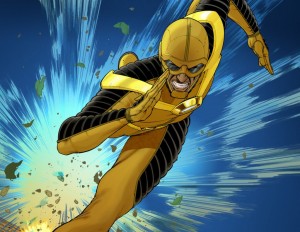
Just usin' the art from Agents of T.H.U.N.D.E.R.!
Here's another character sheet for Marvel Heroic Roleplaying, specifically the PBEM I'm running. It was randomly rolled up, and I collaborated with the player to come up with the rationale.

MACH 3 is a speedster, who also has control over sound, via his special suit. The creator of the Mark III Zoom Suit / Boom Suit joined the world of super-heroics for unknown reasons, but has rapidly become a popular figure in the super-heroic realm.

He can move really fast, and can also generate vibrational effects and sonic booms.

MACH 3

Affiliations: Solo [ d10 ] Buddy [ d8 ] Team [ d6 ]

Distinctions (Use at d4 for 1 PP or Use at d8):
  • I Feel The Need For Speed
  • Push The Envelope
  • Think Fast

POWER SETS

Mark III - Zoom Suit / Boom Suit:
Superhuman Speed [d10], Enhanced Durability [d8], Sound Control [d8]
  • SFX - Area Attack: add a d6 and keep an additional effect die for each additional target.
  • SFX - Boost: Shutdown your highest rated MARK III ZOOM SUIT / BOOM SUIT power to step up another MARK III ZOOM SUIT / BOOM SUIT power by +1. Recover power by activating an opportunity or during a Transition Scene.
  • SFX - Burst: Step up or double a SOUND CONTROL die against a single target. Remove the highest rolling die and add 3 dice for your total.
  • SFX - Unleashed: Step up or double any MARK III ZOOM SUIT / BOOM SUIT power for one action. If the action fails, add a die to doom pool equal to the normal rating of your power die.
  • SFX - Counter Attack: On a reaction against a PHYSICAL STRESS attack action, inflict PHYSICAL STRESS with your effect die at no PP cost or spend a PP to step it up by +1.
  • SFX - Afflict: add a d6 and step up your effect die by +1 when inflicting DEAFENED complication on a target.
Limit - Exhausted: Shutdown any MARK III ZOOM SUIT / BOOM SUIT power to gain 1 PP. Recover power by activating an opportunity or during a Transition Scene.

Limit - Gear: Shutdown MARK III ZOOM SUIT / BOOM SUIT and gain 1 PP. Take
an action vs. doom pool to recover.
SPECIALTIES

Combat Expert [ d8 ], Covert Expert [ d8 ], Science Expert [ d8 ], Tech Master [ d10 ]

Marvel PBEM: Character -- O.M.A.C.

Hard-pressed to come up with a rationale for O.M.A.C. in the Marvel setting, I still have to clear the backstory with the player. However, here's my first pass at the One Man Army Corps.

O.M.A.C. (Buddy Blank)

Affiliations: Solo [ d10 ] Buddy [ d8 ] Team [ d6 ]

Distinctions (Use at d4 for 1 PP or Use at d8):
  • One Man Army Corps
  • OMAC Must Live So That Man May Live
  • Eye In The Sky
POWER SETS

Molecular Engineered Powers: Superhuman Reflexes [ d10 ], Superhuman Strength [ d10 ], Superhuman Stamina [ d8 ], Superhuman Durability [ d8 ], Superhuman Senses [ d10 ]
  • SFX -- Area Attack: Add a d6 and keep an additional effect die for each additional target
  • SFX -- Remade by Brother Eye: Before you make an action including a MOLECULAR ENGINEERED POWERS power, you may move your physical stress die to the doom pool and step up the MOLECULAR ENGINEERED POWERS power by +1 for this action.
  • SFX -- Focus: Replace two dice of equal size with one die +1 step larger
  • SFX -- Big Brother is Watching: Spend 1 PP or use an effect die to create a WATCHED complication for a target. You may track that target anywhere until the complication is removed or SUPERHUMAN SENSES is shut down
  • Limit -- Blanked: Shut down any MOLECULAR ENGINEERED POWERS power to gain 1 PP and revert to Buddy Blank. Recover power by activating an opportunity or during a Transition Scene.
SPECIALTIES

Combat Master [ d10 ], Menace Master [ d10 ], Science Master [ d8 ], Menace Master[ d8 ]

BUDDY BLANK

Affiliations: Solo [ d6 ] Buddy [ d8 ] Team [ d10 ]

Distinctions (Use at d4 for 1 PP or Use at d8):
  • Just Another Face
  • Voice of the Common Man
  • That's Not Fair!
SPECIALTIES

None

Wednesday, July 4, 2012

Marvel PBEM: Character -- MegaVolt

Okay, it seems that I'll get some practice in various stages of new character creation for the PBEM game I'm running for a small group of people online. But before we get to that, let me post the character sheet already done by someone whose had as much time as I have already reading and playing the Marvel Heroic Roleplaying game: pointyman2000!

His character, MegaVolt, is essentially the son of two very well-known characters in the Philippines: Steve Armstrong and Jamie Robinson, from the English-translated version of an old Japanese Anime called Voltes V. Here's the sheet:

"Ultra-electronmagnetic beam! Hey, what's this sword for?"
John Armstrong, aka Megavolt

Solo D10, Buddy D8, Team D6

Distinctions:
Multi-Millionaire
Brilliant Scientist
Uphold the Honor of The Armstrong Family

Power Sets:
Megavolt Armor
Ultra-Electromagnetic Beam (Attack Power) D10
Elemental Control (Electricity) D8
Force Field D10
Subsonic Flight D8
  • SFX: Boost - Shutdown your highest rated MEGAVOLT ARMOR power to step up another MEGAVOLT ARMOR power by +1. Recover power by activating an opportunity or during a Transition Scene
  • SFX: Counterattack - On a reaction against a Physical Stress attack action, inflict Physical Stress with your effect die at no PP cost or spent a PP to step it up by 1
  • Limit: Exhausted - Shutdown any MEGAVOLT ARMOR power to gain 1 PP. Recover power by activating an opportunity or during a Transition Scene.
Specialties:
Combat Expert D8
Medical Expert D8
Science Master D10
Tech Master D10

Milestones

Workplace Ethics:
1XP when you reveal a new stunt associated with your Medical, Science or Tech Specialties
3XP When you engage in a confrontation with another hero regarding your use of your Specialties and your action or reaction total makes you the victor
10XP when you use a questionable Medical, Science or Tech asset or resource to support a team member or you refrain from supporting a team member with your Specialties at a critical moment.

Independent:
1XP when you stand up to another hero
3XP when you prove one of your decisions was the best for your team
10XP when you stress out the last foe in an Action Scene, or another character acknowledges your assistance was essential in saving the day.

Saturday, June 30, 2012

MHRP: One team-up over, another on the horizon

The Spider-man & Daredevil team did quite well in the two action scenes on The Raft in the default Mini-Event. They squared off against Carnage, drove back a mob that included Crossbones and Mr. Fear, and managed to pull off some pretty cool stunts.

I'll post the gameplay summaries from the collated e-mail threads we used, but I have to say that the resolution is pretty fast once every body understands the rules.

I think one of the contributing factors is the ease with which all of us can respond to e-mail threads, given WiFi access, smartphones, and tablets.

Next up involves playing with our own characters in the Marvel Event: Civil War. One player has already submitted his character sheet, and I expect to see the next one later this afternoon. Plus, another friend who recently moved to Canada has shared interest in playing the equivalent of O.M.A.C. in the PBEM.

I'll need to go over them all, understand their backgrounds and see how they weave into the overall storylines. Funny thing is, I really tuned out of Marvel (more than normal, being a mostly DC guy) during this event and now I'm going back to see some of the books to flesh things out. But I'm not gonna be a slave to published canon -- it's an alternate timeline in my mind! Am toying with setting it in a DC / Marvel universe, but I just don't have the time to work on that mega-setting.

Saturday, June 23, 2012

Armchair Review: Marvel Heroic Roleplaying -- Civil War Event

There are two versions of this event, so be careful which one you pick up.
  • If you already have the Marvel Heroic Roleplaying Basic Book, then pick up the Essentials Edition. It contains only the additional rules for the Event and the Event material itself.
  • If you don't have the Marvel Heroic Roleplaying Basic Book, then pick up the Premium Edition. It contains the Rules + Event-specific rules + Event material itself.
That aside, on to our review of the Essentials Edition, as my review and ongoing playtest evaluation of the core rules are elsewhere on my blog.

Additions to the Operations Manual

If you already have the Basic RPG, this is mostly the same material (allegedly with minor modifications and typo fixes -- stuff I haven't actually seen yet). However, there is a random character generation option included in this version. I've heard online that the generator is also available on the publisher's site, though I haven't confirmed it yet.

New Rules

The most interesting rules for this event for me are: Resolving Hero vs. Hero conflicts and Troupe Play.

Hero vs. Hero: interesting because the Civil War event does pit heroes against one another (and villains too), and while some of the rules can be chalked up to extrapolations of the framework already established, it's nice to see it stated outright -- particularly for touchy issues like having one player inflict a crippling complication on another player's character.

Troupe Play: interesting because it allows players to play more than one Hero in the course of this epic event -- important if a character is imprisoned or sidelined by injury. It also posits the option of pooling XP (wherein a player earns XP for the event instead of that player's Heroes), so that key elements of the scenes, storylines, and heroes might be unlocked regardless of the status of any one Hero.

The Event Proper

The book gives a good overview of the Civil War conflict, as well as detail on the factions involved, the key players, and locations and battlefronts that the conflict unfolds on.

In three Acts, the Civil War event is detailed with the recommended sequence of scenes and information on the recommended action and transition scenes for each. There is enough information to run each scene, though I do find myself wanting to pick up the comic books (given the immense amount of backhistory for a lot of the characters) to determine possible reactions of each one in a given scene. There is also space or leeway given to really spin the Event down different paths other than the ones in the official Marvel Universe timeline -- and I'll avoid spoilers here for those who never bothered to pick up all the comics in this mega-crossover event. There's a lovely bibliography in the back if you're interested.

Hero datafiles

32 hero datafiles in the Civil War sourcebook, with an Index that indicates where all the datafiles for the movers and shakers in the Event can be found in either the Basic Book or the Event Sourcebook -- with some of them (like Clint Barton) reflecting the various character changes and roles they played in the entire war.

Excellent material for this widescreen, multi-location, multi-front event.

Summary

Overall, the book really does make me want to get a group together to play out different factions simultaneously to put our own stamp on the Marvel Universe -- perhaps with our own characters or with key players in the event acting the way we feel they should have acted. And that's big praise from someone who really dismissed the entire event when it unfolded in comics as flawed (at best). This tome makes it engaging enough for me to want to be in the event proper and make things turn out differently, hopefully better.

Wednesday, June 20, 2012

MHRP: Learning the Ropes

Whoever thought of the name for the mechanic and the
accompanying picture deserves a raise.
I did a review a while back on Marvel Heroic Roleplaying, with a caveat that I hadn't actually played it. Now that I'm running an intimate online PBEM game with two other gamers interested in the system and the setting, I'm ready to post more observations -- colored by the fact that we haven't gone all out with all the rules yet.

Paradigm Shift

I think that there is a fundamental shift in thinking here, and yet I'm having difficulty pinning down exactly why that is the case. In the main resolution mechanic(s), there are several well-known game system elements that are certainly not new to me:
  • building dice pools to roll
  • choose the best 2 values from the roll (by default, anyway)
  • an action roll compared against an opposing roll
  • an effect mechanic tied to a single die from the pool
And yet, the differences somehow add up to a different way of thinking. You can build up your dice pools to something massive if you're creative (though somewhat mitigated by 'story rationale' and the Plot Point mechanic). You can bend the rules of being restricted to only the best two values for your action roll (mitigated by the Plot Point mechanic), and you can bend the Effect Die mechanic (again, mitigated by the Plot Point economy).

There are interesting decisions that can come up in putting together your dice pools and rolls: you can choose a crappier die to add to your die pool because it can add 1 Plot Point to your dwindling pool; you may have to choose between using that 10 you rolled on your d10 as a component of your action total, or as the lone Effect Die; you may shift your d10 expertise into 2d8 or 3d6 -- sacrificing a potentially high roll for a bellcurve-aided chance at getting a decent set of values to choose from.

It feels oddly like a CCG in some ways, but one flexible enough to tell story games with.

Plot Point economy

I come from the Hero paradigm, and disadvantages are something that you put on your character sheet for points but hope and scheme never to have come up in game. In MHRP, players (and Watcher-controlled characters) bring up disadvantage-like options in gameplay regularly to get precious Plot Points into their pool.

The Plot Point mechanic is an interesting one that bears furthers study. I recognize its roots in the FATE system -- quite honestly, I never got it and played MHRP in the hopes that it would help me understand the mechanic finally.

What does make it confusing: how it is equivalent to the Doom Pool?

The Doom Pool

I like this mechanic, a way to keep track of the increasing tension in a scene and a pseudo-currency of Plot Points for the Watcher. I can see how the Watcher gets to do similar things that players would do with their character to add to the Doom Pool, and can see how 'spending dice' from the Doom Pool also acts like Plot Points -- but the fact that you can do other stuff with the Doom Pool complicates matters for me.

I suppose that the parallel to a CCG comes up again -- I have to manage the various uses of the Doom Pool as a resource at the same time I'm running the game story-wise.

It's a little bit difficult, but perhaps it's something that just needs getting used to. Like Weapon Speed Factors in Arduin. Or not.

We'll see.

Record Keeping

Despite all the fiddly bits that you can create with the resolution system, there isn't a substantial amount of record keeping. In fact, coming from the HERO background, it's all quite easy to keep track of things like Complications and Stress levels and Plot Point totals in your head, and the values are low enough that chips and tokens will aid you handily.

STATUS QUO -- KEEP ON PLAYING

Ultimately, I like what I see but we still haven't fully utilized the system. It's still under playtest for us, and we're trying to bend the rules, as well as figure out how it's supposed to be played.

I'm not about to jump on the bandwagon yet, complaining that it's confusingly written. I think there are some passages that should be cleared up, and I'm thinking of drafting several diagrams to clarify the scene resolution options and flows -- but the sidebars of the book are wonderful cheat sheets already, and I like (in general) how they give lots of examples on how to build and roll and use dice.

However, I think that in some cases, notation might have served better. Especially to differentiate when you're building a pool but haven't rolled the dice yet, and when those dice have been rolled and you're now choosing which dice to put together for the action total and the effect die -- as done, sometimes you're not sure which of the two you're looking at.

Still, it's been fun, and combat / conflict resolution is really fast, which is a godsend for PBEM games. I may have found a PBEM system of choice for supers gaming.

Friday, June 15, 2012

MHRP: Spider-Man Text Character Sheet

As I mentioned before, there's a test PBP game and here's the text character sheet for Spider-man:

SPIDER-MAN

PLOT POINTS: [   ]
STRESS / TRAUMA: Phys [   ] | Ment [   ] | Emot [   ]

Affiliations: Solo [ d8 ] Buddy [ d10 ] Team [ d6 ]

Distinctions: Friendly Neighborhood Hero? | Wisecracker | With Great Power Come Great Responsibility
Use at d4 for 1 PP or Use at d8

POWER SETS

Spider-Powers: Enhanced Senses [ d8 ], Enhanced Stamina [ d8 ], Superhuman Reflexes [ d10 ], Superhuman Strength [ d10 ], Wall-crawling [ d6 ]

  • SFX -- Spider Sense: Spend 1 PP to add ENHANCED SENSES (or step up by +1 if already in your pool) and reroll all dice on a reaction.
  • SFX -- Second Wind: Before you make an action including a SPIDER-POWERS power, you may move your physical stress die to the doom pool and step up the SPIDER-POWERS power by +1 for this action.
  • SFX -- Spider-Tracer: Spend 1 PP or use an effect die to create a TRACED complication for a target. You may track that target anywhere until the complication is removed or ENHANCED SENSES is shut down.
Limit -- Exhausted: Shut down any SPIDER-POWERS power to gain 1 PP. Recover power by activating an opportunity or during a Transition Scene.

Web-Slinging: Enhanced Durability [ d8 ], Swingline [ d8 ], Weapon [ d8 ]
  • SFX -- Grapple: Add d6 and step up effect die +1 when inflicting a complication on a target.
  • SFX -- Web Constructs: when creating web-related assets, add D6 and step up effect die by +1.
Limit -- Exhausted: Shutdown WEB-SLINGING to gain 1 PP. Recover power by activating an opportunity or during a Transition Scene.

SPECIALTIES

Acrobatic Master [ d10 ], Combat Expert [ d8 ], Covert Expert [ d8 ], Psych Expert [ d8 ], Science Expert [ d8 ], Tech Expert [ d8 ]

Monday, June 11, 2012

MHRP: Marvel Team-Up (Spider-Man & Daredevil)

The players joining me in an exploration of the Cortex Plus incarnation for the Marvel universe have chosen their characters: Spider-man and Daredevil. Iconic street-level heroes!

I'm modifying the mini-event in the rulebook for this test run and pitting them against Carnage while they're trapped in a malfunctioning underground level of The Raft, and they're currently about to engage.


I have to say, it's interesting to wrap my mind around the logic of the Plot Point economy, though I have to say that at this point it doesn't seem to contribute to immersion into the world. The players seem to become co-authors in the crafting of the scene (but that's a Watcher's perspective, I gotta ask my players how the game feels afterward).

Which is not to say it's not fun; it is. But it's different from my usual experience in gaming.

Sunday, June 10, 2012

MHRP: Daredevil Text Character Sheet

I'm doing a light play-by-post with a couple of friends online, and since we're all first timers with Marvel Heroic Roleplaying, I decided to put together text character sheets that I we can adjust and send back and forth via e-mail.

This game is really pushing all three of us out of our comfort zones, since two of us (including me) openly admitted to being confused early on when reading it, and another two of us (including me) admitted that the narrative nature of the game is completely alien to my gaming instincts.

In fact, this RPG (along with the FATE-based RPGs) reminds me a little bit about how confused I was about game mechanics and conflict resolution concepts when I first started gaming. It's not completely new, because the concept of RPGs is very clear to me know. It's just that, unlike more simulationist systems (and I hope I use the term correctly here), the logic that is followed here is more along the narrative path -- a give and take of plot points plus a bit of luck in order to deserve whatever outcomes are achieved.

As far as the character sheet is concerned, I only need to adjust the first few lines periodcially -- the rest of the sheet is just a reminder for the players (and for me) what they can do.

Here's the one for Daredevil:

DAREDEVIL

PLOT POINTS: [   ]
STRESS / TRAUMA: Phys [   ] | Ment [   ] | Emot [   ]

Affiliations: Solo [ d10 ] Buddy [ d8 ] Team [ d6 ]

Distinctions: Blind Justice | Man Without Fear | Protector of Hell's Kitchen ( Use at d4 for 1 PP or Use at d8 )

POWER SETS

Billy Club: Enhanced Durability [ d8 ], Swingline [ d6 ], Weapon [ d6 ]

  • SFX -- Rebound: Step up or double WEAPON die against a single target. Remove highest-rolling die and add an additional die to your total.
  • SFX -- Grapple: Add d6 and step up effect die +1 when inflicting a complication on a target.
  • Limit -- Gear: Shut down BILLY CLUB and gain 1 PP. Take an action vs. the doom pool to recover gear.
Hypersenses: Enhanced Reflexes [ d8 ], Enhanced Stamina [ d8 ], Superhuman Senses [ d10 ]
  • SFX -- Focus: In a pool incuding a HYPERSENSES die, replace two dice of equal steps with one die of +1 step.
  • SFX -- Immunity: Spend 1 PP to ignore stress, trauma, or complications from attacks targeting sight or vision.
  • SFX -- Radar Sense: Spend 1 PP to add SUPERHUMAN SENSES (or step up by +1 if already in your pool) and reroll all dice when taking an action.
  • Limit -- Overstim: Shutdown a HYPERSENSES power and gain 1 PP. Recover power by activating an opportunity or during a Transition Scene.
SPECIALTIES

Acrobatic Master [ d10 ], Combat Expert [ d8 ], Cover Expert [ d8 ], Crime Master [ d10 ], Menace Expert [ d8], Psych Expert [ d8 ]

Saturday, June 9, 2012

On the Radar: More Marvel Heroic Roleplaying

I was doing some online research for the Cortex / Cortex Plus system by Margaret Weis Games, specifically for the Marvel Heroic Roleplaying RPG, and happened upon the following images on Amazon:

Marvel Heroic Roleplaying: Civil War Event Book Essentials


Marvel Heroic Roleplaying: Civil War - 50 States Initiative


I like this last book in particular, because it seems like this will finally provide a more detailed set of rules for creating your own heroes and team:
Tony Stark's grand idea following the Superhuman Registration Act is the Initiative, a coast-to-coast operation that sets up Super Hero teams in every state. Train your heroes at Camp Hammond and set up your team in preparation for the next threat to law and order! Includes a full roster of Initiative members and new trainees ready to drop into your Civil War campaign.

Unfortunately, based on the release date, we can expect it some time around July 10, 2012. So that's a bit of a wait.

In the meantime, I am reviewing the rules for a small, intimate, getting-to-know-you play-by-post playtest with a couple of friends. More on that in another post.