Showing posts with label RPG review. Show all posts

Sunday, April 8, 2012

Armchair Reviews: Leverage -- Hitters, Hackers and Thieves

Leverage has shot to the forefront of my go-to RPGs for modern day espionage, detective, and criminal campaigns. I've been reading through both the RPG and the sourcebooks, and I really like how it's put together.

Age of the Geek, baby.
It is still counter to my preferred simulationist game system approach, but it causes less coredumps to my GM operating system than another system like FATE. Perhaps Cortex Plus will be my gateway drug to FATE, but for now, I'm liking it.

I think that the use of the polyhedral dice probably have a comforting effect.

Anyway, here's the first of my reviews on the Leverage sourcebooks:

I kind of gave the Leverage RPG a pass when it came out because -- I didn't watch the show.

But after I finally encountered first the Smallville RPG, then the Marvel Heroic Roleplaying RPG, I decided to pick up Leverage to give it another try. Then I decided to take a look at the sourcebooks for it.

This book, Leverage: Hitters, Hackers, and Thieves, is an indispensable tool for both players and GMs (Fixers in this RPG) interested in rounding out and deepening the capabilities, backgrounds, rivals, and approaches for these types of roles in the game. While it does not (and cannot) give an encyclopedic account of all things Hitter/Hacker/Thief, it does bolster the treatment given in the rulebook with key points in the history and rationale of the role, very flavorful talents to broaden the cinematic treatment in the game, and some Master Class options to make the PCs and NPCs even more awesome than they already are.

There are also additional rules for Locations in this sourcebook to make things more interesting for the Thief (and everyone else) in your Crew. As a bonus, you get several technology-centric Jobs to take your Crew through.

In addition, the book is written clearly, while successfully providing both information and flavor to further reinforce the genre of the game.

If you're into Leverage, pick it up!

As a result, I may begin revisiting my old 'spies' posts regarding the genre of espionage. This game, in particular, makes me think classic Mission: Impossible TV show scenarios are possible to run in an RPG.

And yes, I have finally seen the first season of Leverage.

Monday, February 13, 2012

Armchair Reviews: The Laundry RPG


The Laundry RPG is based on the series of novels, novellas, and short stories by Charles Stross that detail the adventures of "Bob Howard" in a setting that mixes espionage, office bureaucracy, math, computer theory, geek culture, and unspeakable gods.

Now, since I like the series, it stands to reason that I'd be predisposed to an RPG set in its milieu.

However, I have to say that I also like the RPG on its own merits. Here are the reasons why.

Layout

The book / PDF document has a great feel to it, as the layout has the look of a dossier of material. While most of the fonts are the same, there are 'paper-clipped' photos and annotations in different paper types and fonts to reinforce that feeling.

Writing

The style of writing is clear and clean, with a mixture of exposition and explanation and just enough of the humor and informality to be The Laundry. It doesn't dip into Stross's tendency to throw sink-or-swim bits of espionage telling detail or mathematical esoterica that work so well in the fiction, but would leave gamers screaming bloody murder.

Updated Character Creation

It looks similar to the fast character creation rules in Call of Cthulhu, and it should -- The Laundry RPG uses the same Basic Role-Playing system. However, there are some modifications and additions to that process.

Characteristic Rolls -- back in the day, there were only Knowledge Rolls, Idea Rolls, and Luck rolls that were all percentile chances based on a STATx5 formula. Now there are Effort Rolls, Endurance Rolls, Agility Rolls and Influence Rolls, also based on the same formula. I like it, because it makes attributes faster than the old method of referring to the Resistance Table (which still exists, but only for instances with opposing difficulties).

Personality Types and Assignment & Training -- in COC, your Profession determined your primary skill set. Now you have Personality Types and Assignment & Training which do the same thing, but with different rationale. This fits in with the Laundry getting people from all walks of life and backgrounds, and then shoehorning them into the org because they know too damn much about the wrong things.

Possessions -- you get some default equipment based on your work in the Laundry and your various skillsets.

Great Setting Resources

Chapters Nine, Twelve, and Thirteen give great starting background material for folks unfamiliar with U.K. government intelligence institutions and their international counterparts, and the Laundry itself, of course.

Chapters Nineteen and Twenty-One define some pretty important code words in the Laundry setting: BLUE HADES, DEEP SEVEN, GORGONS, and of course, CODE NIGHTMARE GREEN.

Chapters Ten, Eleven, and Fifteen share some of the gear and flavor of working in an occult espionage agency plagued by modern views of bureaucratic best practice.

Chapter Fourteen is a welcome chapter, as it deals with magic. Devotees of the series know that magic isn't as per traditional Cthulhu spellcrafting goes -- there's a layer of mind-straining electromagnetic and mathematical theory on it. Here's where we get to differentiate between mathematical sorcery, traditional sorcery, and the enigmatically named true sorcery. Also, some spells that are mentioned in the books make an appearance here.

Chapter Eighteen has the statted-out characters that appear in the series, as is tradition for many IP-related sourcebooks. What is great is the inclusion of stats for generic support personnel (Plumbers, Cleaners, Baggers, and Toshers) -- unlike the more maverick and isolated cell-structures of the American-based Delta Green RPG / sourcebook, the Laundry is an organization that supports its personnel as much as it tortures them.

Overall, a great book! I just wish that the PDF had a better set of bookmarks.

Saturday, February 11, 2012

Armchair Reviews: NeoExodus -- A House Divided Campaign Setting


Here's my review for this surprising document from LPJ Design: NeoExodus -- A House Divided Campaign Setting.
You should pick up NeoExodus. It should matter to me that it's written for Pathfinder -- a game system I don't follow. But in the modern RPG era of D&D retroclones, neoclones, alterclones and the multiplicity of game systems that evolved from the D20 explosion, it shouldn't really matter. It's a setting that is both packed with history and detail in almost every corner of its universe, but has been constructed to allow minor additions and major game changers to its setting.

Quite possibly the first thing that should be read is not the history, but Page 24: Unique Elements of NeoExodus. It gives the broadstrokes approach that was taken for the creation of the setting, and it feels like they kept referring to it as they lovingly created every bit of it. Here they are in condensed form:

NeoExodus is...

... a world full of magic.
... a world built on epic adventures, heroic quests, and valiant expeditions into the unknown.
... is a setting of unique empires and nations with their own sovereign rights, powers, and issues.
... is a world that is rarely a peace for long.
... mixes traditional fantasy, horror, magic, modern politics, and science fiction.
... is full of all new unique races.
... is a world built on conspiracies, deception, and intrigue.

Everything has a place in NeoExodus.

In terms of production values, I compare it favorably to the Forgotten Realms 3E setting book and the Forgotten Realms supplement Lords of Darkness combined, but infused with the subversive fantasy settings like Talislanta, the over-the-top high magic terror of Arduin, the epic feel of the early Exalted line, and the anything-can-show-up vibe of Rifts.

The art is fantastic and yet labors to give a real sense of an alternative fantasy world without straying too much from what you look for in the genre. The stat blocks and data tables for character classes, races, nations, and other information necessary for making this setting your own are nicely laid out and are very readable.

This isn't something you skim over. This is a book you read from cover to cover -- though I obviously have opinions as to the best sequence to read the chapters -- to identify the things you want to emphasize, and craft your campaign around those elements, leaving the rest of extraneous campaign flavor.

I want to go on longer about specific races that I find cool, about the nations that really speak to me in terms of campaign potential, about historical elements that would have a wealth of plot devices to kick off any number of adventures -- but I think I'd go on too long.

This is one of my favorite type of kitchen sink settings (a term I tend to in my blog -- armchairgamer.blogspot.com -- to refer to settings that have been crafted to allow almost any type of element into it from its genre, or even from other genres). It is a kitchen sink setting that can manage to retain its own identity when other non-native elements are shoved in; any number of rationales -- from the Gates to the high magic running through the setting -- can be brought to bear.

And even if the setting isn't for you, you can mine it for monsters, races, and campaign ideas for years.

I do love the art, despite the tendency to become too cartoony anime-ish at times (I prefer the anime styles in fantasy that approach, but don't necessarily hit, photorealistic), because of the way it drives home the cross-genre, pseudo-gonzo feel of the setting. I like the stat blocks for the political entities, I like Cyneans (crystalline scholars), Dalreans (sentient, mobile plants that can apparently use bows and arrows -- sort of like humans attacking with primate bones, I guess), I like the succinct 5-level progression prestige classes in general. I'm not a fan of too many feats in a D20 / 3E game, but I did like the spells and the monsters in this book.


Sunday, January 29, 2012

Armchair Reviews: Laundry Files - Agent's Handbook


And here's another review of an RPG sourcebook -- Laundry Files: Agent's Handbook, a sourcebook to The Laundry RPG.
Let's get this out of the way first: Steganography is the art and science of writing hidden messages; Stenography is the process of writing in shorthand. While it could be argued that very very few write in shorthand these days and would constitute a hidden message, it is an incorrect (though understandable) misuse of the term.
I hope it gets fixed (if it hasn't already been addressed) as soon as possible.

Anyway, Laundry Files: Agent's Handbook provides a wealth of resources to Players and GMs running the Laundry Files RPG. With a lot of fluff -- filled with telling details from real-life and fictionalized tradecraft, gear, and bureaucracy -- and just enough crunch to add gameplay weight to the source material, this sourcebook will help all parties become acclimatized to Charles Stross's humorous mingling of agency politics and operations, humor, and supernatural monstrosities lurking at the edge of our reality.

Steganography issues aside, the Tradecraft chapter is a must-read. It sets the tone for an operative, and gets certain basics out of the way so that rookie mistakes and questions aren't raised in the middle of a high stakes adventure. Plus, the proper usage of terminology gets players and GMs in the proper mood.

I particularly enjoyed the chapters on Laundry Gear, Bureaucracy, and Training Courses. They emphasize the difference between this type of campaign and the typical Cthulhu-inspired campaign, which often results in scores of dead or insane characters and very few continuing PCs, and they suggest or raise interesting ways that modern technology can be combined with occult knowhow to aid in the fight against the dying of the light.

The layout is clean, and the affectation of images as 'taped on' pictures and tables as 'taped on' reports in dot-matrix printout format helps add to the feel of the setting as well.

I highly recommend this book, not just to players of The Laundry, but to any GMs interested in running campaigns in the Contemporary Urban Fantasy genre.
Contemporary Urban Fantasy, is one of my favorite genres too. I loved playing Cthulhu Now and Delta Green campaigns way back in the day, and have been intrigued other takes on the genre, from the Ghostbusters RPG, to Tri-Tac's Stalking the Night Fantastic, to both editions of Chill, to BTRC's Code: Black, to the Dresden Files RPG, to this one. I think there's even a HeroQuest 2E one out there, and I've also taken a look at the World of Darkness material for a look at how the big three monsters (Vampires, Werewolves, and Mages) are handled -- though I avoided Hunter for some reason unknown to me.

Oh by the way, The Laundry RPG is apparently powered by the Basic Role-Playing System. That means a lot of Call of Cthulhu source material can be used with it.

Saturday, January 21, 2012

Armchair Reviews: Mystic Empyrean RPG Corebook


Here's the thing. I obviously read a bunch of RPG material, and I occasionally pick up nice shiny things and read them as part of my gamer explorations. I picked up the Mystic Empyrean RPG Corebook and gave it a read.
Despite the fact that I've never really playtested this thing, after reading it -- I can say it's really not my thing.

And yet, it's a good book. It does a lot of things well. It explains the core premise of the game, it exhaustively covers the setting (written explanations interspersed with lists), it provides examples of gameplay to really illustrate for players and GMs how a game in this off-the-beaten path setting and ruleset might play out. It has good art, nicely laid out pages, well-organized text.

Ultimately though, it's not the kind of game or the kind of premise that I'd be interested in playing in for an extended campaign. However, I'm re-reading it for some way to do a quicker character and campaign progression since the ability to create multiple universes does intrigue me -- just not for very long campaigns really.

I don't know if it's a good game, but it seems to be a well put together RPG corebook for a setting that I wouldn't be interested in running, but maybe I would be interested in playing it for short mini-campaigns.

And for that reason, I give it four stars.

That's the truth though, I think it's well put together as a book but that it may be my preference that really took the wind out of its sails.

Friday, January 13, 2012

Armchair Reviews: The Cursed Chateau

Here's my short review for the neo-classic adventure module The Cursed Chateau:
I'm only familiar with one of the stated inspirations for The Cursed Chateau -- the classic D&D Module X2 Chateau D'Amberville (Castle Amber), and as such that framed a lot of my expectations for the adventure.

In general, I liked the setup of the map and the anticipated flow of adventurers through the Chateau -- initial encounters being more weird than fatal (unless the adventurers take unnecessary risks), and later encounters becoming more challenging. Of course, the overall setup of the adventure is primarily one of running through a gauntlet until certain conditions are met.

Of course, that's the main issue I had with the adventure: keeping track of whether or not conditions have been met actually ends up consuming a fair amount of the DM's time when running this neoretro-module and I wonder -- if followed as written - that may be some unnecessary overhead to the DM's work.

I loved the artwork -- very atmospheric and evocative of the strangeness DMs should be striving for when showing the strangeness and the horrors of the Chateau. The latter rooms also felt a lot like classic Castle Amber, where players begin encountering evidence of the former resident's life choices and their inevitable ends as they stumble towards their ultimate release from the Chateau.

All in all, a very solid module to run -- though the record keeping associated with the core conceit of the module may have to be handwaved for DMs adverse to it.

Of course, it goes without saying that I haven't had a chance to run the thing, so this isn't a playtested review.


Wednesday, January 4, 2012

Piecemeal System Reviews: Saving Throws in D&D and related systems

First Encounters

To be honest, I didn't hate saving throws at first. D&D was the only RPG I'd ever played, so I figured that saving throws were how you handled certain things.

Sadly, it was the vagueness of what those "certain things" were what initially gave me trouble. Unless it was explicitly stated in the rulebook, I didn't call for saving throws. And because of that it was hard for me to judge when -- in an adventured I'd created -- something would get a saving throw unless such a thing was stated in the monster description, or spell description, or magic item description.

I was very young back then, didn't really get the idea of 'guidelines' as opposed to 'rules', and even when that was brought up, didn't know when you could 'guidelines' something or stick to the rules because the other folks I played with would then attack with very rudimentary rules lawyering arguments.

Failed Save = Death

Eventually, a growing dissonance between the hit point mechanic and the saving throw mechanic emerged in my mind. It was too easy to die by failing a saving throw in comparison to melee combat.

You had two chances to avoid certain death: (1) a botched attack roll; or (2) a low enough damage roll, as opposed to the classic "save vs. poison or die" scenario, where a single die roll decided everything.

It was because of this, and the fact that I didn't really understand when a given saving throw would be applicable ("don't I get a saving throw vs. death every time I'm about to die?" "do I save vs. wands or save vs. magic in this instance?") I eventually began playing to avoid any situations where a saving throw might be needed - but still held the mechanic in contempt.

Departure and Return

Saving throws become a non-issue when I eventually left the system and began my march through many different RPG systems, some of which stayed with me (HERO), some of which I never wrapped my mind around (Cyborg Commando).

Then 3rd Edition happened, and there were only three saving throws -- Fortitude, Reflexes, and Willpower -- which didn't matter so much to me as a simplification, but as a revelation. I finally realized the whole character class + racial bonus/penalty = your chance to avoid something nasty. After that, I had little issue with saving throws as a mechanic.

Expanding on the Saving Throw (M&M, True20, C&C)

I've actually been interested in some of the variants on the saving throw rule since. In particular, I like Mutants & Masterminds / True20 and the way that the extended the saving throw rule to handle damage and eliminate hit points. I also like the way Castles & Crusades extended the number of classic saving throws to six so that there could be a correlation with each stat.

I wonder what other uses this old mechanic has in store in the future?

Saturday, December 31, 2011

Armchair Reviews: Clockwork & Chivalry Core Rulebook 2nd Edition PDF


Here's my latest review:
Having never played any of the flavors of Runequest, ever, it's hard for me to critique this core rulebook's rules (though I am a fan of the parent ruleset and was intrigued at the 1st set of Mongoose Runequest ruleset -- but that's another story). However, as a sourcebook and a spark of inspiration I can offer my opinions.

First off, the setting is one that I thought I was familiar with -- a swashbuckling setting with clockwork marvels -- but I was quickly proven wrong. The game is anchored in the time of the struggle of King Charles I and the English Parliament, with all the political and religious turmoil of that explosive era. Mix in alchemy, clockwork machines, and a changing view of the world, and you have an RPG already very different from the archetypal smooth talk and swordplay model of gameplay.

There rules for character creation seem pretty straightforward, with the 30+ professions and descriptions giving a great feel for the era. The Factions section (and their interrelated nature with the Righteousness mechanic) adds both flavor and potential richness to roleplay and gameplay possibilities.

The illustrated sections on Weapons and Armor will lend players and GMs alike passable expertise on the era's implements of war, and the sections on Alchemy and Witchcraft put a different spin on the traditional view of spellweaving in RPGs, while the section on clockwork devices help frame and make playable this particular conceit of the game. And the source material doesn't end there: maps of Britain, Scotland, Ireland, Europe and the New World; Wages and the Cost of Living, History, Important People, etc.

And there are sections on gamemastering this RPG, a couple of adventures to get you started, and a useful index to find all sorts of material in this dense, seemingly complete RPG corebook.

There are some problems with the PDF bookmarking of the my copy, but these can be easily rectified I'm sure in future iterations of the PDF.

All in all, a fine addition to my RPG collection.

Actually, I doubt I'll ever run it. But I will mine it mercilessly for my Fading Suns campaign.

Wednesday, December 28, 2011

Armchair Reviews: Weird Adventures

Damn, what a densely-packed sourcebook. And I couldn't even cite a specific entry that I liked for fear of spoiling player enjoyment by revealing what I liked (twists and surprises galore). Anyway, here's my review as it appeared on RPGNow.com.

Weird Adventures is a sourcebook for a game setting that is a mixture of traditional fantasy elements and a mad infusion of weird pulp fiction (mostly) set in a strangely familiar nation and city.

The sheer density of setting texture and detail alone makes this sourcebook a must-buy, but it's tied together by a weird conglomeration of almost-recognizable elements taken from history, period culture, myth, movies, fiction, comics, and pulp novel arcana that works as a setting. There is some lacuna left for the tastes of the DM -- but those spaces are easily filled by nabbing from both traditional fantasy and 1920s Americana.

It is a bit light on the game mechanics for a sourcebook, but the new monsters have stats that can be extrapolated to any D&D ruleset, and the DM is open to establishing how prevalent and powerful guns and transport might be in his/her campaign. I do recommend allowing yourself to be inspired by both magic and mad science in answering these questions, as the setting seems to excel at keeping players and GMs on their mental toes in anticipating secrets and twists to the adventure hooks. I'd love to give examples, but to do justice I'd have to give an entire entry away!

The art truly evokes both the feeling of the source material and the conceit of being a travel guide of sorts into this strange realm, and -- while I only have the PDF version -- I think that the printed copy will make a handsome, conversation-starting addition to any gaming collection.

Just make sure your friends don't borrow it without you knowing!

I'm think that an appropriate expansion would be various rulesets expansions for the appropriate retro-clone, but that's another post.

Monday, December 26, 2011

Piecemeal System Reviews: Three from January

I was curious and discovered that I had, in fact, written some reviews before.

There are three "piecemeal system reviews" that I did in January of this year that talk about elements of game systems that I remember. Here they are:

Also, I have the initial post that I made, showing that I had intended to cover a few more system mechanics. Maybe I'll do it next year.

Thursday, December 22, 2011

Armchair Reviews: ICONS -- The RetConQuest PDF


Here's my latest review: an adventure for a system I've never played. However, it is an interesting enough adventure as an introduction to a game system and start of a campaign.

In a nutshell, The RetConQuest is a solid adventure that seems -- structurally -- more appropriate as an introductory adventure rather than as a stand-alone adventure in an ongoing campaign.

The core conceit of 'normal humans' remembering their superpowered selves and slowly/instantaneously regaining their identities and abilities in an alternate timeline is a good one, allowing new players (and characters) to slowly be introduced to the character creation and task resolution rules of Icons without necessarily abandoning the game narrative completely. The plot twists seeded in the "initial" and "final" confrontations with Tempus Khan are also useful in terms of helping fine tune characters created in the course of play, in addition to being a clever, limited-novelty nod to the nature of battling time-conquering villains.

For an ongoing campaign, however, I have a preference for more scenes and encounters that would allow the GM to present a series of encounters with heroes, villains, and normals from the regular campaign and how their lives are different from what is remembered. There was only one opportunity for this in the published adventure, though a clever GM could arguably extend or spread out such scenes.

Finally, there were a small number of typos that could have been fixed (and still can be through the magic of updated PDFs): like the "page @@" incident and a missing apostrophe.

All in all, a solid, clever adventure and a potentially great beginning for a great campaign!

I would add to this review that my preferences do tend more to sourcebooks, and adventures that actually flesh out certain portions of a campaign world with little bits of texture and telling detail. Despite this, and a staggering realization that I prefer smaller fonts to larger ones in my gaming material, I thought this was a good product.

Monday, December 19, 2011

Armchair Reviews: Isle of the Unknown PDF edition


Something with the title Isle of the Unknown conjures up an island far from the outposts of civilization, shrouded in mystery, brimming with strangeness and wonders. In this case, only the first aspect is untrue since the island in question is 35,00 square miles in size, broken up into 330 land hexes (each 86 square miles), and each hex is keyed with a central point of interest which includes a number of towns and one city (ruled by a king). But there is mystery, strangeness and wonder aplenty on it.

The island in question is 35,00 square miles in size, broken up into 330 land hexes (each 86 square miles), and is described in much the same way that the Carcosa sandbox setting was -- each hex is keyed with a central point of interest.

Comparisons to Carcosa are unavoidable because Isle of the Unknown is written by the same author, published by same publisher, and is presented in roughly the same format (which is not a bad one) as Carcosa, though it does lack the extensive hyperlinking. So let's take a look at what some of those similarities are.

Like Carcosa, the hexmap is numbered -- each numbered hex corresponds to a location or entity of interest. Like Carcosa, Isle of the Unknown is not a sourcebook that deals in minutae, but provides sufficient information for a GM to flesh out (or even run a fast-and-loose game, since Hit Dice, hit points, and other key information are provided without resorting to stat blocks).

Unlike Carcosa, however, Isle of the Unknown is less concerned with emphasizing the non-standard nature of the setting. On the contrary, Isle of the Unknown takes great pains to allow easy slotting of the setting into an existing campaign -- the culture and political structures of the cities and towns and churches are tackled with the lightest of broad strokes.

Instead the book focuses on three primary types of encounters / hexes of interest scattered throughout the island: magic-users, statues, and creatures.
  • The magic-users are clearly non-standard ones: they tend to wear armor not normally associated with their kind, have special innate abilities above and beyond normal mages, and tend to enjoy painted full-page, full-color depictions (which are quite evocative).
  • The statues are strange, powerful, and attired in clothes and armor evocative of a fallen Roman Empire (though clearly, one can insert the attire of another great fallen empire appropriate to one's campaign) and can grant abilities, aid or curse visitors, or attack them outright.
  • The creatures are primarily chimerical creatures, ranging from larger versions of normal animals (a 6' tall roadrunner), twisted versions of normal creatures (an 8' tall humanoid swan with sleeping human faces on its torso), and -- of course -- mix-and-match combinations of creatures.
Taken individually, these encounters can be used as a magical rogues gallery, a statue encounter list, and a large monster's manual. Together, it suggests something else: perhaps the last flowering remnants of a vastly powerful empire, or a land touched by forgotten gods. The magic-users as described and depicted evoke the feeling of Greek or Roman gods, playfully skirting direct analogues and clearly being less powered; the statues smack of powerfully wrought enchantments that once served some greater purpose, and the creatures seem like echoes of an age when rampant magical experimentation on creatures was the norm.

There are, of course, other types of encounters, but the preponderance of these three suggest that a campaign geared towards exploring the unknown nature of the island would do well to focus on these elements.

Isle of the Unknown wraps all this up with the keyed map, printable Player and GM maps, and appendices that list the locations of all magic-users, all statues, and even provide a visual listing of all the creatures grouped by HD rating.

All in all, a rich setting with a lot of usable material the could have perhaps benefited from a few more hints on the origins and nature of the mysteries of the island -- without necessarily setting it in stone, of course.

Friday, December 16, 2011

Armchair Reviews: Carcosa PDF Edition


After that spectacular sale on all the Lamentations of the Flame Princess imprint mentioned earlier in my blog, guess what I get to review first as a DriveThruRPG / RPGNow reviewer? One of the newest offerings (at least on RPGNow / DriveThruRPG) from the Lamentations of the Flame Princess imprint: Carcosa.

Here's the review I gave:
This PDF edition of Carcosa is apparently a compilation and revision of material that has appeared before -- material I'm not familiar with in detail, but have passing familiarity with from the OSR blogosphere.

In a market that often seems to be divided between super-slick hi-resolution imagery and sadly amateurish attempts at passable gaming material, Carcosa manages to stake a claim for solid gaming bang for buck on its own terms.

As stated in the Introduction of this sourcebook, Carcosa is not a sourcebook that will drown its readers in setting minutae, but will give sufficient information concerning the setting that will allow GMs and players to use the material any way they wish -- even if they wish to cannibalize the material for monsters, ideas, rules, and adventure seeds.

Fortunately much of that material is very good, despite my misgivings about the 'mature nature' of the setting and the Weird Science Fantasy label is well-deserved -- it somehow manages to merge legacy alien technology, macabre sorcerous rituals, and a decadent, decaying, dangerous world filled with terrible creatures and awful gods into a uniquely setting that comes across as both challenging and interesting to adventure in.

While some may be more used to slicker and cleaner art styles, I feel that the art direction and execution is excellent -- it captures the weirdness of the setting, and evokes the feel of the sourcebook as an old-style travel guide or almanac for a foreign land. I would go as far as saying that the linework and the composition tends to connote its subject matter more than denoting it -- they have the feel of being "artist's interpretations" of people, places, and things that are real and were lifted from an accomplished artist's sketchbook.

The PDF has the following sections:
  • Introduction -- does much to frame the understanding and use of the sourcebook
  • Men and Magic -- describes rules such as dice conventions, allowed character classes, and building characters in this setting
  • Sorcerous Rituals -- talks about nature of rituals in sorcery; extensively hyperlinked to the appropriate Monster Descriptions
  • Monster Descriptions -- the monstrous menagerie of Carcosa; externsively hyperlinked
  • Hex Description -- there's a Hex Map of Carcosa with number hexes; you can find the descriptions of each number hex here; extensive hyperlinking to monster descriptions and sorcerous rituals
  • Fungoid Gardens of the Bone Sorceror -- a short sample adventure that takes place in one of the Hexes
  • Addenda -- lots of good stuff here for the GM
The PDF also sports features like a default two-page spread, a handy table of contents sidebar, and meticulously hyperlinked text. That last bit, by the way, is what pushed this product from a four-star product to a five-star product for me -- it may not be as slick or flashy as some other sourcebooks, but in terms of content, design, and utility it was a winner for me.
I don't know if it should be longer, but Carcosa is definitely something I'll be referring to now as one of my favorite sources of gaming material.

Armchair Reviews: Thoughts on Approach

I'm about to start reviewing some products for the DriveThruRPG and RPGNow sites, and it's made me think about methodology.

How does one give a fair review?

First off, I'd have to have a quick disclaimer that my review is based on a mere reading, rather than an actual playtest of the material. I think this is important, because -- and I think most would agree -- reading a good RPG rulebook or sourcebook is a different experience from actually using it in a game.

This observation is not meant to lower the importance of the initial reading and impression of the material. That first experience informs and inspires the GM and his/her players as to the scope, themes, subtexts, vistas, archetypes, and possibilities of the game system, game setting, or game adventure.

Second, I'd have to review the material not only by component elements (chapters, writing, artwork, layout, fluff, crunch) but also by the gestalt impression left on me. This is because certain works work despite the mad, frankenstein's monster approach to the content and presentation, and certain works lie stillborn on the mad scientist's worktable bereft of life despite their surface beauty.

Third, I'd have to figure out how to condense all that into a five-star rating mechanism.

Hrm.

Tuesday, February 1, 2011

Piecemeal System Review: Top Secret / S.I.

There's not a lot I remember about this RPG. I think remember it more for the default setting it tried to create around it -- and I remember I was more interested in the F.R.E.E.Lancer setting which was more meta-human paramilitary operatives rather than movie-style espionage by the Orion Foundation against the evil super-agency called WEB.

I remember that I liked the percentile mechanic in combat -- regular roll tells you if you succeed or fail, the 1's dice in the same roll indicates the hit location.

I wasn't as much a fan of the full %, half %, quarter % mechanic that they advocated for handling skill difficulties, because I wondered why unskilled people didn't suffer as big a penalty in difficult situations as really skilled people did!

I mean, a guy with 80% skill is dropped by half to 40%; that's a -40%! Whereas a dabbler with a puny 2% skill is dropped by half to 1%; that's only a -1% penalty! The dabbler sucks so badly that increased difficulty in combat still gives him about the same chance?

Of course, at least in this game the martial arts rules were changed from the original table-based combat system for HTH. And I remember that I felt the font size (though I didn't know the term at the time) was too large for the book. I felt that I'd gotten less rules for what I'd paid for.

Saturday, January 29, 2011

Piecemeal System Review: Damage in Fuzion

Rules Pedigree

Fuzion Core Rules (at least, the last official version of the rules, which was 5.02), inherited rules from two sources: the Hero System (by Hero Games), and the Interlock System (by R. Talsorian). This ruleset owes much to both, and there was even a conversion system with some designer's comments on the rules decisions.

And I was a fan of both. Interestingly, I was more of a Hero System fan than an Interlock System fan BUT, I loved the settings that R. Talsorian came up with. The parallels between the systems were interesting, but I found that the most interesting things for me in the system were some of the ways they handled damage.

Basics

As far as damage is concerned, it's split into two types of "hit points": Stun and Hits.

Stun is the amount of stunning damage you can take before being knocked unconscious.
Hits are the amount of killing damage you can take before you start dying.

Both are x5 multiplier on another Primary Stat, quite different from another lesser "damage stat" called Resistance which is based on a x3 multiplier.

Aside from that, on the basic level, it's not much different from hit points mechanics-wise.

Why do I like it? Well, I've always liked this damage philosophy from the early Champions / Hero System days, because at some point I became dissatisfied with hit points and some different mechanic for handling knocking someone out (Gasp! Blasphemy!) and the whole percentile system for assassination.

I realized at that age I was looking for a game system that somehow hewed closer to my limited understanding of combat physics. Now while I couldn't really handle Phoenix Command / Living Steel / Stalking The Night Fantastic rules (too complicated), the AD&D and then AD&D 2nd Ed rules abstractions seemed to run counter to my tastes.

Complications

Fuzion follows the philosophy that armor should reduce damage, as well as the philosophy that there is inherent toughness that reduces damage -- as opposed to the D&D philosophy that it be bundled with the To Hit resolution.

Stun Defense reduces stun damage. Formula is Stun damage minus Stun Defense equals Stun taken.
Killing Defense reduces killing damage. Formula is Killing damage minus Killing Defense equals Hits taken (well, they didn't use Kills because that's reserved for high level megadamage as per Mekton -- an Interlock game for giant robots).

I also like this, because I appreciate the way you can differentiate creatures that can be super-tough vs. punches and kicks yet totally defenseless against guns -- while other creatures can bounce bullets but not rocket launchers and so on.

Fuzion also brings in the concept of damage statuses from Hero:

  • take more than 1/2 Stun from a single attack, and you're Stunned -- lose your next Action;
  • take more than 1/2 Hits, and you're Impaired -- take a penalty to your Primary Attributes.

And there's the concept of damage rollover from each type of damage into the other:

  • for every 5 points of Stun taken, take 1 point of Hits damage;
  • for every 5 points of Hits taken, take 1 point of Stun damage.
The logic is plausible, and is a bit more simplified than same concept in the Hero System.

I also enjoy these in the game, because they add some interesting combat texture and tactical concerns for the  player. Plus the plausibility helps reinforce that sort of "action movie" logic for an RPG.

Overall, I liked these rules elements, though I feel that the rules could have been written more consistently and clearly.

Saturday, January 22, 2011

Piecemeal System Review: Sanity in Chaosium's Call of Cthulhu

Everyone knows that in the Call of Cthulhu RPG, when you see something sanity-blasting: a murder, a giant severed head falling down from the heavens, a fairy, or even Great Cthulhu himself, you lose sanity from your Sanity stat. When you drop down to zero, you go insane. Kind of like hit points, right?

Not quite.

Starting Sanity and Hit Points
While Sanity and Hit Points operate largely the same (you can pretty much operate at full capacity while you have some points in either). However starting values are different. In the RPG, your hit points are based on the average between two stats -- which normally top out at 18, while your Sanity is based on a single stat (POW) multiplied by 5. In general, you have way more Sanity Points than Hit Points but jumping to the conclusion that it's easier to die than go insane is misleading; there are extra rules governing one's sanity.

When you take physical damage, you roll the damage dice, total it up, and subtract it from your current hit points. If you have any left, you're alive and can keep on keepin' on.

The first Call of Cthulhu
book I ever owned 
When you see something sanity-threatening, you're asked to make a percentile roll against your current sanity value. If you make it, you lose sanity equal to the lower sanity loss dice of whatever you saw. If you don't make it, you lose sanity equal to the higher sanity loss dice of whatever you saw.

For example, if you saw something truly nasty, the ratings are (1D10/1D100) Sanity loss. Make the sanity check, and you only lose a maximum of 10 sanity from your total. Blow the sanity check, and you could lose 100 sanity. That's bad because...

Permanent Insanity and Temporary Insanity
The maximum possible value for your sanity is 99 (more on why later). Lose 100 sanity points means instant permanent insanity and NPC-dom for your former Player Character.

But even if you do make your Sanity roll, and lose only 10 Sanity... there a chance you could go temporarily insane. You compare your total Sanity loss in a short time period against one of your stats (which doesn't go higher in normal characters than either 18 or 21 -- I forget which -- and averages around the 10 to 12 range) and if it exceeds... you must check if can FAIL an Idea roll.

An Idea roll is an interesting old school mechanic meant to reflect that while the Player may not be able to think of something, his or her smarter character might. If after losing too much Sanity a PC FAILS the Idea roll, he or she does NOT understand the full import of what was seen and is okay. If the PC succeeds the Ideal roll, the he or she does and goes temporarily insane.

In other words, remaining sane in this game is not only a mixture of prudence and cunning game play, it's also a matter of luck and some timely (or inherent) character stupidity.

Maximum Sanity
The maximum possible Sanity for a PC is 99 minus the amount of Cthulhu Mythos knowledge the character has. This means that the more a character learns about the secrets of the mythos, the less likely he or she is to be sane. To be an expert in Cthulhu Mythos is to threaten one's sanity.

I bring this up, not only because I'm fascinated how the mechanics have been able to echo the logic seen in the stories, and how being too smart and too brave and too knowledgeable in the game can threaten one's character. All these things are important to successful completions of adventures, but in a game where you really can die quite easily, there's a mechanic that makes you question whether or not you really do need more information, and whether or not you can handle it -- or if some other character should shoulder the burden for at least a little while.

Friday, January 21, 2011

Piecemeal System Reviews: Guidelines

Well, my tendency is to want to do a page-by-page reviews of RPGs and sourcebooks and I get bogged down by going through things in sequence. And I get bored and stop.

So I want to just point out little things that I love in those same books and hope to encourage and see more of and affirm and whatnot.

This by the way was spurred on by my going through all of the books remaining in my collection and realizing how some books had some real gems that were in a not-so-engaging package and how little love these things get (and may get lost as newer gamer generations pile up).

Some things I can think of and want to bring up in the future (all apparently related to damage rules):
  • BTRC's original TimeLords RPG's complicated but enlightening damage rules
  • The ill-fated Fuzion RPG rules from Hero Games and R. Talsorian
  • Call of Cthulhu's not-so-simple sanity rules
  • Mekton's non-random damage rules
  • Top Secret / SI's damage location rules

Friday, December 4, 2009

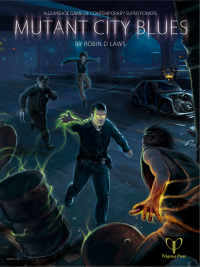
Quick Read Review - Mutant City Blues

Ten years ago, one percent of the population gained mutant powers. But one percent of the citizens means one percent of the criminals – and you're the cops who clean up the mess.

As you may have gleaned from the blurb, this RPG is set in the near future, after a virus event seemingly grants a significant percentage of the population beneficial mutations – of the super-powers variety.

Surprisingly, the world is not radically changed by this – not everyone decides to become a superhero or supervillain, not everyone wants to cash in on their abilities, and so some people go on with their lives trying to hide and forget that they have powers and abilities far beyond those of mere mortals.

But enough do, and some of them commit crimes, and that’s where you come in.

Powered by the Gumshoe system – a game system focused on investigation-oriented adventures – Mutant City Blues allows you to solve super-powered crimes and capers committed by a cast that could be taken from Heroes with a tone ranging from Castle’s light-hearted banter to Law & Order’s gritty procedurals.

One of the more interesting elements of this game is the Quade diagram. While most RPGs involving super-powers make a big deal out of being able to replicate any power in the comic books, Mutant City Blues imposes limits and definite patterns to metahuman abilities. In game terms, abilities connected to other abilities with a solid line are free; abilities connected to other abilities with a dotted line cost 2 points for each ability traversed; and abilities not connected cannot be purchased (you have to trace the web of lines to get to the ability you want).

This intriguing part of the game has two immediately obvious effects: (1) it suggests that in this particular setting, there is a predictability to meta-human powers, making professional crime-solving more about investigation, research, and deduction rather than a brainstorming / argument session about what weird combination of abilities was most likely to have been used to perpetrate the crime; (2) it makes certain combinations of abilities more desirable and other combinations of abilities too damn expensive to build.

Mutant City Blues looks like an RPG worthy of the mini-series treatment: build characters and play for a “season” of 3 to 6 episodes, then step back and evaluate how your campaign is going. If there’s promise, then make tweaks and start into the second season.

Suggested campaign inspirations: Law & Order, Heroes, Touching Evil, Castle, X-files, Warehouse 13 and Wire in the Blood.