When the Forgotten Realms boxed set first came out, I remember subconsciously avoiding it.
On the surface of it, this seemed to be an out-of-character choice for me. I was always fascinated by almost all things D&D, and -- given the relative scarcity of RPG material in the Philippines -- tended to jump on the latest D&D thing. I picked up stuff that I didn't know was Greyhawk, picked up stuff I didn't know was Mystara, devoured the rare Dragonlance module that made it to our shores, so why did I develop an aversion to the Realms before I'd even looked through it? Furthermore, the Realms came out when I was about a year into my time in the U.S. and dazzled by the availability of gaming material that had once been so killingly difficult to get.
Hindsight theorizes that it was my first taste of "it's not my kind of D&D" attitude. Maybe it was a dislike of jumping on the bandwagon (with all the contradictory interpretation of a bandwagon that comes with being a teenager), or a reluctance to learn a completely new world from the ones I was already familiar with, or a general resistance to AD&D 2nd Edition (despite the fact that the first boxed set was all in 1st Edition AD&D -- like I said, I had a weird aversion to it and didn't even look closely at it), which was out at around the same time.
To be clear, I was not yet fully cognizant of either Mystara or Greyhawk at this time; I was still in the module mindset -- adventure sites in D&D and AD&D were these islands of solidity that were connected by vague landscapes of setting. Perhaps this contributed to my aversion -- Dragonlance I could accept, because I felt the modules were just a translation of the novels into game form, but the Forgotten Realms was this weird animal I didn't quite understand in my rudimentary gaming psyche.
Now keep in mind, I was not clued into the whole Gygax controversy, so that definitely didn't factor into things.
It would take 3rd Edition to bring me into the Realms, long after I'd rediscovered Mystara and tried to retroactively claim Greyhawk as a major setting influence on my gaming life.
If you had a similar experience, you may wish to check out this old post on The Troll Ate My Homework to see someone else's view on the impact Forgotten Realms had on his game life (and on others' gaming lives as well).
Showing posts with label setting. Show all posts
Tuesday, June 19, 2012
Sunday, March 25, 2012
Setting Expeditions: The Hero Universe, Part I -- Pre-Cataclysm
Naturally, it's not going to give you anything other than the broad strokes of the meta-setting, and in fact some of the settings were fleshed out in separate (not-free) setting books from HERO Games.
Overall, it reminds me of three things: The History of the DC Universe which was published after the seminal Crisis on Infinite Earths maxi-series, the Planetary comics series by Warren Ellis and John Cassaday, and the Wold Newton Universe which grew out of Philip Jose Farmer's ingenious attempts to tie all manner of pulp heroes (and villains) into a single history and set of families.The reasons it does this include: to create a massive backdrop against which Heroic and Super-heroic adventures may be played; to allow spaces in the timeline in which the various genres and sub-genres that super-heroic fiction might be played; to create rationale for bringing various NPCs and organizations backwards and forwards in the timeline.
Before I talk about the pros and cons of the approach, let me give you a taste of the various time periods (and descriptions + inspirations of each) tackled in the document. Much of it is taken from the PDF itself, though trimmed, edited and annotated by yours truly.
But let's start off with the era that seems most friendly to the type of settings found in OSR adventures -- the fantasy genre-friendly era:
The Pre-Cataclysm Period
The Pre-Cataclysm Period is an age of civilization prior to the recorded history of mankind. For flavor, think Robert E. Howard, Clark Ashton Smith, Jack Vance, Lord Dunsany, Michael Moorcock, Lin Carter, and the like.
Fantasy Primeval (100,000 TO 75,000 BC)
The first civilizations of men other sentient races -- such as Dwarves and Elves -- arise. Initially, many of the dreaded Elder Races control much of the planet, and dominate most of the races of men either directly or through fear, but are in decline, gradually leaving Earth after warring with each other for millennia.
The gods evolve, and many walk the Earth, using humans as pawns in their interminable wars with each other. At long last, the wars of the gods come to a head, and in a tremendous clash they break the world. Realizing they could destroy themselves by destroying their worshipers, the gods depart Earth for other dimensions, leaving the planet to settle down and the few surviving humans to rebuild their shattered civilizations.
Note: One might consider this very similar to the Runequest setting, where magics constantly shape the world, physics are just as valid in terms of world rules as arcana, and where battles of gods ensnare the lives of mortals.
Turakian Age (73,000 to 65,000 BC)
An age defined by the rise and fall of Kal-Turak, Ravager of Men, from whom this period takes its name. It ends with the overthrow of Kal-Turak at the hands of all the free peoples of the world, in a magical cataclysm that once again re-shapes the world.
Note: Kal-Turak acts much like a campaign's uber-baddie, kind of a Vecna meets Invincible Overlord meets Darkseid, and gets to return in various forms and guises in future ages of the timeline.
Valdorian Age (50,000 BC TO 33,000 BC)
The Valdorian Age -- named after a Hero Universe fantasy empire founded by its hero-king Valdor -- is a classic sword-and-sorcery style fantasy setting in the mode of Howard or Moorcock. Mankind remains the dominant race on the planet; other races go into decline (many apparently vanish). Fantastic creatures of all descriptions are found on the Earth (some remnants of the Primeval age, others newly arisen). The gods still exert a strong influence on the Earth through gateways, priests, and avatars.
Note: This age seems friendliest to a Conan-like campaign, or an Elric-like campaign, or a Fafhrd and the Grey Mouser campaign depending on where you adventure and how you arrange your nations and states.
Atlantean Age (32,000 TO ~30,000 BC)
Toward the end of the Valdorian Age, a new empire, the Dominion of Atlantis, arose. Based on an ancient island (of the same name) of great mystical power, Atlantis soon came to dominate most of the world. Around 30,500 BC, Dalsith, son of the rebellious warrior-king and sorcerer Cormar the Mighty, sacrificed his soul to the Kings of Edom for great mystical power and became Sharna-Gorak the Destroyer, Vondarien’s greatest enemy. The clash between Sharna-Gorak and the forces of Atlantis shook the earth, eventually sinking continents, toppling mountain ranges, and creating a great flood -- the Cataclysm.
Note: The Atlantean Age is a overpowered high fantasy campaign setting, where magic can push the power ratings to super-heroic levels. It has an eclectic cultural mix that is reminiscent of Barsoom or Jack Vance’s Dying Earth or perhaps even the Final Fantasy series of video games.
The Cataclysm
This takes place around ~30,000 B.C. and it changes the world yet again. It destroyed almost all traces of civilization prior to this time. The survivors were thrown back to Stone Age technology and magic.
Note: the function of the Cataclysm is meant to handwave all this hoo-hah about no evidence existing concerning pretty much everything that happened prior. There will be stories and accounts that might survive to the present day, but since terrible physical and magical energies laid waste to everything, what puny evidence might be found is inconclusive and certainly insufficient to draw any inference about the majestic histories that were wiped from memory.
Tuesday, November 22, 2011
Kitchen Sink Expeditions: Lightspeed -- Part IV
In this brief exploration of the Lightspeed RPG, I've taken a look at the broad strokes of the setting, picked at the major elements, and showed some of the little cameos and campaign options available to players and GMs.
So to wrap things up, I decided to list some campaign premises (a.k.a. the more popular term now, campaign frameworks) that can be run in the setting.
Default Campaigns
The three major default campaigns come from the major powers / political factions of the galaxy.
The most straightforward of the three is the Pan-Solar Empire. This is essentially a no-Jedi Rebel Alliance campaign just waiting to be run. The fact that it isn't Star Wars means that you don't have to deal with fans waving books of Star Wars canon in your face every time you bring out a different kind of stormtrooper that wasn't in the movies or books. Plus, you get to do a lot of "wahoo" type adventuring on seedy planets on the fringes of Imperial power, and some tense infiltration work against well-funded, jackbooted military types on fully armed and operations battlestations -- because the RPG does have vehicle and space combat rules taken from Fuzion.
Almost as straightforward is the Interstellar Federation. While it is essentially Star Trek, there is some variance in terms of power levels here. You can ratchet them up to Next Generation levels, or bring them down to Original Series levels, but the implication is that the might and technology of the Empire should be capable of giving them a run for their money.
Federation campaigns can either be the classic ship-based Star Trek set-up, with a crew and semi-disposable away teams sent to explore the frontier of the Federation (or perform diplomatic missions of import for the Federation even while under this exploratory edict, go figure), or can be patterned after the excellent StarFleet Universe product Prime Directive, which posits an away team based campaign (renamed Prime Teams) with specific protocols on how to deal with hostile targets, first contact, etc.
However, with the existence of the various arms of the AstroPol, a Federation-empowered law enforcement organizations, you can also run planet-, system-, or Federation-wide campaigns that deal with crimes committed against Federation citizenry. As AstroPol Agents you can hunt down high-level criminals in the riches systems in the Galaxy, while as AstroPol Rangers you can keep the peace on the frontier.
Now it's not explicitly stated, but based on the original source material both these settings are fairly optimistic -- there's a prevailing belief that despite difficulties (and insurmountable obstacles) good will eventually triumph over evil.
That's not necessarily true in the Old Earth Empire, which has a dystopian feel tinged with cyberpunk ethos. Blade Runner could have happened here, alongside Alien and Aliens, and Predator. Campaigns with cynical heroes struggling to survive in systems dominated by mega-corporations.
Strange Brews
Those aren't the only possible campaigns, of course. You can have mixes between the mini-settings -- with Interstellar Federation spies going deep into the Pan-Solar Empire to aid the Rebellion with new technology -- cutting edge mecha. You can have Old Earth Empire mercenaries squaring off against criminals with slightly more superior technology from the Interstellar Federation. You can even have a Pan-Solar Empire battlegroup fall through a wormhole into the mysterious Centaurus Quadrant and have to battle their way past strange aliens and mysterious megastructures back to their home sector to suspicious superiors.
Lightspeed has a good mix of SF-inspired settings kluged together without necessarily losing the cores of each, allowing riffs and homages in a holistic setting. You may occasionally wonder how the entire socio-economic-political structure holds together, but there's enough space -- lacuna -- for the GM to come up with whatever rationale he can and the just run his campaign in whatever sandbox he's built for himself in the overall setting.
Here's hoping that Lightspeed eventually finds new life with another system that's more well-supported than Fuzion.
So to wrap things up, I decided to list some campaign premises (a.k.a. the more popular term now, campaign frameworks) that can be run in the setting.
Default Campaigns
The three major default campaigns come from the major powers / political factions of the galaxy.
The most straightforward of the three is the Pan-Solar Empire. This is essentially a no-Jedi Rebel Alliance campaign just waiting to be run. The fact that it isn't Star Wars means that you don't have to deal with fans waving books of Star Wars canon in your face every time you bring out a different kind of stormtrooper that wasn't in the movies or books. Plus, you get to do a lot of "wahoo" type adventuring on seedy planets on the fringes of Imperial power, and some tense infiltration work against well-funded, jackbooted military types on fully armed and operations battlestations -- because the RPG does have vehicle and space combat rules taken from Fuzion.
Almost as straightforward is the Interstellar Federation. While it is essentially Star Trek, there is some variance in terms of power levels here. You can ratchet them up to Next Generation levels, or bring them down to Original Series levels, but the implication is that the might and technology of the Empire should be capable of giving them a run for their money.
Federation campaigns can either be the classic ship-based Star Trek set-up, with a crew and semi-disposable away teams sent to explore the frontier of the Federation (or perform diplomatic missions of import for the Federation even while under this exploratory edict, go figure), or can be patterned after the excellent StarFleet Universe product Prime Directive, which posits an away team based campaign (renamed Prime Teams) with specific protocols on how to deal with hostile targets, first contact, etc.
However, with the existence of the various arms of the AstroPol, a Federation-empowered law enforcement organizations, you can also run planet-, system-, or Federation-wide campaigns that deal with crimes committed against Federation citizenry. As AstroPol Agents you can hunt down high-level criminals in the riches systems in the Galaxy, while as AstroPol Rangers you can keep the peace on the frontier.
Now it's not explicitly stated, but based on the original source material both these settings are fairly optimistic -- there's a prevailing belief that despite difficulties (and insurmountable obstacles) good will eventually triumph over evil.
That's not necessarily true in the Old Earth Empire, which has a dystopian feel tinged with cyberpunk ethos. Blade Runner could have happened here, alongside Alien and Aliens, and Predator. Campaigns with cynical heroes struggling to survive in systems dominated by mega-corporations.
Strange Brews
Those aren't the only possible campaigns, of course. You can have mixes between the mini-settings -- with Interstellar Federation spies going deep into the Pan-Solar Empire to aid the Rebellion with new technology -- cutting edge mecha. You can have Old Earth Empire mercenaries squaring off against criminals with slightly more superior technology from the Interstellar Federation. You can even have a Pan-Solar Empire battlegroup fall through a wormhole into the mysterious Centaurus Quadrant and have to battle their way past strange aliens and mysterious megastructures back to their home sector to suspicious superiors.
Lightspeed has a good mix of SF-inspired settings kluged together without necessarily losing the cores of each, allowing riffs and homages in a holistic setting. You may occasionally wonder how the entire socio-economic-political structure holds together, but there's enough space -- lacuna -- for the GM to come up with whatever rationale he can and the just run his campaign in whatever sandbox he's built for himself in the overall setting.
Here's hoping that Lightspeed eventually finds new life with another system that's more well-supported than Fuzion.
Saturday, November 19, 2011
Kitchen Sink Expeditions: Lightspeed -- Part III
| Think Space Wars vs. Space Trek. That's the ticket, yeah... |
ESPERS
One of these expansions tackled ESPERs (known as wielders of Psionics and Mental Abilities and Super Powers in other settings).
Inspired, no doubt, by anime shows like Cosmo Police Justy and Dragon Ball, this aspect of the setting posited that high-powered ESPERs existed in the universe. Now don't think Counselor Troi of Star Trek or even the uplifted Telepaths of B5 -- think Goku and his friends, deputized by the AstroPol going out to fight other similarly powered villains.
Any GM worth his salt is going to sense that such a setting element would raise terrible questions in terms of the viability of SF setting plausibility, unless a Legion of Super-Heroes vibe is evoked. So that would mean ditching this particular aspect of the setting, unless the PCs themselves were all ESPERs of that class.
However, I did feel that the complete removal eliminated the potential PSI Judge, Jedi, PsiCorps, Mentat, or Lensman element to the series and wish it could be brought back somehow.
RACES, RACES, RACES
There's no shortage of races in Lightspeed, and there's certainly enough space to add your own in. Some of them come across as homages to certain well-known SF properties, while others take on a more archetypal feel:
- Argesians: smart, great with technology, pacifistic. Star Trek Vulcans with a dash of the Known Universe Puppeteers.
- Heshans: a race of ascetics who believe in non-violence, they do have the potential to ignite into a Battle Rage. Star Trek Vulcans crossed with Dragon Ball Z Saiyans (without the planet destroying power levels)
- Hunters: xenophobic race that uses cloaking devices and prefers hand to hand weaponry when hunting all other races. Predators with the numbers filed off.
- Krung: a tall, swarthy warrior race. Klingons, man.
- Mronians: cat-people from outerspace. Chanur, anyone?
- Nerfel: short, furry mammalian species that is very cute. Ewoks.
- Yuzri: tall, furry bestial humanoids. Wookies.
- Saure: an alien species that tends to hibernate in deep space until they encounter another races, then they awaken, hunt, and breed. Hated by the Hunters. Aliens (vs. Predators) to be sure.
- The Robot Nexus: Think the Borg mixed with the AI Virus of Traveller.
Lightspeed has a lot of ship designs in their art, and even released a supplement on ships of the galaxy. Now while the ships of the Pan-Solar Empire have a distinctive Star Wars feel in the art, the Interstellar Federation doesn't seem to be quite as a Star Trek inspired. If I ran the campaign, I'd definitely make their ships more Trek-ish so contrast with the Empire, and (in my own opinion) the more Babylon 5 meets Firefly feel of the Old Earth Empire ships.
And I think that you'd have to hammer out the balances between the ship designs to make sure that questions wouldn't arise like: why doesn't the Federation wipe out the Empire in one afternoon and then warp back for tea?
To be fair, the author may have balanced out the ship designs, but I never really delved deep enough to figure out if the various factions were an even match for one another despite differences in technological paths.
Up Next: Wrapping things Up
Monday, November 14, 2011
Kitchen Sink Expeditions: Lightspeed -- Part II
In Part I, we explored the background of Lightspeed and the broad strokes of the setting. In this Part, I hope to tackle the major elements of the setting, and show how they can be used as the homages that they are.
The Interstellar Federation
AstroPol is a star-spanning law enforcement agency, with many different arms to help create many different law enforcement campaign frames. There are the equivelent of Police Departments, Rangers for the borders, and Agents that are the equivalent of FBI/CIA operatives working of the good of the Federation.
StarForce is clearly a StarFleet equivalent, and the military structure and several other existents certainly do little to dispel that notion. The main difference is that StarForce is primarily concerned with defending against the machinations of the Pan-Solar Empire. Therefore, while there can be equivalents of Klingons, Romulans, and the Borg, the primary border of concerns is likely to be the one shared with the Empire.
Basing your campaign in the Interstellar Federation give you a chance to adventure in a stable, progressive space republic. It's not a utopia as the presence of AstroPol and StarForce makes clear, but it is perhaps, a society that believes that such a utopia is possible, despite the difficulties and opposition of rivals in the cold blackness of space.
Speaking of rivals...
The Pan-Solar Empire
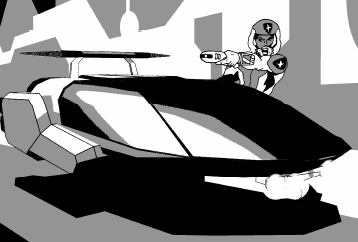
| The Emperor has a fondness for these insect inspired designs. |
Opposing him are the Anti-Imperial Rebels -- outnumbered and outgunned at every turn, they fight valiantly to throw off the yoke of Imperial rule. Using guerilla tactics, old colonial spacecraft and secret bases, these Rebels manage to push forward in their efforts through covert financial and supply support from three main sources: aristocratic families that went into hiding after the Emperor came into power, the Interstellar Federation, and friendly Old Earth Empire factions.
There is a distinct lack of a Jedi equivalent in the setting -- which would actually work out well given the tendency of everyone and his mother wanting to play the supposedly extinct Jedi in a Rebellion Era Star Wars setting. There is also no Force in the setting, but older iterations of the Lightspeed may have a solution for that: ESPERs (which will be tackled in Part III).
Without ESPERs, however, the Rebellion will have to find other sources of technology and resources, and those may be found in the troubled birthplace of humanity...
The Old Earth Empires
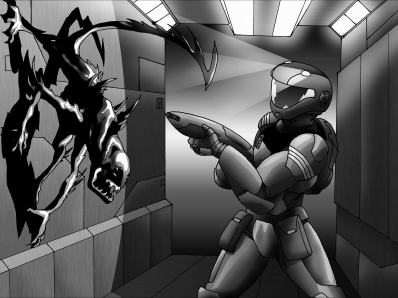
| The Corporation won't be happy about this... |
Most visible is the MegaCorporation-dominant vision, as reflected in Blade Runner (and revisited in Anime like Bubblegum Crisis), and the Alien / Aliens series of films. Cyberpunk campaigns and gritty space dramas can unfold in this corner of the galaxy, with protagonists eking out whatever small amount of happiness they can.
However, the MegaCorporations aren't necessarily the only game in town. Countries other than the U.S. have managed to retain their sovereignity and are reaching for the stars themselves. Japan's Space Defense Force, inspired by the Interstellar Federation, is an example of this; other countries in the world have managed to maintain and grow their interstellar holdings. In this setting, the European Union is a sad shadow of its former self, as most of its interstellar holdings were lost to the Pan-Solar Empire centuries ago.
Next Up: notable inclusions and possible additions
Saturday, November 12, 2011
Kitchen Sink Expeditions: Lightspeed -- Part I
Looking for a Science Fiction setting that is a mix of Star Wars, Star Trek, and other SF properties with a little Anime thrown into the mix? Look no further than the Lightspeed RPG by Christian Conkle.
Background
I first encountered Lightspeed back in the days when Fuzion was a still a thriving RPG system, and the first iterations of the game and setting were available for free on the internet. Even in those days, the intent to create a kitchen sink setting was not only apparent, it was stated as a goal by the author:
Broad Strokes
Intent is one thing, but how was the execution? To understand the broad strokes of the setting, it's best to take a look at the map of the Galaxy and how it was broken up -- it gives out the clearest visual idea of the approach taken with the setting.
Major elements of the setting include the Interstellar Federation with the StarForce Officers and the Federation Rangers; the PanSolar Empire ruled by the Emperor; and the remnants of the Old Earth Empires, filled with powerful mega-corporations and nations locked in cold and hot wars.
Next Up: A closer look at the major elements of the setting.
Background
I first encountered Lightspeed back in the days when Fuzion was a still a thriving RPG system, and the first iterations of the game and setting were available for free on the internet. Even in those days, the intent to create a kitchen sink setting was not only apparent, it was stated as a goal by the author:
"If elements of Lightspeed seem familiar, that is intentional. Lightspeed attempts to be all inclusive, drawing inspiration from many Science Fiction films and novels and putting them together into a coherent whole. The purpose of this is to make Lightspeed as generic as possible, allowing players and gamemasters to set their characters and stories against any backdrop they desire. Within you’ll find elements of Star Trek, Star Wars, Aliens, Bladerunner, XFiles, Predator, Japanese Anime, Cyberpunk fiction, Lovecraftian fiction, and other Science Fiction games."
Broad Strokes
Intent is one thing, but how was the execution? To understand the broad strokes of the setting, it's best to take a look at the map of the Galaxy and how it was broken up -- it gives out the clearest visual idea of the approach taken with the setting.
Major elements of the setting include the Interstellar Federation with the StarForce Officers and the Federation Rangers; the PanSolar Empire ruled by the Emperor; and the remnants of the Old Earth Empires, filled with powerful mega-corporations and nations locked in cold and hot wars.
Next Up: A closer look at the major elements of the setting.
Saturday, August 6, 2011
Setting Mashup Source #5: Over The Edge
| I picked up the 1st Edition and still have it. Never found a printed copy of the 2nd Edition. |
Now, while the island of Al Amarja is already interesting enough to drag into a fantasy realm (no guns except for the Peace Force, more on that later) -- the city known as The Edge can be a refreshing change to the normal type of fantasy world city.
It is nicely laid out with Plazas that attract a certain kind of personage that tends to co-mingle. Taking this tack, you can create Plazas where artists tend to hang out, where fighters congregate to find hirelings and check out the latest developments in weaponry, where mages browse through book sellers and tomes in the labyrinthine alleyways off the main plaza, and so on.
In addition, Al Amarja has its own patois despite the official language being American English (Common) with interesting twists:
An example would be the word "Yes" — the English "Yes" is used for simple confirmation, the French "Oui" is used to imply apathy or boredom, the Russian "Da" is used for dejected acceptance of the inevitable, and the Japanese "Hai" is selected for enthusiastic agreement.
Another cultural twist that serves to reinforce that your PCs just "aren't in Kansas anymore" include the elimination of the terms "police" and "law" with "peace". Hence:
"Stop! Peace!"The prevalence of poisoning (and forcing altered states of mind on victims) as a favored method of expediting matters has many drinkers -- even in 'trusted company' -- covering their cups, glasses, bottles and flasks with their hands.
"This is the Peace Force! We have you surrounded!"
"Halt in the name of the Peace!"
"You can't run from the Peace."
This setting would get my vote for a cultural overlay on the creepy Principalities of Glantri in Mystara. Or perhaps as a counterpoint to ruler of the City-State of the Invincible Overlord.
Al Amarja's own President-For-Life Monique D'Aubianne -- who is stated as having been Benito Mussolini's lover in the original setting -- could probably give him a run for his money. Or just give an idea what messing with an outwardly polite ruler of a police state is like.
Friday, April 22, 2011
Not Enough Time
![]() |
| It's not my shelf, but I've got a similar collection of stuff. Across several shelves and boxes. |
But I just don't have enough time. I don't.
Even if I gave up on Real Life, which -- of course -- I won't and can't.
So it's time to review all the things that I spend my time on in this hobby of mine and see what things I should be spending my time on.
The Short List
News and Feeds
Well, first and foremost I do enjoy hearing about the latest and greatest news and controversies about the hobby. I'm fascinated by the emergence of the Indie RPG, and the developments in the 3.5E / OGL industry space (especially Pathfinder, Castles & Crusades, Stars Without Number, True20, etc.). I'm fascinated by FATE, and all this stuff spurred on by stuff from OSR enthusiasts.
So feeds and blogging and news sites will be important.
Systems
I'll have to narrow down the systems I try to learn, and have some favorite go-to systems if I ever get to run games again. On the list right now are:
- For the fantasy genre, I tend toward the D20-inspired branch of systems, I'm looking at Castles & Crusades and True20;
- For the supers genre, I'm looking at Hero System, M&M, and either Icons or BASH;
- For the SF genre, I also look at the Hero System, EABA, and True20.
Of course, I do like reading up on new systems. But I will have to limit it to a certain number a year. And currently, one of those slots is taken up by Cortex-Smallville.
Settings
I always want to learn more about settings I like. But I really have to temper it somehow. After all, even if enjoy the exploration of various aspects of a setting -- at some point it becomes tedious, or boring, or more simply, enough.
For example, D&D 3E's Forgotten Realms main sourcebook, plus the Lords of Darkness book were enough for me. Other books were nice to have (Faiths and Pantheons and Magic of Faerun, for example), but the fleshing out of other areas started to become too much.
Also, I'm not a total slave to canon either -- I like to retain key elements of settings but would prefer to have space to insert my own ideas into the world.
Right now, my favored settings include: the iconic DC Universe & the iconic Marvel Universe, Forgotten Realms 3E, Mystara, Blue Planet, Fading Suns, Babylon 5, and the meta-setting of Call of Cthulhu (which includes 1890s,1920s, and Delta Green).
Runners up include Eclipse Phase, SF settings like Lightspeed that allow combining Star Wars and Star Trek elements into it, and city-based mini-settings like Lankhmar, Thieves' World, and Freeport.
Saturday, March 12, 2011
Weekend Roundup: March 12, 2011
Not necessarily the week in review as far as blog posts is concerned, but certainly a roundup of blog posts that caught my eye this week.
On System:
Bat In The Attic - Mechanical Complexity of D&D Part I
Bat In The Attic - Mechanical Complexity of D&D Part II
Lord Kilgore - Multiple Attacks
Lord Kilgore - Momentum
As a system tinkerer, I was drawn not only to the exploration of rules from various incarnations of D&D by Rob Conley, but also to Lord Kilgore's continuous tinkering with his D&D-inspired ruleset.
On Setting:
Bat In The Attic - Medieval Farming Year
Ever curious about verisimilitude in a pseudo-medieval fantasy setting, I enjoyed the post and the links on medieval farming (and the sheer number of resources dedicated to it in a given society), and realized how burning a series of farmland's entire yield of crops could easily be considered grounds for bloody retribution.
Blood of Prokopius - Mining Some Circa 1981 Gold
Always fond of FrDave's posts on religion and D&D, I found this post echoing my own thoughts on monotheistic religions not only in fantasy settings, but also in science fiction settings. Perhaps this was part of the appeal that Fading Suns had on me. Must recruit this guy into Fading Suns when 3rd Edition comes out! Or at least tap him as a resource.
From the Sorceror's Skull - In Any Language
The art posted here from the Swedish RPG Drakar och Demoner (Dragons & Demons) is awesome, but it also reminds me how by just changing the art and the rules treatment of monsters in fantasy RPGs can give gameplay that unpredictable, exploratory feel.
Fire in the Jungle - Tunnels in the Jungle
While the post on Vietnam tunnels does ignite some rationale for dungeons and stirs memories about the Iwo Jima tunnels in WWII, it is the plaster-filled ant colony image that really stirs the imagination and dredges up ancient memories of a Bill Homeyer campaign where a seemingly infinite (and oddly monsterless) staircase stretches down into the pits of hell. Awesome.
On OSR:
Lands of Ara - Top 15 Classic OSR Blog Posts: On Game Design and Campaign Resources
The Society of Torch Pole and Rope - An Evaluation of Watchfires & Thrones: Year One
Swords Against The Outer Dark - My Message to the OSR
Salon.com - How Dungeons & Dragons Changed My Life
Though I don't really game OSR these days, out of nostalgia and an attempt to understand the effect that D&D (and the hobby of RPGs as a whole) has had on my life, I find myself drawn to these posts for various reasons.
Tuesday, March 8, 2011
Musings: Conquistadors in the Archipelago -- a first look
![]() |
| Die, Spanish-speaking, armored symbol of colonialism and oppression. Crom! |
Now, one major element of a Philippine fantasy setting -- assuming you're planning on dealing with that period of history anyway -- are the Spaniards.
Despite this wonderfully patriotic, nationalist pride-stirring image, we eventually succumbed to the colonization efforts of Spain (and the reasons are manifold and the subject of heated academic debate). But some research on conquistadors elsewhere reveals some surprising information.
According to About.com, the mental image we have of the conquistadors (who weren't called that in their lifetimes) is very different from the reality:
There were two sorts of Spanish conquistadors: horsemen or cavalry and foot soldiers or infantry... Cavalrymen received a much higher share of the treasure than foot soldiers when the spoils were divided.
The Spanish horsemen generally had two sorts of weapons: lances and swords. Their lances were long wooden spears with iron or steel points on the ends, used to devastating effect on masses of native foot soldiers. In closer combat, a rider would use his sword. Steel Spanish swords of the conquest were about three feet long and relatively narrow, sharp on both sides.
Spanish footsoldiers could use a variety of weapons. Many people incorrectly think that it was firearms that doomed the New World natives, but that’s not the case. Some Spanish soldiers used a harquebus, a sort of early musket. The harquebus was undeniably effective against any one opponent, but they are slow to load, heavy, and firing one is a complicated process involving the use of a wick which must be kept lit.Furthermore, according to the Cabrillo National Monument site under npr.gov...
...this was not a nationally subsidized army. There was no such thing as a uniform, no two Spanish soldiers looked the same, nor did they want to. These were disciplined soldiers but they were also rugged individualists. Each man provided his own equipment and except for the nobility and very wealthy it was usually a mixed bag of whatever the soldier could find and afford.Sounds a lot like the traditional D&D fighters buying and upgrading their weapons and armor as they came into money. And speaking of quality weapons, here's what's said about that Toledo steel:
The Spanish city of Toledo was known as one of the best places in the world for making arms and armor and a fine Toledo sword was a valuable weapon indeed: the finely made weapons did not pass inspection until they could bend in a half-circle and survive a full-force impact with a metal helmet. The fine Spanish steel sword was such an advantage that for some time after the conquest, it was illegal for natives to have one.Could be an equivalent of the +1 swords in D&D being restricted to ownership by the occupying forces, yes?
Tuesday, February 22, 2011
Musings: The Jungle in a Filipino Fantasy Setting
As a tip of the hat to A Fire in the Jungle I decided to mention this aspect about the Filipino Fantasy setting: jungle.
Jungle
The Philippines isn't all jungle (especially with all the mining and illegal logging and cities). But a lot of it was jungle way back when. I'm not sure how many of you have ever been in a jungle, but this isn't your nicely spaced out, well managed forest in a tropical climate. Those of you who've had to go through thick foresty wilderness in the temperate zone know what a godsend trails are.
Even footing, the ability to see what you're stepping on, thick vines and annoyingly sharp thorns, branches, and even leaves make going through thick jungle difficult to impossible. And this is ignoring things like the heat, insects, and wild animals. And mystical creatures like pugos, kapres, aswangs, tikbalangs, and mananaggals, and mystical threats like mambabarangs, mangkukulams, and engkantos / malignos.
Any filipino fantasy setting should remind people what a hostile place the jungle can be -- and can even up importance of a class like the druid for extended travel into the wilderness.
Potential Encounter Seed
After tackling this kind of terrain all day, a nipa hut (an indigenous home built on stilts from wood and nipa leaves) with a light in the window at night can be a welcome sight. But be wary. Some of these homes are enchanted, designed to trap the unwary traveler who eats a well-laid out meal at the table of these seemingly empty homes. Doing so will imprison those who consume the meals in the land of the engkantos.
Of course, attempting to leave the area of this enchanted nipa hut will be difficult. Illusions and enchantments and invisible spirits will attempt to confuse the travelers, often sending them back to the mysterious house where the scent of freshly cooked food entices them to come closer. By the third approach to the same house, despite attempts to head back into the darkness of the jungle, experienced travelers will know to attempt simple methods to ward enchantements -- prayers, oracions, and even reversing one's clothes to confuse the spirits.
Jungle
The Philippines isn't all jungle (especially with all the mining and illegal logging and cities). But a lot of it was jungle way back when. I'm not sure how many of you have ever been in a jungle, but this isn't your nicely spaced out, well managed forest in a tropical climate. Those of you who've had to go through thick foresty wilderness in the temperate zone know what a godsend trails are.
Even footing, the ability to see what you're stepping on, thick vines and annoyingly sharp thorns, branches, and even leaves make going through thick jungle difficult to impossible. And this is ignoring things like the heat, insects, and wild animals. And mystical creatures like pugos, kapres, aswangs, tikbalangs, and mananaggals, and mystical threats like mambabarangs, mangkukulams, and engkantos / malignos.
Any filipino fantasy setting should remind people what a hostile place the jungle can be -- and can even up importance of a class like the druid for extended travel into the wilderness.
Potential Encounter Seed
After tackling this kind of terrain all day, a nipa hut (an indigenous home built on stilts from wood and nipa leaves) with a light in the window at night can be a welcome sight. But be wary. Some of these homes are enchanted, designed to trap the unwary traveler who eats a well-laid out meal at the table of these seemingly empty homes. Doing so will imprison those who consume the meals in the land of the engkantos.
Of course, attempting to leave the area of this enchanted nipa hut will be difficult. Illusions and enchantments and invisible spirits will attempt to confuse the travelers, often sending them back to the mysterious house where the scent of freshly cooked food entices them to come closer. By the third approach to the same house, despite attempts to head back into the darkness of the jungle, experienced travelers will know to attempt simple methods to ward enchantements -- prayers, oracions, and even reversing one's clothes to confuse the spirits.
Sunday, February 6, 2011
D&D Campaign Planning: Setting Mash-ups (updated)
Original Post (Feb 2010)
One of the things that draws fire from dungeoncrawl adventure critics is the reasonableness of dungeons filled with a mish-mash of monsters, treasure, and confusing architecture beneath some abandoned keep or in a network of caves (and mega-dungeons get it worse).
Mad uber-mages like Halaster Blackcloak may find it fun to move around rooms, corridors, monsters, and traps inside their dungeon, it stretches plausibility in an extended campaign to find yet another mega-dungeon somewhere. ("By the beard of Zoroaster, we should make psychological screening of mages at Hogwarts a requirement!" "But we get so much tax revenue from adventurers who clear their dungeons out periodically...")
While sites like dungeonaday.com have a rationale for the irrationality of dungeons ("No wonder they're all so aggressive -- there's no place to relieve yourself here." "Don't worry, this level has a gelatinous cube.") It can't hurt to have multiple ideas to justify the dungeons and megadungeons we love so much.
So I'm going to start posting ideas filched from other possibly lesser known RPG settings that might help DMs and Players like me who care about that sorta thing.
Update (Feb 2011)
Here's a list of what I've done so far:
But it also occurred to me that I should take a look at what other "mashups" folks have done with D&D settings, especially with Mystara. Of course one that comes to mind is Tim Brannan's Mystoerth work on his blog. That's some good reading, especially since I also like to pilfer from Greyhawk for my D&D fantasy games.
Oddly enough, I prefer to keep Forgotten Realms primarily its own creature. I don't know why, but it could be because in my mind Mystara and Greyhawk were more prone to the early "mix & match" approach to settings, while the Realms -- to my mind -- have a particular canon that must be adhered to.
One of the things that draws fire from dungeoncrawl adventure critics is the reasonableness of dungeons filled with a mish-mash of monsters, treasure, and confusing architecture beneath some abandoned keep or in a network of caves (and mega-dungeons get it worse).
Mad uber-mages like Halaster Blackcloak may find it fun to move around rooms, corridors, monsters, and traps inside their dungeon, it stretches plausibility in an extended campaign to find yet another mega-dungeon somewhere. ("By the beard of Zoroaster, we should make psychological screening of mages at Hogwarts a requirement!" "But we get so much tax revenue from adventurers who clear their dungeons out periodically...")
While sites like dungeonaday.com have a rationale for the irrationality of dungeons ("No wonder they're all so aggressive -- there's no place to relieve yourself here." "Don't worry, this level has a gelatinous cube.") It can't hurt to have multiple ideas to justify the dungeons and megadungeons we love so much.
So I'm going to start posting ideas filched from other possibly lesser known RPG settings that might help DMs and Players like me who care about that sorta thing.
Update (Feb 2011)
Here's a list of what I've done so far:
- Setting Mashup #1: Code Black
- Setting Mashup #2: JAGS Wonderland
- Setting Mashup #3: Kult
But it also occurred to me that I should take a look at what other "mashups" folks have done with D&D settings, especially with Mystara. Of course one that comes to mind is Tim Brannan's Mystoerth work on his blog. That's some good reading, especially since I also like to pilfer from Greyhawk for my D&D fantasy games.
Oddly enough, I prefer to keep Forgotten Realms primarily its own creature. I don't know why, but it could be because in my mind Mystara and Greyhawk were more prone to the early "mix & match" approach to settings, while the Realms -- to my mind -- have a particular canon that must be adhered to.
Thursday, January 27, 2011
Mining Mystara #3: Glantri
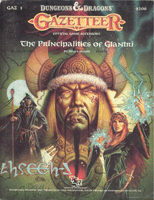
So. The Principalities of Glantri.
I like the Gazetteer, and the insight that they give on spellcraft and wizardly culture, despite their distance from my preferred core location (Karameikos). I doubt I'd let people travel there in-game, but would allow flashbacks for any spellcasters who might've chosen to originate from that land.
The reasons I'd use them for a campaign are:
Mad Science / Mad Wizards
It's a wonderful place for strange Magic McGuffins. All sorts of brand-spanking new spells and magic items (that don't quite work that well) could potentially be offloaded to NPCs or PCs. Rumors that the way that most people understand magic aren't really how it works can be based on this land -- kind of like how cutting-edge research people would look at mere technicians and end-users of technological products.
Playing God With The World
In fact, some of these research efforts may have uncovered some sources of power that weren't really meant to be in mortal hands. Gateways into other realms, imprisoned evils unleashed, potentially catastrophic magical fallout -- many things that adventure hooks and interesting dungeon-delving locations can be based on.
You and what army?
In addition, they reinforce the feel that Mystara isn't necessarily a totally stable geopolitical environment. Glantri is a major political power who doesn't have 'politically correct views' and in fact has very hostile attitudes to most character classes (clerics are criminals, Halflings and Dwarves are potential experimental subjects, Elves could be spies, and all non-mages = second class citizens). Should be a blast if a liberally-minded party ever meets a delegation from there.
The Radiance
The Radiance is a mega-macguffin for the campaign, especially if you plan on using the "Wrath of the Immortals" storyline.
I like the Gazetteer, and the insight that they give on spellcraft and wizardly culture, despite their distance from my preferred core location (Karameikos). I doubt I'd let people travel there in-game, but would allow flashbacks for any spellcasters who might've chosen to originate from that land.
The reasons I'd use them for a campaign are:
Mad Science / Mad Wizards
It's a wonderful place for strange Magic McGuffins. All sorts of brand-spanking new spells and magic items (that don't quite work that well) could potentially be offloaded to NPCs or PCs. Rumors that the way that most people understand magic aren't really how it works can be based on this land -- kind of like how cutting-edge research people would look at mere technicians and end-users of technological products.
Playing God With The World
In fact, some of these research efforts may have uncovered some sources of power that weren't really meant to be in mortal hands. Gateways into other realms, imprisoned evils unleashed, potentially catastrophic magical fallout -- many things that adventure hooks and interesting dungeon-delving locations can be based on.
You and what army?
In addition, they reinforce the feel that Mystara isn't necessarily a totally stable geopolitical environment. Glantri is a major political power who doesn't have 'politically correct views' and in fact has very hostile attitudes to most character classes (clerics are criminals, Halflings and Dwarves are potential experimental subjects, Elves could be spies, and all non-mages = second class citizens). Should be a blast if a liberally-minded party ever meets a delegation from there.
The Radiance
The Radiance is a mega-macguffin for the campaign, especially if you plan on using the "Wrath of the Immortals" storyline.
Friday, December 31, 2010
Goodbye, ICE; Hello New ICE!
Snagged this news announcement over RPG.net:
So, while there's a loss of the current holder of ICE intellectual properties, apparently a new group will be taking over the reins. And I've grabbed some stuff from Guild Companion for HARP (primarily to look at the system) and HARN (to look at the setting), so I'm hopeful.
My big interests here are more HARP and HARN and Shadow World, as I'm not a big fan of Rolemaster.
Aurigas Aldebaron LLC, owner of Iron Crown Enterprises and all its intellectual property, announces the appointment of Guild Companion Publications Limited, based in the United Kingdom, as the licensee for our High Action Role Playing (“HARP”), Rolemaster and Spacemaster game systems, which is in addition to the recently awarded license they hold for HARP Science Fiction system and the long-running Shadow World setting.
Aurigas Aldebaron LLC is instituting its vision of “next generation game company management” by reducing the number of vertical layers in the industry which stand between game creators and the fans that play such games. It is seeking game developers to utilise its additional properties including Cyberspace and the pirates-based game Run out the Guns!, and possibly the Silent Death game system Combat Express license. Its new strategy also includes more involvement from a community support and marketing perspective, and it expects to have some more involvement with its properties than it has had in its past. To support these efforts, Aurigas Aldebaron LLC has recruited third parties and volunteers to manage its licensee properties, relationships, website, forums and marketing efforts.
About Aurigas Aldebaron LLC: In December of 2001, Iron Crown Enterprises (“ICE”) and all its intellectual property was purchased by Aurigas Aldebaron LLC, a Virginia-based company backed by several wealthy individuals. Aurigas immediately replaced the former ICE management with part of the management team from ICE which formed itself into a separate company to manage ICE under license. Aurigas Aldebaron LLC will continue to act in a capacity of an intellectual property owner licensing its properties to qualified game creators and developers. It will continue to seek properties to acquire and additional game creators and developers to work with. For more information, please visit www.ironcrown.com.
About Guild Companion Publications Limited: Guild Companion Publications Limited is the commercial arm of the Guild Companion magazine (www.guildcompanion.com). Previously it published Rolemaster, HARP and Spacemaster products under license from Mjolnir LLC, and already holds a direct license from Aurigas Aldebaron LLC to publish HARP SF and Shadow World products, and its Director (Nicholas HM Caldwell) is the author of Rolemaster’s Mentalism Companion and Construct Companion, HARP’s College of Magics, and of the upcoming HARP SF and HARP SF Xtreme products. The new license arrangement with Aurigas Aldebaron LLC provides GCP Ltd a complete offering in fantasy and science-fiction gaming. GCP Ltd’s commercial products are available exclusively via the OneBookShelf network of ecommerce outlets (see http://www.rpgnow.com/index.php?manufacturers_id=461).
Guild Companion Publications Limited is a private limited company registered in England and Wales under No 7094505. Registered office: 77 Speedwell Close, Cambridge, CB1 9YS.
So, while there's a loss of the current holder of ICE intellectual properties, apparently a new group will be taking over the reins. And I've grabbed some stuff from Guild Companion for HARP (primarily to look at the system) and HARN (to look at the setting), so I'm hopeful.My big interests here are more HARP and HARN and Shadow World, as I'm not a big fan of Rolemaster.
Saturday, December 25, 2010
A New Fading Suns Blog Post!
( UPDATE 03 Feb 2022: For the latest update, check out this latest blogpost regarding the current status of Fading Suns under the care of Ulisses Spiele. )
( UPDATE 26 Mar 2020: Please check out a newer blog post regarding the Kickstarter for Fading Suns by Ulisses Spiele. I'm only updating this very old post because it's my top performing post, and people may get the wrong idea. The post below is outdated, as RedBrick are no longer handling Fading Suns.)
Not just this one, but the one on the official site!
The dream is not dead, is in fact alive and well and waiting to get published. Some intriguing snippets from the upcoming edition include:
The Hazat teeter on edge of bankruptcy from their war effort against the Caliphate (and the Emperor Wars), though temporarily buoyed up by the vassalage of their former lords, House Chauki, and the acquisition of the world of Iver. But neither the Emperor nor the Universal Church are being seen to offer support in their war against the heretic Kurgans.
It's nice to see the Chauki plotline still alive and kicking in the 3rd edition.
With the impending death of the Patriarch, the Universal Church has turned inwards with thoughts of succession. Candidates now jockey against rivals in a bid for esteem in the eyes of the College of Ethicals. Some seek noble patronage in their quest to rise to the pinnacle of Church hierarchy, while others court the esteem of their fellows (and, some say, darker paths).
A good effort to weaken the overwhelming power of the Universal Church (though not too much, hopefully, as they provided a nice twist to the Dune-ish feel of the setting).
The Merchant League continues to scheme quietly. The recent granting of a new interstellar patent brings a sixth guild to interstellar recognition, and some cry foul. New worlds have opened on the jumpweb, but many are savage and dangerous places that threaten the flow of interstellar commerce. The dream of a Third Republic remains just a dream for now.
Looks like the new patent will add interest to playing groups from the Merchant League, though I feel that there should be time spent explaining how the League's influence counterbalances the Noble Houses and the Church.
Being based in the Philippines, I once remarked to a friend how similar the Fading Suns universe power structure was to our country. The Nobles were akin to our own wealthy families -- some long-time juggernauts with holdings in various key industries, some withering on the vine, and some (buoyed by celebrity status and bolstered by solid business or political sense) establishing themselves as new players in the field. The Church covered not just the dominant Catholic church, but also the various denominations and religious organizations that have great influence on the populace. The League: lawyers, accountants, and other professions that make the machinery work...
( UPDATE 26 Mar 2020: Please check out a newer blog post regarding the Kickstarter for Fading Suns by Ulisses Spiele. I'm only updating this very old post because it's my top performing post, and people may get the wrong idea. The post below is outdated, as RedBrick are no longer handling Fading Suns.)
Not just this one, but the one on the official site!
The dream is not dead, is in fact alive and well and waiting to get published. Some intriguing snippets from the upcoming edition include:
The Hazat teeter on edge of bankruptcy from their war effort against the Caliphate (and the Emperor Wars), though temporarily buoyed up by the vassalage of their former lords, House Chauki, and the acquisition of the world of Iver. But neither the Emperor nor the Universal Church are being seen to offer support in their war against the heretic Kurgans.
It's nice to see the Chauki plotline still alive and kicking in the 3rd edition.
With the impending death of the Patriarch, the Universal Church has turned inwards with thoughts of succession. Candidates now jockey against rivals in a bid for esteem in the eyes of the College of Ethicals. Some seek noble patronage in their quest to rise to the pinnacle of Church hierarchy, while others court the esteem of their fellows (and, some say, darker paths).
A good effort to weaken the overwhelming power of the Universal Church (though not too much, hopefully, as they provided a nice twist to the Dune-ish feel of the setting).
The Merchant League continues to scheme quietly. The recent granting of a new interstellar patent brings a sixth guild to interstellar recognition, and some cry foul. New worlds have opened on the jumpweb, but many are savage and dangerous places that threaten the flow of interstellar commerce. The dream of a Third Republic remains just a dream for now.
Looks like the new patent will add interest to playing groups from the Merchant League, though I feel that there should be time spent explaining how the League's influence counterbalances the Noble Houses and the Church.
Being based in the Philippines, I once remarked to a friend how similar the Fading Suns universe power structure was to our country. The Nobles were akin to our own wealthy families -- some long-time juggernauts with holdings in various key industries, some withering on the vine, and some (buoyed by celebrity status and bolstered by solid business or political sense) establishing themselves as new players in the field. The Church covered not just the dominant Catholic church, but also the various denominations and religious organizations that have great influence on the populace. The League: lawyers, accountants, and other professions that make the machinery work...
Saturday, November 6, 2010
Roleplaying in the Worlds of Star Trek -- Part II
In the first part of this article, I tackled finding and using some of the licensed Star Trek RPG games to get your fix of Star Trek gaming. But since those RPGs are currently difficult to find (especially here in the Philippines), what other alternatives is there?
Using a current RPG system -- one that you can get ahold of and are comfortable with -- and building everything Star Trek-related with it!
There are two general approaches for this:
Two of the go-to generic systems for traditional RPGs are the Hero System and GURPS. Each of them have a wealth of source material appropriate for a Science Fiction campaign and for a Star Trek campaign in particular.
Using a current RPG system -- one that you can get ahold of and are comfortable with -- and building everything Star Trek-related with it!
There are two general approaches for this:
- find a generic RPG system, get all the native source material for a Science Fiction game, and get started converting to Star Trek;
- find a specific Science Fiction system, and tweak it into a Star Trek setting.
Let's tackle Generic RPG system solutions first!
Generic RPG Systems
Two of the go-to generic systems for traditional RPGs are the Hero System and GURPS. Each of them have a wealth of source material appropriate for a Science Fiction campaign and for a Star Trek campaign in particular.Hero has a reputation for being a little more supporting of -- well -- heroic gaming, while GURPS has a reputation for being slightly more gritty and less forgiving with regard to superhuman abilities and recovering from damage.
The Hero System has a genre book titled Star Hero. It discusses the various Science Fiction genres, dissects how these genres and subgenres are applicable to games (as opposed to fiction), and lays out how to put together a Science Fiction campaign. It gives guidelines on solar system and planet creation, as well as rules for weapons, armor, technology, and starships.
Hero also has two other supplements available that are of special interest to Star Trek fans. These are the Terran Empire sourcebook (the primary Hero System Science Fiction setting) and the Star Trek sourcebooks (an unofficial sourcebook put together by fans). The former is available for purchase, while the latter must be found by searching online.
GURPS 4th Edition has a sourcebook titled GURPS Space, is a revised version of the 3rd Edition book, and is also chock full of source material on creating your own Science Fiction setting, the benefits and pitfalls of certain setting decisions regarding political structures, technology levels, etc. There are character professions appropriate for the various aspects of interplanetary and intergalactic empires (complete with recommended skillsets), and sections on weapons and spaceships.
Of course, GURPS has several other sourcebooks that may be of use to someone looking to build their own Star Trek-ish universe: GURPS Ultra-Tech and GURPS Spaceships come to mind.
By the way, both these systems use normal six-sided dice as opposed to the polyhedral dice collections favored by D20 systems, so this shouldn't be a hinderance to getting your game on.
Other generic systems you may wish to consider, with slightly different RPG philosophies are the D6 system and FATE -- and each have their own respective books that include both the ruleset and genre source material in a single tome.
D6 Space is the latest (free) incarnation of the D6 ruleset which is probably best known for the original Star Wars RPG ruleset. It also uses only 6-sided dice, and favors cinematic styles of role-play for all types of conflict. Space combat in particular is interesting due to options that allow a non-map based style of play that is fast and furious -- though this may be at odds with the traditional capital ship combat that is emblematic of the Star Trek series.
Another thing that is of note: D6 is known for really fast character creation. With pre-prepared profession / archetype templates, you can have your players finished with mechanical character creation within minutes.
Starblazer Adventures may not seem like a very generic name for a generic RPG, but it can be considered the Science Fiction sourcebook for the current FATE ruleset. Its name is drawn from a series of British pulp SF comic books, but due to the breadth of SF settings that these comic books tackled in their lifetime, the RPG talks at length about creating your own campaign setting.
FATE itself has a reputation for being more narrative in its approach to RPGs, and unless you've been playing a variety of RPGs for a while, that may not make a lot of sense. Suffice it to say that the mechanics focus less on attempting to model an internally consistent and plausible reality, and more on telling an internally consistent and satisfying story using game mechanics.
Interestingly, there's another FATE entry in the Science Fiction RPG arena -- one that attempts to describe a more Hard Science Fiction feel to a campaign. You may wish to pick this RPG (known as Diaspora) as well, and mine it for rules, guidelines, and source material that is also appropriate for the Star Trek settings.
continued in Part III
Thursday, April 22, 2010
Roleplaying in the Worlds of Star Trek -- Part I
So, the new Star Trek movie was a hit and will probably spawn more sequels that are hopefully of the same caliber or better.
It's only natural that gamers will turn their thoughts to gaming in the Star Trek universe. What games and resources are out there for the gamer seeking to play in the universe of the Federation?
Licensed Star Trek Role-Playing Games
Surely there's been a Star Trek RPG out there? Why not just go out and buy it?
Well, there have been several Star Trek RPGs. The first one was by FASA -- no, wait!
The first Star Trek RPG was published in 1978 by Heritage Models, if Wikipedia is to be believed. It was called Star Trek: Adventure Gaming in the Final Frontier and covered under its license the original series and the animated series.
The next Star Trek RPG was FASA's, and it came out between 1982 to 1989. It was based on the Star Trek universe as defined by the original series, the animated series, some fan fiction, and the novels of noted Star Trek novelist John M. Ford (particularly his rationale for the two apparently wildly different looking Klingons in the series). Non-gamers actually welcomed this RPG and assumed that the source material found in it was canon. They were disabused of this notion when Star Trek: The Next Generation came out in 1987 and eliminated the concepts of "Imperial" Klingons, "human-fusion" Klingons, and "Romulan-fusion" klingons, replacing them with the Viking Samurai Klingons who had joined the Federation.
Then came Last Unicorn Games' Star Trek RPG, which was called Star Trek: The Next Generation Role-playing game. It received the 1998 Origins Award for Best Role-playing Game and came out with a lot of source material. In fact, they intended on coming out with a core rulebook for each of the Star Trek TV series, and nearly succeeded (they came out with a Deep Space 9 core book, and an Original Series corebook) but lost the license to Decipher before they could finish. It's rumored that they intended to come out with a Voyager core book, but it's doubtful that they would have ever considered the other, always forgotten Star Trek TV series (Star Trek: the Animated Series).
Decipher's Star Trek RPG came out in 2002. It was called the Star Trek Roleplaying Game. They came out with several books, including:
and several others, but ceased publishing and producing the RPG in 2007. And that's where that road ends.
Fortunately, there are alternate roads.
There was an RPG published by Task Force Games in 1993 (!) called Prime Directive. It is set in the Star Fleet Universe - a Paramount-sanctioned spin-off intellectual property that is essentially the original series + the animated series but never mentions certain things, like "Trek" or "Kirk" or "Spock", but does include Klingons, and Romulans, and Constitution-class ships... For old-school wargamers, yes, this is the same universe that the war games Federation Commander and the vernerable Star Fleet Battles are set in. Interestingly enough, that the author of the original Heritage Games Star Trek RPG has a connection to Amarillo Design Bureau, Inc., the long-time publishers of Star Fleet Battles.
When Task Force Games folded, the game was ported into two other systems: GURPS Prime Directive and D20 Prime Directive.
Of course, if neither of these appeal to you, there are non-licensed RPGs that can deliver a similar Star Trek feel...
continued in Part II
It's only natural that gamers will turn their thoughts to gaming in the Star Trek universe. What games and resources are out there for the gamer seeking to play in the universe of the Federation?
Licensed Star Trek Role-Playing Games
Surely there's been a Star Trek RPG out there? Why not just go out and buy it?
Well, there have been several Star Trek RPGs. The first one was by FASA -- no, wait!
The first Star Trek RPG was published in 1978 by Heritage Models, if Wikipedia is to be believed. It was called Star Trek: Adventure Gaming in the Final Frontier and covered under its license the original series and the animated series.
The next Star Trek RPG was FASA's, and it came out between 1982 to 1989. It was based on the Star Trek universe as defined by the original series, the animated series, some fan fiction, and the novels of noted Star Trek novelist John M. Ford (particularly his rationale for the two apparently wildly different looking Klingons in the series). Non-gamers actually welcomed this RPG and assumed that the source material found in it was canon. They were disabused of this notion when Star Trek: The Next Generation came out in 1987 and eliminated the concepts of "Imperial" Klingons, "human-fusion" Klingons, and "Romulan-fusion" klingons, replacing them with the Viking Samurai Klingons who had joined the Federation.Then came Last Unicorn Games' Star Trek RPG, which was called Star Trek: The Next Generation Role-playing game. It received the 1998 Origins Award for Best Role-playing Game and came out with a lot of source material. In fact, they intended on coming out with a core rulebook for each of the Star Trek TV series, and nearly succeeded (they came out with a Deep Space 9 core book, and an Original Series corebook) but lost the license to Decipher before they could finish. It's rumored that they intended to come out with a Voyager core book, but it's doubtful that they would have ever considered the other, always forgotten Star Trek TV series (Star Trek: the Animated Series).
Decipher's Star Trek RPG came out in 2002. It was called the Star Trek Roleplaying Game. They came out with several books, including:
- Book 1: Star Trek Roleplaying Game Player's Guide (2002)
- Book 2: Star Trek Roleplaying Game Narrator's Guide (2002)
- Book 3: Starfleet Operations Manual (2003)
- Book 4: Starships (2003)
- Book 5: Aliens (2003)
- Book 6: Creatures (2003)
and several others, but ceased publishing and producing the RPG in 2007. And that's where that road ends.
Fortunately, there are alternate roads.
There was an RPG published by Task Force Games in 1993 (!) called Prime Directive. It is set in the Star Fleet Universe - a Paramount-sanctioned spin-off intellectual property that is essentially the original series + the animated series but never mentions certain things, like "Trek" or "Kirk" or "Spock", but does include Klingons, and Romulans, and Constitution-class ships... For old-school wargamers, yes, this is the same universe that the war games Federation Commander and the vernerable Star Fleet Battles are set in. Interestingly enough, that the author of the original Heritage Games Star Trek RPG has a connection to Amarillo Design Bureau, Inc., the long-time publishers of Star Fleet Battles.
When Task Force Games folded, the game was ported into two other systems: GURPS Prime Directive and D20 Prime Directive.
Of course, if neither of these appeal to you, there are non-licensed RPGs that can deliver a similar Star Trek feel...
continued in Part II
Sunday, April 18, 2010
Musings: A Filipino Fantasy Setting
Many of the attempts that I've seen on a Filipino fantasy RPG setting tend to be this: a mostly historical setting dappled with mystical elements from local myth and folklore. While this approach tends to work for an urban fantasy setting, inspiration stemming largely from the example of White Wolf's World of Darkness, I find it odd that there aren't more varied takes -- especially with the variety present in local TV, films, komiks, and other locally produced fantasy media.
Of course, it's very easy to snipe from the sidelines, so since I've prepared the noose for others, I might as well start some work on what I'd like to see in such a setting.
1st Principle: Historical inspiration over historical accuracy
Don't be a slave to history; tweak, alter, and ignore history to make the setting interesting -- which is good considering that the history wasn't that pretty (especially for us Filipinos).
2nd Principle: Only the names have changed
There are some cultural and behavioral patterns that seem to repeat themselves a lot in our history, and -- big and small -- they should make their way into the setting. Otherwise, why'd we even call it one? Some things that come to mind are:
Furthermore, there are other RPG-related concerns: game balance (or lack thereof), abilities that can consistently be represented by rulesets, thematic decisions, the ability to inspire a sense of wonder, and so on.
Of course, it's very easy to snipe from the sidelines, so since I've prepared the noose for others, I might as well start some work on what I'd like to see in such a setting.
1st Principle: Historical inspiration over historical accuracy
Don't be a slave to history; tweak, alter, and ignore history to make the setting interesting -- which is good considering that the history wasn't that pretty (especially for us Filipinos).
2nd Principle: Only the names have changed
There are some cultural and behavioral patterns that seem to repeat themselves a lot in our history, and -- big and small -- they should make their way into the setting. Otherwise, why'd we even call it one? Some things that come to mind are:
- religious tensions and evolutions - before the Spaniards came over to disseminate Roman Catholicism, religion was a mix of animist beliefs, the muslim contingent (which was never completely eradicated in places in the Southern area), and whatever else came over with the traders from nearby countries (China, we're looking at you); this kind of religious diversity, openness, and intolerance must be an element.
- cultural tensions - as an archipelago of 7,100 islands (give or take given the tide) with mountain ranges and valleys, and a host of caverns and other natural barriers and natural resources, there were a lot of varied clans/tribes/alliances that developed their own languages and customs, warred against each other, and even "betrayed" one another when the Spaniards came to invade; this kind of factionalism and divisiveness must also be an element.
- adventuring tropes - with D&D as an inspiration, we look for adventuring sites. Wilderness adventures are an obvious choice, but cave-based "dungeons" may be done as well. City-based adventures would work, along with the smaller towns ravaged by a single creature or a small horde of 'monsters' attacking the town. There's no shortage of local creatures to fight: higantes, aswangs, pugos, kapres, tikbalangs, manananggals, engkantos, etc. Sadly, most of the big structures were built by the Spaniards (that we know of), so we'll have to be creative if we want some kind of break from this disparity. Magic systems will be interesting -- various types of local witchcraft, and local bits of color like anting-antings and oracions; these must be represented in some way as well.
Furthermore, there are other RPG-related concerns: game balance (or lack thereof), abilities that can consistently be represented by rulesets, thematic decisions, the ability to inspire a sense of wonder, and so on.
Friday, March 5, 2010
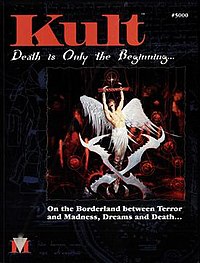
Setting Mashup Source #3: Kult
Kult was an RPG I played in, but never had the courage to run (and I mean that on multiple levels).
Aside from resonating with the whole 'reality is a prison' vibe that we'd also get from Code: Black, there's something else I'd take from this: our world is an Illusion -- and reality is trying to break through it.
The slow appearance of cities in our world is the effect of the real world -- the city known as Metropolis -- slowly making its way into ours.
One can imagine in D&D how all these city crawls can give us glimpses into the many facets of this primal city archetype, and how the twisted humans and creatures and monsters that infest some of the biggest fantasy cities and somehow urge these cities to grow larger is evidence of Metropolis attempting to escape from the prison. If this twisted city of "heaven" or its many facets is doing this to the cities, what are all these dungeons?
The sewers, the under city, the "hell" of metropolis is also trying to manifest itself on the wild natural landscape of the world.
Another page that can be taken from this: the Archangels and their evil counterparts all have the equivalent of avatars ensconced in various places of power and are taking control of the world for good or for ill -- kind of how pantheons of gods manipulate humans for their own ends. The entire backstory of creation, gods and the missing Demiurge can provide the foundations for the watered down and contradictory version of 'religion' known to low-level dungeon crawlers.
Okay, enough with sources dealing with creation myth, reality and its underpinnings. Time to move on to the world that PCs deal with on a daily basis.
Aside from resonating with the whole 'reality is a prison' vibe that we'd also get from Code: Black, there's something else I'd take from this: our world is an Illusion -- and reality is trying to break through it.
The slow appearance of cities in our world is the effect of the real world -- the city known as Metropolis -- slowly making its way into ours.
One can imagine in D&D how all these city crawls can give us glimpses into the many facets of this primal city archetype, and how the twisted humans and creatures and monsters that infest some of the biggest fantasy cities and somehow urge these cities to grow larger is evidence of Metropolis attempting to escape from the prison. If this twisted city of "heaven" or its many facets is doing this to the cities, what are all these dungeons?
The sewers, the under city, the "hell" of metropolis is also trying to manifest itself on the wild natural landscape of the world.
Another page that can be taken from this: the Archangels and their evil counterparts all have the equivalent of avatars ensconced in various places of power and are taking control of the world for good or for ill -- kind of how pantheons of gods manipulate humans for their own ends. The entire backstory of creation, gods and the missing Demiurge can provide the foundations for the watered down and contradictory version of 'religion' known to low-level dungeon crawlers.
Okay, enough with sources dealing with creation myth, reality and its underpinnings. Time to move on to the world that PCs deal with on a daily basis.
Tuesday, March 2, 2010
Mining Mystara #1 - The Shearing
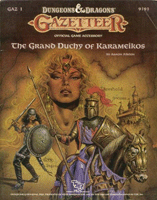
There have been many reviews of GAZ1 - The Grand Duchy of Karameikos. This isn't one of them.
Instead, this is the first in a series of short articles on the little things that I liked about the Karameikos setting that made it perfect for a first-time GM's D&D campaign.
Background
The Grand Duchy of Karameikos was once considered a useless part of the Thyatian empire, and the native human races -- the Traladarans -- were just fine with that. When Duke Stefan Karameikos entered into a little-known agreement with his friend the Thyatian emperor, he effectively got this entire land as his own kingdom, but being sneaky, named it as a Grand Duchy so he still enjoyed the perception of being part of the Thyatian Empire.
The Traladarans were less than thrilled about the sudden seriousness of the Thyatian invaders, and revolts were sparked. Karameikos is now more or less stable, but unrest still simmers.
The Shearing
This Traladaran custom -- which was adopted enthusiastically by the Grand Duke -- involves "shearing" children when they come of age. They are given a small amount of money and gear (this is the initial money they get from character creation) and are officially detached from their families and their claims of inheritance. They take on new names, go out to find their fortune, and can only return when they have made something of themselves, and are then welcomed once again into their family.
Some apprentice themselves to master craftsmen, others learn new skills and try out new careers, and others become adventurers.
The Grand Duke saw it as a way to get rid of the "dead weight" of younger nobility that had followed him, even going as far as having his children go through it.
Using the Shearing
Not only is this a good rationale for having young folks who would otherwise be farmers or craftsmen suddenly deciding to take on a life of adventuring -- it's also a great justification for the sometimes flippant names that people adopt for their characters (like Vulgar McKickface or Bob).
Adventuring parties could then arguably be a mix of the wealthy Traladaran merchant offspring, rich Thyatian nobility, and other human of more humble origin.
Furthermore, despite the public 'disowning' of the sheared, nobility that is important enough would likely become targets for unscrupulous individuals hoping for a ransom. In fact this was a potential plot element for the Duke's youngest son, who had just reached 'shear-able' age.
Instead, this is the first in a series of short articles on the little things that I liked about the Karameikos setting that made it perfect for a first-time GM's D&D campaign.
Background
The Grand Duchy of Karameikos was once considered a useless part of the Thyatian empire, and the native human races -- the Traladarans -- were just fine with that. When Duke Stefan Karameikos entered into a little-known agreement with his friend the Thyatian emperor, he effectively got this entire land as his own kingdom, but being sneaky, named it as a Grand Duchy so he still enjoyed the perception of being part of the Thyatian Empire.
The Traladarans were less than thrilled about the sudden seriousness of the Thyatian invaders, and revolts were sparked. Karameikos is now more or less stable, but unrest still simmers.
The Shearing
This Traladaran custom -- which was adopted enthusiastically by the Grand Duke -- involves "shearing" children when they come of age. They are given a small amount of money and gear (this is the initial money they get from character creation) and are officially detached from their families and their claims of inheritance. They take on new names, go out to find their fortune, and can only return when they have made something of themselves, and are then welcomed once again into their family.
Some apprentice themselves to master craftsmen, others learn new skills and try out new careers, and others become adventurers.
The Grand Duke saw it as a way to get rid of the "dead weight" of younger nobility that had followed him, even going as far as having his children go through it.
Using the Shearing
Not only is this a good rationale for having young folks who would otherwise be farmers or craftsmen suddenly deciding to take on a life of adventuring -- it's also a great justification for the sometimes flippant names that people adopt for their characters (like Vulgar McKickface or Bob).
Furthermore, despite the public 'disowning' of the sheared, nobility that is important enough would likely become targets for unscrupulous individuals hoping for a ransom. In fact this was a potential plot element for the Duke's youngest son, who had just reached 'shear-able' age.
Subscribe to:
Posts (Atom)