Showing posts with label Setting: Hero Universe. Show all posts

Wednesday, May 23, 2012

Setting Expeditions: The Hero Universe, Part VI -- The Future

At last, we're in the future eras of the Hero Universe. The past five installments can be found here...

Setting Expeditions: The Hero Universe, Part I -- Pre-Cataclysm
Setting Expeditions: The Hero Universe, Part II -- Post-Cataclysm to the Medieval Era
Setting Expeditions: The Hero Universe, Part III -- Musketeers, Pirates, and Revolutions
Setting Expeditions: The Hero Universe, Part IV -- Cowboys and Victorians 
Setting Expeditions: The Hero Universe, Part V -- Mystery Men and Super-heroes

The future itself is open ended; plenty of space to insert your own side timeline or slap something beyond the last era. Like a Fading Suns-ish setting, for example.

Anyway, here we go:

Cyber Hero (2020 to 2080)

The rise of pervasive computer technology, genetic engineering, and increasing political factionalism and splintering (including terrorism) lead to constant struggles for power over this new world order. Techno-anarchists, vigilantes, eco-terrorists, rogue capitalists, and others fight against the domination of the major forces in society, governments and mega-corporations.

During this period, mankind builds its first tentative manned orbital and lunar colonies, and sends explorers to Mars. But for the most part the eyes of men are not cast up toward the stars, but downward into the squalid urban settings where the vast majority of them live, or “outward” into the glittering neon pseudoworld of the CyberNet. Superheroes and superpowers no longer play any role, having died off or faded away.

Cyberpunk style, but with a heroic bent, as vigilante-style heroes with attitude fight back against the forces that threaten to plunge the world into darkness.

Notes: It's really easy to mine almost all the cyberpunk and lower-level transhumanist materials out there for this genre. In fact, for the more Akira and Ghost in the Shell-inspired dystopian future, there's an excellent sourcebook from Blackwyrm Games: Kazei 5 by Michael Surbrook.

Solar Hero (2080 to 2200)

Humans make their first true journeys away from their birthplace. They explore their solar system, establishing colonies and exploiting the heavens for commercial gain. Relatively cheap space travel has a huge impact on society. Cut off from the mainstream of human civilization, colonies and outposts sometimes become lawless places, with reports of slave labor in the asteroid belts. Countries and corporations wage an undeclared war over the resources of the system, and many new political entities appear. An alien invasion in 2153 throws all of this into even deeper turmoil.

By this point Earth has saved itself from the potential societal collapse hinted at in Cyber Hero. Solar Hero is a hard SF/low SF setting limited to our solar system, with perhaps tentative, slower-than light (sleeper ships, generation ships, and the like) journeys to nearby systems, (e.g., Alpha Centauri). Who knows what mysteries may lurk, hidden on the planets so close to us, and yet so far away?


Notes: Folks unfamiliar with this genre of SF might think that the solar system is a small place to adventure in. Not so! A great example of such a (surprisingly Hard SF) setting from another publisher is Jovian Chronicles by DreamPod 9. Yes, it does feature giant mechs warring against one another -- more Gundam than Mechwarrior though.

Interstellar Era (2200 to 2300)

Human existence is revolutionized by the discovery of FTL travel (or perhaps enterprising humans swipe it from the defeated alien invaders of Solar Hero). At first FTL drives aren’t much faster than 1 light-year per year, but they improve slowly and steadily. Military and commercial vessels tasked with exploration spread out through the stars within 200 light-years of Earth.

Independent traders seek to bring back the wealth of the stars as adventurous colonists try to establish new homes on strange worlds. Humanity encounters many alien species.

Notes: The default FTL travel used seems far removed from the Jumpgate-based SF like Babylon 5, and more like Star Trek: Enterprise. Or even Firefly. Just sayin'.

Alien Wars (2300 to 2400)

Mankind engages in its first interstellar war with an implacably hostile species, the insectoid/reptiloid Xenovores. Powered armor, starship battles, and bizarre alien tactics and technology take center stage as the vicious Xenovores try to exterminate humanity. The war rages for a century throughout human and Xenovore space, throwing mankind into turmoil and shattering his sphere of control into many individual worlds (or small confederations of worlds) that have little or no contact with Earth -- and soon don’t feel beholden to it anymore.

Note: think Starship Troopers meets Aliens. But with other alien races around as well.

The Terran Empire (2400 to 2700)

Nope, this isn't available anymore.
In the wake of the costly defeat (but not utter destruction) of the Xenovores, militarists struggle for control over Humanspace after Earth’s attempt to re-assert its control fails in the face of determined independence movements in many Human worlds and systems. After decades of struggle, Admiral Marissa DeValiere establishes the Terran Empire, which the House of DeValiere rules for the next 250 years. Forged from the bits and pieces of Humanspace, and soon including various conquered or allied alien races, the Empire is a political juggernaut, wielding influence throughout the Milky Way Galaxy.

The Terran Empire setting features a multitude of adventuring possibilities: political intrigue, rebellions against the Empire’s authority, military action against alien enemies or targets of conquest, galactic power struggles with alien empires, expanding the boundaries of Human knowledge via exploration and trade, and many more.

Note: this has a feel of Traveller, with a touch of the Star Wars Old Republic. It is an Empire that will fragment, but has a good run.

The Galactic Federation (2700 to at least 3000, perhaps beyond)

After decades of worsening political unrest beginning about 2660, the Empire falls in 2702, leading to thirty years of instability, warlordism, and troubles. Eventually, led by charismatic diplomats and scientists, most of humanity (and some alien species) comes together to form the Galactic Federation of Free Worlds. Based on free trade, democracy, and federalism, it rebuilds, then blossoms and expands for centuries.

Note: this is more like the Federation of Star Trek, and perhaps a bit more of the Old Republic of Star Wars. The instability era could be likened to Farscape in feel.

Galactic Champions (3000)

As magic once again subtly waxes, superhumans (and super-beings from other species) arise throughout the galaxy. Superheroes and starships fight planet-shattering battles to preserve the future of sapient life in the galaxy against a myriad of terrifying threats. Civilization breaks down in a few places where magic becomes so strong that technology becomes unreliable.

Note: this so Legion of Super-Heroes, honestly. I love it. Especially because the default setting brings back its equivalent of Ultron into the high-tech far future. And all this talk of magic bring to mind the Magic Wars that erupted at the end of the original LSH series. No, they never really fought Magneto, but mutants would rationalize why so many humans suddenly developed powers to deal with the difficulties of their respective planets.

Beyond 3000

The possibilities are endless!

Note: Yep, Fading Suns and probably something Transhumanist like Eclipse Phase.

Sunday, April 22, 2012

Setting Expeditions: The Hero Universe, Part V -- Superheroes

This two-part graphic novel, along with
the Wold Newton work, helped me
understand the allure of an all-in-one
universe setting.
Here we at the true origins of Hero Universe -- the super-heroic era! After all, the Hero System got its start in a super-hero RPG: Champions. The past four installments can be found here...

Setting Expeditions: The Hero Universe, Part I -- Pre-Cataclysm
Setting Expeditions: The Hero Universe, Part II -- Post-Cataclysm to the Medieval Era
Setting Expeditions: The Hero Universe, Part III -- Musketeers, Pirates, and Revolutions
Setting Expeditions: The Hero Universe, Part IV -- Cowboys and Victorians 

... and when you look at it now, you can see how much of those prior eras were approached with a view toward being able to present them in a pastiche-y, superhero comic universe. It is very much like the ground breaking History of the DC Universe book by Wolfman & Perez. In terms of presentation, it solidified the entire universe visually for me, as it was all done by Perez, and in terms of breaking down the times and places for all the heroes in their universe, it gave me a solid handle on the time periods and the heroes and villains in each without overwhelming me with too much detail.

And now, as Super-Grover once said: "Yes, on to our story!"

THE MODERN ERA (1910-2020)

Pulp Hero (1920-1940)

The era of the great pulp adventure stories (and the gangster fighting Prohibition era). Masked adventurers, more commonly known as “mystery men,” abound, and the first true "superhumans” manifest toward the end of this period. However, talented humans and driven adventurers constantly embroiled in mysteries and adventures are a staple of this era as well.

Notes: Mystery, adventure, crime fighting, the occult, science fiction, and more. For influence and inspiration, think Indiana Jones, the Shadow, Doc Savage, the Spider, the Avenger, H. P. Lovecraft, and the other great heroes and stories of the pulp magazines. One can also look at the many pulp era RPGs for inspiration, as well as Justice Inc., the original Hero Games pulp era RPG.

Golden Age Champions (1939 to 1945)

One of the two settings that takes place during WWII, this one focuses on the “Golden Age” superheroes helping to fight World War II and stop Hitler.


Notes: This era is brightly-colored, (mostly) lower powered heroes, or normally powered with some crippling weaknesses to common items -- the original Green Lantern had a weakness to wood, for example. They are highly patriotic and noticeably non-politically correct at times, but their hearts are usually in the right place.

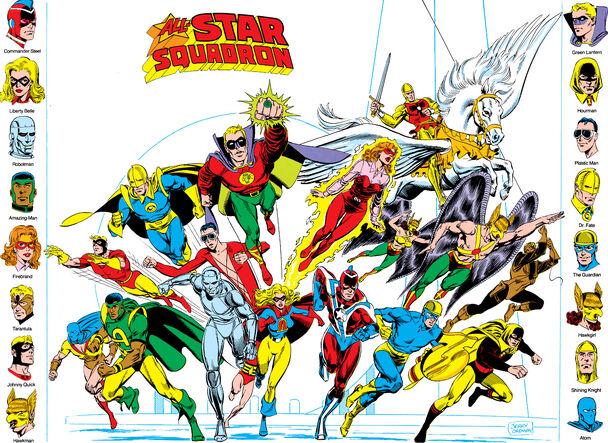
For the comics-savvy, this is the place to throw your All Star Squadron, your Invaders, your Liberty Legion, your Justice Society of America. This is the place to create reasons as to why Superman and Captain America and Dr. Fate and the Spectre don't just walk over to the enemies of the Allies and end the gosh-darned war.

War Hero (1939 to 1945)

The second WWII setting, this one focuses on military and espionage action set against the romantic/horrific backdrop of World War II.


Notes: Think Rat Patrol, Kelly’s Heroes, Saving Private Ryan, Schindler’s List. Think Band of Brothers and Sgt. Rock, the Dirty Dozen and the Howling Commandos. You can even toss in things like the Creature Commandos and G.I. Robot for a real Weird War feel.

Danger International (1950 to 1990)

A classic line.
This is the setting for the turbulent, intrigue- and action-filled post-World War II era. Espionage set in the era of the Cold War, the rise of international terrorism, industrial espionage, conspiracies, drug lords, police action adventure, mercenary activities, detectives, and so on.

Note: Think Dangerman and James Bond and The Man from U.N.C.L.E. and I Spy and Mission: Impossible and even The Prisoner. Think Challengers of the Unknown and Task Force X. Think of Mack Bolan and The Destroyer.

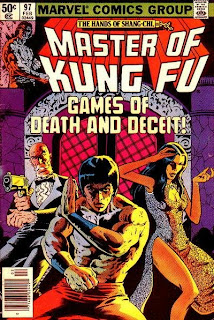
One could even make a case for Shang-Chi: Master of Kung-Fu as being part of this genre (considering he rubbed elbows with Clive Reston), and perhaps even Richard Dragon.

Pulling from other media, you can look at a lot of the martial arts flicks set not in the past, but in the modern era.


Silver Age Champions (1965 to 1980)

Superheroes at the dawn of the modern age of comics -- optimistic and bright in general, but with social awareness and responsibility creeping into the tales.

There's an explosion of ideas here, stretching beyond the initial pulp roots and early mystery men roots, and fully embracing and integrating sources from science fiction, fantasy, horror, and everything in between. The full flowering of the potential of superhero comics starts here.

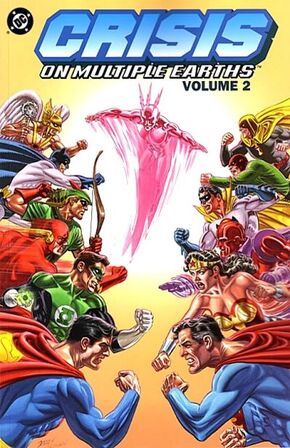
Notes: There are many arguments over the definition of Golden Age & Silver Age in comics. You can certainly think of the style of early Stan Lee/Steve Ditko, Jack Kirby, and the like. Many comic book history articles and books have been written tackling this era, and many RPG sourcebooks have been done here as well. This is when the concept of a shared, consistent universe began to take shape and solidify, with continuity cops making sure that few contradictions across universes would emerge. For DC, the multiple earths solution arose here, to distinguish between Golden Age heroes and Silver Age heroes with the same secret identities (Superman/Clark Kent, Wonder Woman/Diana Prince, Batman/Bruce Wayne).

Dark Champions (1985 to 2020)

Modern-day cities as an urban battleground between ruthless, heavily-armed criminals who prey upon the innocent and the equally heavily-armed vigilantes determined to stop them. It features no “true” superhumans such as seen in Champions, but some low-powered quasi-superhumans with various powers and abilities that contribute to the feel and flavor of the setting.

Notes: one can think of this as a street-level sort of heroic setting. Martial arts, guns, and gadgets abound. The Punisher, Wild Dog, and The Butcher would be at home here.

Champions (1980 to 2020)

This setting tackles superheroes in the modern-day world. You can include the modern incarnations of all superheroes during this time period, including all the crazy status quo altering / revising / resetting crossovers. You can tackle the grim-and-gritty explosion of WildDarkBloodClawBladeShot named heroes in this era, straddling the line between vigilantism and outright criminal activity, as well as the call for more relevant heroism to return to comics.

At the end of this period, superhumans fade from the scene for centuries due to the concomitant fading of magic (meaning that accidents and discoveries which once created superhumans now have purely mundane outcomes).

Note: A huge volume of material to cover in such short span of time in human history, but with a wealth material to draw from. This is meant to be the modern day superheroic setting, and as such demands a superheroic universe that is relevant to modern technology, socio-political concerns and cultural mores, as well as to the source material itself. For time-traveling heroes, this is often the default time period that they travel from.

Next: the Future

Monday, April 9, 2012

Setting Expeditions: The Hero Universe, Part IV -- Cowboys and Victorians

So, here we are just about to hit the modern era of the Hero Universe. The past three installments can be found here...

Setting Expeditions: The Hero Universe, Part I -- Pre-Cataclysm
Setting Expeditions: The Hero Universe, Part II -- Post-Cataclysm to the Medieval Era
Setting Expeditions: The Hero Universe, Part III -- Musketeers, Pirates, and Revolutions

... and we still have quite a ways to go. No time to dawdle then! On to Leagues of Extraordinary Gentlepersons and Blazing Saddles!

Victorian Hero (1837 to 1910)
A page from Bernie Wrightson's awe-inspiring masterwork: Frankenstein.
His linework and visual interpretation of the novel goes a long way to
evoking the feel of the era and the story. The resoluteness of Frankenstein
and the power and savage strength of his monster are so vivid here.

A fine time for adventures, beginning with Queen Victoria’s ascension to the throne and the invention of the cartridge. Encompasses great explorations, gold rushes, frontiers, the American Civil War, lost lands, darkest Africa, strange forbidden magics, Frankenstein, the Mummy, Dracula, Fu Manchu, Sherlock Holmes, Captain Nemo, and more. Hudson City is a hustling, bustling center of commerce and culture, second only to New York City in the Americas.

As yet, no “superheroes” exist, but there are “masked adventurers” from time to time, and many more who are not masked. Toward the end of this period some people begin to verge, albeit slightly, toward true “superpowers”; this is best seen in Hawley Griffith, the so-called “Invisible Man,” and Dr. Jekyll. The presence of “steampunk” weird science is also possible.

For influence and ideas, see the works of Haggard, Doyle, Verne, Stoker, and Wells.


Note: This era has blossomed into many different types of genre variants and pastiches for gaming. In addition to Steampunk and Faeriepunk (Castle Falkenstein, I'm looking at you), Alan Moore's League of Extraordinary Gentlemen graphic novels really opened the eyes of many people to the wonders of adventuring in a world where elements of fiction set in the era are/were true. Of course, fans of the work of Jules Verne were sold on the idea long before.

Western Hero (1866 to 1890)

The Wild West, an era of gunfighters, Indians, lawmen, outlaws, gamblers, saloon gals, and trains. Some magical or strange elements — shamanic magic, steampunk science, vampires — could also exist.

I was never able to collect all the graphic novels of Lucky Luke, unlike my Tintin and Asterix collections.
But the man who shoots faster than his own shadow has a certain charm that I wish I'd been able to complete.


Note: well, heck. This is a genre that also has tons of source material for it in various media. My fascination for it on this blog has tackled Western RPGs, an ongoing weird west comic known as The Sixth Gun, and my strangely popular post on a seminal Filipino Western movie. Like many of the eras in the timeline, this era deserves a sourcebook on its own -- and this is the strength of the Hero Universe: the ability to provide a broad canvas for nearly of all the heroic eras in a single timeline.

Saturday, April 7, 2012

Setting Expeditions: The Hero Universe, Part III -- Musketeers, Pirates, and Revolutions

Carrying on my journey through the mega-setting of the Hero Universe, here's the next segment!

Termed the Early Modern Period, this era ranges from 1500 to 1800, an age familiar to heroic literature fans -- a time of swordplay, gunpowder, and dazzling heroics to gritty life-and-death showdowns.

Swashbuckling Hero (1500 to 1650)

Also known as “Age of Reason Hero” this is the era of the Three Musketeers, and of exploration of the rest of the world by Europeans. By this time magic has largely faded away, especially in “civilized” areas, and is rarely encountered by anyone.

Try the Captain Alatriste novels for a gritty and textured world
of Spanish swashbuckling adventure!
Note: One of the axioms mentioned early on in the document, which I've skipped over, is the rationalization of the ebb and rise of magic and superheroics as a sort of rise and fall of 'the background magic level in the universe'. As word choice and objective correlatives go, it is not my own preference, but I understood the rationale's essence. I myself would posit a different approach, will retaining the core premise.

Pirate Hero (1650 to 1750)
Not DC's Captain Blood, nor the movie,
nor the novel. A newer comic series.

The era of Blackbeard, Captain Kidd, Treasure Island, and maritime deviltry on the Spanish Main. Pirates and privateers aplenty can be set in this era, and -- despite the loss of magic in 'civilized eras' much of that magic can be place in the mysterious seas of the world and certainly in mystical and mythical places in pirate lore -- ala Pirates of the Carribean.


Note: There's a lot of pirate source material to draw on for adventures here, particularly given the popularity of recent film franchises mentioned above.

In addition, DC Comics itself had a fair amount of pirate action in its older incarnations (like Captain Blood and Jon Valor, the Black Pirate), and recently had a pirate Batman when he was a timelost mythic figure in one of Grant Morrison's storytelling escapades.

Revolutionary Hero (1770 to 1799)

The time of America in the era of the Revolutionary War. Unlike a lot of other settings and comic book universes, the Hero Universe establishes this as the era of the very earliest “masked adventurers” ever seen in America. It is also the era of the Exploration of the Americas, the French Revolution and, later, Napoleon.

Black Mask, the Hero Universe's first
masked adventurer in the Americas, and
founder of a long heroic dynasty.

Note: this is also an era that is rich with mysticism, natural philosophy, secret societies, and encounters with the various Native American tribes and their own myths and views of the world. Again, DC Comics had a number of comics characters set in this era, and regularly have modern heroes thrown back in time to encounter them.

Friday, March 30, 2012

Setting Expeditions: The Hero Universe, Part II -- Post-Cataclysm to the Medieval Era

As I mentioned in Part I, the Hero Universe meta-setting is one of the most kitchen sinky of kitchen sink settings, spanning pre-historic past to the far future, and all the spaces in between. Again, most of this text comes from the PDF found in the link above, and is available for free from their site. Just a bit of editing and rewriting was done on my part.

Part I tackled all the Pre-Cataclysm eras and ages. Part II tackles the setting from the Cataclysm through the Medieval Era.

The Cataclysm (~30,000 B.C.)


In this extinction-level event, the lands of the Atlantean Age are shattered, or sink beneath the waves, destroying virtually all traces of the pre-Cataclysm civilization. Due to one last heroic act by Emperor Vondarian, the few survivors of the Cataclysm gain the ability to breathe underwater and found the underwater realm of Atlantis.

Several other hidden kingdoms manage to survive somehow up until the modern era.

Note: In addition to ending the existence of most of the fantasy races and creatures that existed in the prior era, this even also manages to re-arrange the world into a more recognizable map. However, I do find the extinction of races interesting -- this is where ridiculously powerful and advanced races that could have given humanity a run for dominance of the planet get caught off-guard and are weakened or wiped out. It also helps establish the scope of humanity's capacity for destruction.

The World of Tuala Morn (28,000 BC TO 20,000 BC)

When the waves recede, new landmasses and new civilizations -- mostly predecessors of those to come -- arise, such as the quasi-Irish Celtic land of Tuala Morn, the quasi-Arthurian land of Logres, the quasi-Meosamerican Taloctec lands, and so forth. But the lands are unstable, and after eight thousand years collapse back beneath the waves.

The Age of Legends (20,000 BC TO 11,000 BC)

Once again, new continents arise in the forms known to us in the modern age (although most of North Africa is forest and savannah rather than desert). After a few thousand years of Stone Age level technology, some civilizations -- whose influence is later seen during historic times -- arise in this period.

Note: Great cities are built in South America, Africa, and Asia, as well as in Europe and Australia, with each culture or civilization a sort of “fantasized” version of what appears later. Toward the end of this period these civilizations all collapse, leaving the stage empty for later ones. See Philip Jose Farmer’s “Hadon of Ancient Opar” for a good example of what this could be like, or Wilbur Smith’s “The Sunbird,” or Charles Saunders’s “Imaro” series.

The Classical Age (10,000 BC TO 400 AD)

This age is broken up into two major segments.

The Age of Heroes spans from 10,000 BC to 200 BC. In this era of civilization, Ancient Egypt arises along with Mycenae, Crete, and Sumeria -- but Greece is the dominant culture near the end of the
era. Many believe in magic, but it is rarely seen in action (at least, not by everyday folk!). The era of Greek, Norse, etc. mythology, when gods, demigods, and mortals mingle on Earth. The decline of Greece and the rise of the Roman empire marks the end of this age.

The Roman Empire ranges from 200 BC to 400 AD. In this era,  the Roman Empire conquers much of the known world during this period; great civilizations also flourish in China and the Americas. For the most part, the pragmatic Romans disbelieve in magic, as the gradual decline of mystical forces makes true spellcasters increasingly uncommon (though magic remains stronger in some corners of the world far from Rome).

Note: A lot of the classical elements that have found their way into the modern fantasy genres (and in fact the foundations of western theater and storytelling) come from this age. Sword and sandal adventures abound here, and the full flowering of some of the most well-known mythologies are ready for use in this age.

The Medieval Age (400 AD TO 1500)

This is also broken up into two major sub-ages -- Arthurian Hero and Fantasy Europe.

Arthurian Hero takes place from 400 AD to 900 AD, and is a time of Merlin-esque magics,
the faerie folk, and adventure around the world. It focuses on a Fantasy Europe, a dark/low sort of fantasy set in the Celtic/Arthurian Age (with, of course, anachronisms like plate armor as necessary for fl avor). Europe is a wilderness with pockets of civilization here and there. The wilds are dangerous, home to dragons, trolls, and fierce beasts.

Notes: The “Bard” series by Keith Taylor, Celtic myths, Arthurian legends, and Norse sagas are excellent resources for this sub-age.

Fantasy Europe takes place from 900 to 1500 AD, and is the classic period of medieval adventure when magic briefly surges upward in power again before continuing its swift decline during the
Renaissance. Knights in shining armor, powerful yet fairly rare sorcery. High adventure in a “fantasy medieval Europe” where magic exists, knights in shining armor slay dragons, and only the power of
the Church keeps demonic minions at bay.

Notes: Adventures in fantastic realms (such as Lyonesse, Hybrasil, and Antillia) are possible during this time, but they eventually sink or pass into the Land of Legends as magic diminishes or magical disasters occur. This is also the time that many mystical creatures and races like the Fair Folk begin their transitions into other realms, whose doors become increasingly more difficult to open. Furthermore, there is a spate of monster slaying in this era, which eradicates many creatures of magic.


Next Up: The Modern Eras of the Hero Universe

Sunday, March 25, 2012

Setting Expeditions: The Hero Universe, Part I -- Pre-Cataclysm

In one of the most kitchen sinky of kitchen sink settings, the Hero Universe meta-setting lays claim to a single setting from the pre-historic past to the far future, and all the spaces in between. The link above is to a free six-page PDF that was released around the time of the 5th Edition ruleset, so it's been around a while.

Naturally, it's not going to give you anything other than the broad strokes of the meta-setting, and in fact some of the settings were fleshed out in separate (not-free) setting books from HERO Games.

Overall, it reminds me of three things: The History of the DC Universe which was published after the seminal Crisis on Infinite Earths maxi-series, the Planetary comics series by Warren Ellis and John Cassaday, and the Wold Newton Universe which grew out of Philip Jose Farmer's ingenious attempts to tie all manner of pulp heroes (and villains) into a single history and set of families.

The reasons it does this include: to create a massive backdrop against which Heroic and Super-heroic adventures may be played; to allow spaces in the timeline in which the various genres and sub-genres that super-heroic fiction might be played; to create rationale for bringing various NPCs and organizations backwards and forwards in the timeline.

Before I talk about the pros and cons of the approach, let me give you a taste of the various time periods (and descriptions + inspirations of each) tackled in the document. Much of it is taken from the PDF itself, though trimmed, edited and annotated by yours truly.

But let's start off with the era that seems most friendly to the type of settings found in OSR adventures -- the fantasy genre-friendly era:

The Pre-Cataclysm Period

The Pre-Cataclysm Period is an age of civilization prior to the recorded history of mankind. For flavor, think Robert E. Howard, Clark Ashton Smith, Jack Vance, Lord Dunsany, Michael Moorcock, Lin Carter, and the like.

Fantasy Primeval (100,000 TO 75,000 BC)

The first civilizations of men other sentient races -- such as Dwarves and Elves -- arise. Initially, many of the dreaded Elder Races control much of the planet, and dominate most of the races of men either directly or through fear, but are in decline, gradually leaving Earth after warring with each other for millennia.

The gods evolve, and many walk the Earth, using humans as pawns in their interminable wars with each other. At long last, the wars of the gods come to a head, and in a tremendous clash they break the world. Realizing they could destroy themselves by destroying their worshipers, the gods depart Earth for other dimensions, leaving the planet to settle down and the few surviving humans to rebuild their shattered civilizations.

Note: One might consider this very similar to the Runequest setting, where magics constantly shape the world, physics are just as valid in terms of world rules as arcana, and where battles of gods ensnare the lives of mortals.

Turakian Age (73,000 to 65,000 BC)

An age defined by the rise and fall of Kal-Turak, Ravager of Men, from whom this period takes its name. It ends with the overthrow of Kal-Turak at the hands of all the free peoples of the world, in a magical cataclysm that once again re-shapes the world.

Note: Kal-Turak acts much like a campaign's uber-baddie, kind of a Vecna meets Invincible Overlord meets Darkseid, and gets to return in various forms and guises in future ages of the timeline.

Valdorian Age (50,000 BC TO 33,000 BC)

The Valdorian Age -- named after a Hero Universe fantasy empire founded by its hero-king Valdor -- is a classic sword-and-sorcery style fantasy setting in the mode of Howard or Moorcock. Mankind remains the dominant race on the planet; other races go into decline (many apparently vanish). Fantastic creatures of all descriptions are found on the Earth (some remnants of the Primeval age, others newly arisen). The gods still exert a strong influence on the Earth through gateways, priests, and avatars.

Note: This age seems friendliest to a Conan-like campaign, or an Elric-like campaign, or a Fafhrd and the Grey Mouser campaign depending on where you adventure and how you arrange your nations and states.

Atlantean Age (32,000 TO ~30,000 BC)

Toward the end of the Valdorian Age, a new empire, the Dominion of Atlantis, arose. Based on an ancient island (of the same name) of great mystical power, Atlantis soon came to dominate most of the world. Around 30,500 BC, Dalsith, son of the rebellious warrior-king and sorcerer Cormar the Mighty, sacrificed his soul to the Kings of Edom for great mystical power and became Sharna-Gorak the Destroyer, Vondarien’s greatest enemy. The clash between Sharna-Gorak and the forces of Atlantis shook the earth, eventually sinking continents, toppling mountain ranges, and creating a great flood -- the Cataclysm.

Note: The Atlantean Age is a overpowered high fantasy campaign setting, where magic can push the power ratings to super-heroic levels. It has an eclectic cultural mix that is reminiscent of Barsoom or Jack Vance’s Dying Earth or perhaps even the Final Fantasy series of video games.

The Cataclysm

This takes place around ~30,000 B.C. and it changes the world yet again. It destroyed almost all traces of civilization prior to this time. The survivors were thrown back to Stone Age technology and magic.

Note: the function of the Cataclysm is meant to handwave all this hoo-hah about no evidence existing concerning pretty much everything that happened prior. There will be stories and accounts that might survive to the present day, but since terrible physical and magical energies laid waste to everything, what puny evidence might be found is inconclusive and certainly insufficient to draw any inference about the majestic histories that were wiped from memory.

Saturday, March 24, 2012

NPC Heroes: Elemental Champions

Alena
Title: Torrent Rider
Element: Water
Points: 300 + 150
Amihan
Title: Jetstream Juggernaut
Element: Air
Points: 300 + 150
Danaya
Title: Stonewood Savant
Element: Earth
Points: 300 + 150
Pirena
Title: Firestorm Magus
Element: Fire
Points: 300 + 150