Showing posts with label system: Gumshoe. Show all posts

Wednesday, November 18, 2015

Let's Read: The Dracula Dossier (Operation Edom: Eyes Only Briefing)

After the Foreword and the biblical quote referring to Lillith and Edom, we run into a short, succinct inciting incident for the whole campaign:

"In 1893, a visionary British Naval Intelligence Department spymaster codenamed 'Peter Hawkins' launched a plan to recruit the perfect spy: a vampire."

I can already see the scene with the crew, hunted by vampires and their thralls, knee-deep in sorting out warring conspiracies, then having this little nugget of info dropped in their laps. Cue the swearing, shaking of heads, and sarcastic revisitings of the ironic phrase: "What could possibly go wrong?"

And then, we're treated to a two page summary of what has happened as a result of the green lighting of that audacious, perilous decision from 1893 to the present. It is at this point that I run into one of my weaknesses -- dates and timelines.

A naked year or date often makes my mind go blank, unless I get lucky (or someone helpfully tosses out a name, incident, or location), as I scramble to establish the context. Fortunately, as I went through the general broad eras of the campaign, there were helpful labels that I kept in mind as I read the overviews of multiple generations of operatives somehow continuously thinking that the inciting incident above idea was a good one, and might just need some tweaking to make it work this time.

So, to my mind, the eras were:

  • Classic Dracula (actual book subtitle: Bold Experiments)
  • World War II (actual book subtitle: Desperate Measures)
  • The Cold War (actual book subtitle: Hidden Hunts)
  • Modern Day (actual book subtitle: Black Assets)

One thing that also made it difficult to follow, my date / timeline weakness notwithstanding, was the necessary vagueness regarding key events during these eras. Since the actual events and conspiracies will be filled up in the conspyramid as the sandbox investigative campaign moves on, most of the unfolding events in the summaries were done on broad strokes, to leave space for the players and the Director to play in.

Reactions to Classic Dracula


"A meet was set and made, a safe house and a headquarters in England prepared. Then it all started to go wrong."

This is the one I'm most comfortable with, as it's the type of stuff I expected from the main premise -- the novel Dracula being a sanitised version of the original after-action report of the failed op. Some historically resonant names and links to Bram Stoker. I do like the references to earthquakes coinciding with vampiric power, even if I'm not so sold on telluric vampires yet.

It seems to me that part of the joy of playing in, or uncovering the events in this era would stem primarily on how the true events diverged from the fictional account.

Reactions to World War II


"Rather than bring Dracula to England, however, this time the plan was simply to let him out and turn him against the Hitler-allied Antonescu government — if necessary, to back him as Romania’s new leader."

Quite on board with using Dracula in time of desperate need for Britain, when it was alone in Europe against the rising tide of expansionist warfare. However, my lack of knowledge in the lesser known theatres of war during WWII make it hard for me to envision what happened here, beyond the generic SNAFU labels and Murphy's Law invocations. (Note: read up on Antonescu and Romania in World War II).

At this point, tempting as a Dirty Dozen meets Castle Dracula exploit might be, this seems to be more of an interesting era to uncover clues, history, and trace how certain artifacts found their way into the hands of modern operators. It's the closest era, of course, to the original Edom operation -- and many innovations in modern espionage have their birth during this time.

Or perhaps one of the capstones at the end can serve as a climactic ending for this era?

(Aside: funny, I'm getting a hint of a Blackadder vibe to each era as a season. The same souls drawn back into each era as Dracula re-emerges to further his plans?)

Reactions to The Cold War


"Edom needed to find Dracula’s leavebehind network in London — after all, the analysts realized in retrospect, he had had months to build it back in 1894, and the power to keep it alive long after his seeming demise."

The closest era to modern day, and the classic espionage era (James Bond, I-Spy, The Man from U.N.C.L.E., George Smiley, and a certain novel known as Declare). And while Edom was certainly questionable from the beginning, the background of this era -- with mole hunts and double agents and defections and betrayals -- makes it very inviting to run. Of course, my relative ignorance beyond cinematic tradecraft would hamstring me a bit, but for me this is the quintessential Government Spies vs. Vampires period. It should be noted that I have memories of a vampire in a Starsky & Hutch episode, so even a U.S. interlude or two wouldn't be out of place.

At this point, however, the campaign seems very daunting. Starting from the modern era and working backwards seems like more of a challenge than the chronological play-through -- but then, how would the actual Dracula Dossier artefact be used?

Then again, since I'm barely into the book, I'm sure that these questions and more are addressed later.

Reactions to Modern Day


"She began to keep her own record, annotating the Dossier as her predecessors had. She gave herself the workname “Hopkins” as she annotated the bloody fingerprints of Edom — and the trail of corpses left by Dracula."

Oh, there it is -- the narrative hook explained. Since Night's Black Agents is more of Jason Bourne meets Dracula, there is more of that independent operator vibe here.

Right now, it occurs to me that the introduction of Dracula has to be handled very well -- the campaign bears his foul name, after all -- and he cannot be introduced as campy or as a joke. Somehow the tone has to be sustained as the players are brought into the campaign and peel away the layers of secrets and deaths to be presented with choices and threats.

It also seems to be that, given this two-page set of broad stroke events and 'secrets' of the default campaign background, both the initial era and the modern era are most clear in my mind. The middle eras are a mess of questions and actual historical events and classic tropes for now in my mind.


I may be detouring from the linear reading of the back. Definitely need to see the proposed defaults and spines, but then I may jump ahead a bit to see some juicy characters, locations, and macguffins before returning to the earlier sections.

We'll see!

Saturday, November 14, 2015

Let's Read: The Dracula Dossier (TOC and Skim)

The Dracula Dossier is a massive reading endeavour. In addition to the Director's Handbook, there's the Dracula Unredacted document, and Hawkin's Papers. So where to start?

Director's Handbook

Started with this, because it promises to provide the overall framework of the campaign and should explain how Dracula Unredacted (the original after-action report that was redacted and rewritten into the novel we know as Dracula) and Hawkin's Papers (various in-game artifacts and in-game documents that help reveal the mystery) fit into the running of the game.

I suppose that when trying to understand how to run what is essentially a sandbox investigative game (!), it's best to understand what the default / likely scenario(s) will be, before attempting your own spin.

As usual, I did a quick review of the Table of Contents (TOC) and skim through the pages, to get my bearings -- an overview, identify areas of interest to skip ahead to, become familiar with terms.

Table of Contents

Foreword, Operation Edom, How To Use This Book

Comfortingly, the first few chapters and sections do take the time to quickly explain what all the books are used for, what the default campaign might be like (with suggestions for variety and customisation), and some key questions that a sharp-minded Director might want answered right away, before going any further (such as: "In Life, Which Historical Figure, If Any, Was Dracula?").

The 1894 Network, Opposition Forces, People

Then, it moves on to detail the various characters from the 1894 Network and to the modern era. The book gives options for each character being exactly what they seem to be, or as an agent of Edom, a minion of Dracula, or some other twist that will not only keep your Players on their toes, but will offer satisfying twists and turns to your campaign.

Nodes, Locations, Objects

There is a LOT of material here for allies, enemies, third parties that may or may not oppose you. There are also fleshed out Nodes (organisations, corporations, conspiracies) to complicate matters for your players, various key Locations across Europe and in the United States and Israel that your players may want to visit (or be spirited away to), and some Objects of interest that may provide clues (like Renfield's Journal) or valuable anti-vampire utility (like Vanderpool Garlic) or unwanted violent attention due to its value (like the Cameos of Dracula).

Scenario Spines & Capstones

There are three scenario spines provided (London Heat, Covering Our Tracks, For the Dead Talk Fast), all of which give Directors a good idea of the types of scenarios that can be used to introduce players to the overall campaign, and give a feel of how some improvisation might go while running it.

There are four capstones provided (Zalmoxis Rising, Dracula's Mill, Russian Roulette, The Tomb of Dracula) which give you options, or perhaps seed ideas, on how you can end your overall campaign on a climactic note.

All these are structured in such a way that it makes comparing and comprehending the materials relatively straightforward, even as a Director might already be planning modifications to the materials provided.

Campaign Frames, Looking Glass: Bucharest, and Indices

The Campaign Frames are interesting -- apparently some non-traditional / high-challenge level campaigns for the advanced Director -- but will require more detailed analysis when I get to it.

Looking Glass: Bucharest gives some much-needed detail to this exotic campaign location.

Indices helps you find things in the book, that you might need at a critical campaign prep (or game running) juncture.

Overall

Seems like a very meaty book to dive into. So, we'll get to that in the next instalment!


Saturday, October 10, 2015

Philippine Gumshoe: Smaller & Smaller Circles

Stepping away from the more fantastic elements of Gumshoe to a straightforward procedural hunt for a serial killer, my immediate instinct is trying to set it in a local setting. Sadly, there aren't many local novels that stray into genre fiction. F. H. Batacan's Smaller and Smaller Circles is one of those rare books.

When F.H. Batacan first published Smaller and Smaller Circles—now acknowledged as the Philippines’ first crime novel—she was calling for a revolution. Or maybe two. 
Early in Batacan’s prizewinning novel, the hero-sleuth, Jesuit priest and forensic anthropologist Father Gus Saenz, reveals his personal dream of overturning the popular national myth that there are no serial killers in the Philippines... F.H. Batacan also started a literary revolution by producing what is now widely acknowledged as the first Filipino crime novel. In the decade that has passed since its publication, others have begun to follow suit, and now the genre is burgeoning. (from the Soho Press blog

The idea of having the a priest as the protagonist / detective in the Philippines is an interesting one, as it affords some latitude for the 'amateur sleuth' archetype in the predominantly Catholic country. They  have a measure of respect that allows some access to otherwise prohibited locales of people, and their position in the political landscape of the Philippines affords them some protection from some of the ensconced powers-that-be.

Also, the nature of local crime scene investigation is exposed as being somewhat behind the more modern U.S. and U.K. approaches, rationalising why observation, deduction, psychology, and ground-pounding work are more than valid in a modern world where TV shows like C.S.I. became a phenomenon.

Perhaps more similar amateur detective archetypes can be thought up for a Philippine Gumshoe campaign.

Let's Read: The Dracula Dossier (Preamble)

Not the cover for The Dracula Dossier,
but a cover by John Cassaday for a
comic book series in 2009.
I backed the Kickstarter for The Dracula Dossier, and I'm finally getting down to a serious reading of it. Many Gumshoe games have piqued my interest, but I've yet to play or run any game.

The Dracula Dossier intrigues me because (a) it involves the seminal vampire in the seminal vampire story; (b) it layers in not only a secret history of the original story, but it also; (c) layers in more secret histories that bring it up to the current day. Here's the summary, in the book's own words:


The Dracula Dossier (without italics) is an in-game artifact, the first draft of Bram
Stoker’s Dracula. Written as an after-action report for Operation Edom in 1894, it was classified by Her Majesty’s Government, to be issued on a need-to-know basis to Edom operatives on later missions. Two of those operatives, tasked for Edom missions in 1940 and 1977, added their own annotations to one copy of the Dossier, providing a few answers and many leads. 
In 2011, that copy fell into the hands of a third denizen of Britain’s shadow realm, who added her own annotations — and when she disappeared, it showed up in your player characters’ computers, or in their hands. The Dracula Dossier is the annotated version of Dracula Unredacted
The Dracula Dossier (with italics) is a collaborative, improvisational Night’s Black Agents campaign, in which heroic Agents hunt and (one hopes) finally destroy Dracula, while they evade (and likely expose) the secret vampire program within MI6 known as Edom.

Bottom line: it's a lot of reading. But it does intrigue me in terms of how this improvisational campaign works. It seems a lot like (gasp) a sandboxy investigative modern game. It sounds really cool as an overall concept, and it also uses one of the things I loved about the classic Call of Cthulhu RPG: lots of in-game artefacts that are potentially critical clues or hints for the game.

I have a mad idea that I'll be able to shoehorn The Dracula Dossier into a Doctor Who RPG-powered game, with the team members all a part of U.N.I.T. -- but for now, I'll just read.

Tuesday, March 24, 2015

Tradecraft Tuesday: Night's Black Agents in Fading Suns?

There are, of course, intelligence agencies mentioned in the Fading Suns setting. The ones that initially hooked me were the Hidden Martyrs of House Li Halan -- faceless spies who put together a steady diet of intelligence for their masters.

But a recent re-watching of Brotherhood of the Wolf (and the brief reminder of the absurdist Hudson Hawk) reminded me of the possibilities of a Church-based intelligence agency.

Monica Bellucci (pictured above) portrayed a dangerous, ruthless character strongly hinted at being in the service of the Vatican, helping the protagonist along in his efforts to discover the secrets of the Brotherhood of the Wolf.

Why not something similar in Fading Suns?

There's no shortage of suspects, mystical, mutant, alien, or otherwise, in the setting that could take the place of the Vampire Conspiracy.

I plan to put together a mini-campaign for this, but I need to find a strong hook for the campaign. In the meantime, here's a snapshot of one of my notes for it from last year:


Because of the procedural-friendliness of Gumshoe systems, I was trying to figure out a kind of "monster of the week" approach, intertwined with a spooky X-files feel against a dark space opera campaign.

Perhaps with a bit more discipline, I'll be able to finish mini-document of it and post it online.

Sunday, February 1, 2015

Fading Sundays: Using Ashen Stars (and Hideous Creatures)

Ashen Stars is a GUMSHOE-powered SF RPG that could be used for Fading Suns. The races might require a bit of tweaking, and of course the background would have to hew closer to Fading Suns (particularly with the importance of investigation and the presence of religion).

The primary adventuring group centers around licensed troubleshooters on the frontiers that are legally empowered to taken on 'law enforcement / problem resolution' jobs.

However, it has something else going for it that makes it quite palatable for an Inquisitorial Seal-powered set of Lazers on a ship: the presence of Kenneth Hite's series of Hideous Creatures for Trail of Cthulhu (another GUMSHOE-powered RPG dealing with, er, Cthulhoid adventures).

Here are some initial suggestions that you may wish to look at:
  • Hounds of Tindalos -- great for a near-encounter while transiting via Jumpgate! And then when they begin following you throughout the void by materializing in the corners of your ship -- or even on ground... I guess it just adds to the dangers of jumpgate travel. And perhaps that's the real reason for the Sathra dampers? Perhaps the minds of Sathraists have intersected in some way with those of the Hounds -- or their masters?
  • Star Vampires -- an invisible creature whose horrible inhuman visage is slowly revealed by the splattering blood of victims that it feeds on? Perfect for a shadowy encounter on a planet -- perhaps in a town that has ceased to communicate with the main colony of the planet. And initial sorties that have gone to investigate haven't returned.
  • Ghouls -- Lazers coming in, expecting to deal with a husk outbreak will be woefully unprepared for these cunning predators. Far more interesting is to introduce them in one of their aspects are denizens of the Dreamlands, and their hints as to how they've been able to colonize the stars via Jumpgates and human exploration. Is there, perhaps, an empire of space-faring ghouls beyond one of the Jumpgates? One shudders at the thought.

Wednesday, March 26, 2014

Confederation Chronicles: A Gumshoe Sidestory

I've been reading through Ashen Stars and began looking at ways to integrate it into the Stars Without Number setting. I suppose it's due to my curiosity about Gumshoe's focus on both investigation issues in RPGs AND about tackling the procedural format in gaming sessions.

My original concept for the Confederation Chronicles tackles an all-out exploration / expeditionary approach to the Stars Without Number setting & system.

The setting is different, but not campaign shatteringly so. There are echoes of Stars Without Number here, and the mystery of the Mohilar war certainly has resonances similar to the Scream of SWN.

In the end, it's the campaign framework I'm looking at testing, and having Lazers trolling the Bleed to solve mysteries and uphold justice on the frontier does have a nice feel to it.

Thursday, October 10, 2013

Night's Black Agents: U.N.I.T. Freelancers


Good things of day begin to droop and drowse; While night's black agents to their preys do rouse.
Macbeth, Act III, Scene 2
I was thinking about a Night's Black Agents + Esoterrorists + Mutant City Blues: a different system for a U.N.I.T. meets Torchwood campaign in America. And was looking at old TV shows for additional inspiration.

Instead of working for the government (which the U.S. might take issue to, given that they probably have a slew of anti-alien agencies already), I was thinking of a campaign where a small U.N.I.T. CRASH team is assembled from freelancers, ala Global Frequency meets Masquerade.

For the spooky, conspiracy-laden humans vs. aliens atmosphere, I'd look at shows like:

  • X-files
  • Kolchak
  • Fringe
For the setting, with super-spies, private eyes, talented amateurs, and multi-national agencies:
  • I-Spy
  • The Man from U.N.C.L.E.
  • the Equalizer
  • The A-team
  • MacGyver
  • The Pretender
  • Stingray
  • Strange Luck
  • Charlie's Angels
  • Burn Notice
For banter and ensemble teams:
  • Magnum PI
  • Simon & Simon
  • Remington Steele
  • Moonlighting
  • Ten Speed & Brownshoe
  • Castle
  • Starsky & Hutch
For Science Fiction / Fantasy Weirdness:
  • The Six Million Dollar Man
  • The Bionic Woman
  • The Immortal
  • The Tomorrow People
  • Sapphire & Steel
  • Torchwood
  • Warehouse 13
  • Knight Rider
  • UFO
  • Project UFO
  • Fringe

Monday, August 19, 2013

On the Radar: Some Thoughts on the Ennies

I was browsing through the winners of the Ennies, trying -- I suppose -- to see how up-to-date and in tune I really was with the popular view of the RPG industry. Overall, I sense that I'm really a niched kind of gamer, with off-center tastes, but I'd hesitate to call myself eccentric or unusual given the pool of gamers out there.

Here are a few things that caught my eye:

Night's Black Agents gets the Silvers for Best Game AND Best Writing


I did an Armchair Review for this RPG and its related campaign, The Zalohzny Quartet, and I heartily agree with the award. It's a lovely crafted subgenre that does spectacular work in focusing on the parent genre -- espionage -- for genre emulation.

I think a lot of people recognize its many merits; after all it was nominated for Best Rules, Best Interior Art, Best Game, Best Writing and Product of the Year!

On a meta level, the Gumshoe ruleset is certainly coming along nicely. It's gotten so that the ruleset allows for a greater variety of genre scope.

In fact, with Night's Black Agents, Ashen Stars, Trail of Cthulhu, and Mutant City Blues, a possible sub-campaign premise in my developing Confederation Chronicles campaign would be:

Not all Lasers are released into the wilds of space. Some are tasked to keep track of worlds and systems being brought into the fold of the expanding Confederation -- to make sure that the weaknesses, dangers, and existential threats that might be lurking beneath the surface of these rediscovered wonders do not destroy all that the Confederation has built.
Trained, Motivated, and gifted with special abilities that set them apart from their peers, these Ultra-violet Lasers stand against another Fall of Night, as the Confederation struggles toward a true rebirth.

Doctor Who: Adventures in Time and Space wins the Gold for Best Family Game AND Doctor Who: The Time Traveler's Companion wins the Silver for Best Supplement

I quite like this RPG, and I'd never actually thought about it as being a family game. The de-emphasis on combat (and rules that support this -- with talking and running taking place before any combat initiative-wise) was, in my mind, a great nod to this genre of TV show.

In retrospect, it does have a family appeal with the emphasis on resorting to communication first, before resorting to an out-and-out rumble.

The supplements for this RPG have also been astounding, with real love for the entire series very evident. A review of the Second Doctor's sourcebook will be upcoming.

Other Items of Note

Eldritch Skies gets a Judge's nod -- a game whose take on the Cthulhu mythos deserves a return, beyond my initial Armchair Review. Certain themes and aspects of the themes and tone make it a fresh feel on the standard mythos treatement, in my humble opinion.

Also, this Pathfinder RPG seems to be really popular. ;) Probably should give it a read.

Monday, August 12, 2013

Armchair Review: The Zalozhniy Quartet

I posted my review of this Night's Black Agents adventure earlier in the year on RPGNow, but forgot to put it here:

t
Once you've settled in to your regularly Night's Black Agents sessions, I highly recommend The Zalozhniy Quartet.

Set in post-Cold War Europe, agents must unearth the nature of the conspiracy from clues, and a tangled web of allies, foils, and enemies.

I liken it to a shorter Masks of Nyarlathotep, wherein the campaign is best run when the Director (GM) has read through all the materials, has prepared and understood where all the events, clues, NPCs, and linkages are in advance so as to maximize the enjoyment and reward of the players when (if?) they overcome this slew of antagonists and difficulties.

Unlike Masks, the author has gone out of his way to enable running the four segments of the campaign in any order! This means that there are options for each segment to be modified if it is played 2nd, 3rd or last (and therefore a climactic ending) in the campaign.

As a resource for a supernaturally touched post-Cold War Europe, it also has a lot of material to mine and reuse in future campaigns.

I'm a bit daunted by the modern day espionage campaign; perhaps I always was. But when I remind myself that a campaign can be grounded in cinematic versions of espionage, then I can probably try my hand at it.

There is a certain level of commitment to this type of campaign, certainly. And my old GM muscles want me to actually insert it into an ongoing campaign. But I think it actually might work as is, sort of a tip of the hat to British TV series -- a complete season in one go.

Saturday, November 24, 2012

Armchair Review: Night's Black Agents

Click the pic to see the RPGNow page.
This little gem from Kenneth Hite and Pelgrane Press comes at a really good time for me. Of course, I've written about my fascination for the Cold War era espionage genre, as well as the more action-packed Top Secret type of game, and other subgenres of the modern spy story before. But I think that with modern TV shows like Homeland and Rubicon, my interest in modern espionage has resurfaced.

Unfortunately, I'm just not up to keeping track of all the various socio-political alliances, tensions and betrayals all around the world for such a campaign. And I'm envious of those who can. I'd been thinking of creating an international evil spy / paramilitary organization, sort of a cross between S.P.E.C.T.R.E., T.H.R.U.S.H., and the WEB from Top Secret / S.I. when I heard about this RPG in development and decided to wait.

Here's the blurb from RPGNow:
The Cold War is over. Bush’s War is winding down.
You were a shadowy soldier in those fights, trained to move through the secret world: deniable and deadly. 
Then you got out, or you got shut out, or you got burned out. You didn’t come in from the cold. Instead, you found your own entrances into Europe’s clandestine networks of power and crime. You did a few ops, and you asked even fewer questions. Who gave you that job in Prague? Who paid for your silence in that Swiss account? You told yourself it didn’t matter. 
It turned out to matter a lot. Because it turned out you were working for vampires.
Vampires exist. What can they do? Who do they own? Where is safe? You don’t know those answers yet. So you’d better start asking questions. You have to trace the bloodsuckers’ operations, penetrate their networks, follow their trail, and target their weak points. Because if you don’t hunt them, they will hunt you. And they will kill you.
 
Or worse.
Fantastic internal illustration from the book.
Now that Night's Black Agents is finally out, I've gotten ahold of a copy and haven't been disappointed. Here's my shortish review:
There is much to love about this RPG. First, it extends the already interesting Gumshoe game system used for such games as Ashen Stars, Trail of Cthulhu, Esoterrorists and Mutant City Blues. I've been itching to try out the investigation mechanics for Gumshoe, and this recent incarnation and extension of the ruleset affords me such additional rules the combat and cinematic chase rules to support the espionage/thriller genre. 
Next, it also provides rule options to help emulate and support various subgenres of the spy thriller. There are rules for the interestingly-named subgenres: Burn ("psychological damage and the cost of heroism"), Dust ("gritty, lo-fi espionage"), Mirror ("hidden agendas and shifting alliances"), and Stakes ("higher purposes than mere survival or 'getting the job done'"). In addition to the Drives and Sources of Stability that we've seen in other flavors of Gumshoe, the Trust / Betrayal mechanics are particularly interesting and volatile in a espionage game (reminds me of Cold City / Hot War)! 
Gunplay and cinematic chase rules look good from the emulation space, though I'd be remiss if I didn't say that proper playtesting should be done on my part before I can say if it's to my taste. 
As for the vampire aspect -- great latitude is given to the GM and the players is choosing the type of vampires they're fighting (which is good to keep the surprises coming in a thriller), and the organization creation rules married with the classic genre pattern of starting at the bottom of the conspiracy pyramid and moving up through the ranks until dealing with the Big Bad (to borrow some Buffy terminology here) has really ratcheted up my desire to play this game as soon as possible! That's made easier by the sample vampires and their various minions also included in the book. 
Well done, Pelgrane Press -- I look forward to future releases in this line!
So I've started up character creation for a PBEM game with some friends, and hope to put this thing through its paces. I'm already thinking of how the Vampire: The Masquerade elements might be reformed into some kind of more criminal, espionage, world domination-y spin.

Monday, October 15, 2012

On the Radar: Ashen Stars -- Tartarus

The latest release for Pelgrane Press's Ashen Stars RPG is Ashen Stars: Tartarus.

I'm a fan of this stuff from Pelgrane Press, and the copy for this one caught my eye:
In this scenario of exploration and confrontation in a devastatingly hostile environment, hard-bitten lasers, who know enough not to touch the gooey stuff or take off their helmets in an untested biosphere, investigate the demise of a survey crew doomed by the above mistakes, and more.
I chuckled to myself a while after reading that. Those of you who watched Prometheus -- well, you know what this is referring to.

Okay, time to add this to the read pile.

Saturday, October 6, 2012

System musings

Listening to the Ken And Robin Talk About Stuff podcasts triggered my fascination with game systems and how they impact gameplay.

And reminded me about systems I used to favor, systems I've only read, and systems I've only heard about. Here are some of them:
  • D6 - ghostbusters has been on the plus threads recently, which makes me happy. I ran it a lot, ripping off and tweaking adventures from Call of Cthulhu and Chill to add that humorous spin. Then Star Wars came round and I ran that a lot - and became the first system I messed with (badly) with house rules. Hope to go back to it again.
  • Amber diceless - there's a new game out which I hope to explore which is based on the Amber Diceless system. Never played it, fascination with diceless systems have always been there, and I like to see how gods are handled system-wise.
  • Mortal Coil - speaking of handling gods, one of the campaign frames for Mortal Coil does deal with gods. However, my main interest in this system is how it handles magic across multiple spell casting styles and systems.
  • Gumshoe - been looking at this damn system since Trail of Cthulhu, Esoterrorists, Mutant City Blues, and Ashen Stars. Need to run a game with this soon.
  • RuneQuest 6 - tried building a character for this already, but the multiple magical disciplines are different enough to constitute separate systems to learn.
  • FATE - Now that I'm able to appreciate the game system elements, thanks to the sideways entry through Cortex Plus's Marvel Heroic Roleplaying, I'm trying to pick the right game or setting to tackle this system with. 
Other systems out there are also creeping around the edges of my awareness, too many to reasonably attempt, but I can dream.

Saturday, April 28, 2012

Mutant City Blues: Roll Call

I'm trying to come up with a list of cops for a Mutant City Blues campaign, and the one approach I came up with was to create cops based on superheroic detectives.

There are several obvious answers:
  • Batman - since there's an option in the game to create non-powered investigators in the Heightened Crimes division, I think building a low-powered Batman analogue is pretty easy given the game emphasis on investigation. He may not be a master of the fighting arts, but he'll be a master detective with some skills in hand-to-hand. Investigational emphasis would be a jack of all trades investigator, plus the patented intimidation skills.
  • The Elongated Man - an unusual choice for powers, but one that would work well with the Batman analogue. He'd be less driven, less serious, but certainly share in that passion for solving crimes. His powers would be limited to the stretching of limbs, and I have to check the Quade Diagram to see what his twitching nose might be defined as.
  • Jonni Thunder - so she was a private eye, but she tended to rely on her detective skills rather than her Thunderbolt persona. The Thunderbolt abilities seemed to be limited to flying and blasting people with energy, so that should be doable.
  • Wolverine - well, he has a reputation as a tracker, so that would be his specialty. I'd have to figure out how expensive his animal senses + healing + claws would be. Sorry, no adamantium.
  • Daredevil - doesn't have much of a reputation for actual detective work, but certainly takes the cake for enhanced senses. It'll probably be too expensive to get all the enhanced senses -- the supersensitive touch in particular is too far away on the Quade Diagram -- but we'll approximate the best we can.
  • Chameleon Boy - from the Legion of Super-Heroes, Reep Daggle had a skill in this type of thing, especially as a member of the Legion Espionage Squad
I realize that I should probably figure out how they differ in terms of investigational specializations. More as it progresses.

Saturday, May 21, 2011

On the Radar: Pelgrane Press's Ashen Stars (Stellar Nursery Edition)

I'm not that clear on the details, but apparently the Stellar Nursery edition of Ashen Stars is the same as the Pre-pre-order edition. In any case you can check out the details here.

But what is Ashen Stars? Well, it's an RPG (system: Gumshoe) of a Science Fiction bent that's been mentioned by others as inspired by Babylon 5, Firefly, and Farscape. Here's the official spiel:

In this gritty space opera game, the PCs are Lasers, freelance troubleshooters and law enforcers operating in a remote sector called the Bleed. They’re needed in the wake of a massive retreat by the Combine,  the utopian empire that colonized it. Amid the ashes of a devastating war, the lasers solve mysteries, fix thorny problems, and explore strange corners of space—all on a contract basis.
They balance the immediate rewards of a quick buck against their need to maintain their reputation, so that they can continue to quickly secure lucrative contracts and pay the upkeep on their ship and their cyber- and viroware enhancements.
Featuring seven new and highly detailed playable species -
  • The eerily beautiful, nature-loving, emotion-fearing balla
  • The cybes, former humans radically altered by cybernetic and genetic science
  • The durugh, hunched, furtive ex-enemies of the Combine who can momentarily phase through solid matter.
  • The humans, adaptable, resourceful, and numerous. They comprise the majority of a typical laser crew.
  • The kch-thk, warrior locust people who migrate to new bodies when their old ones are destroyed.
  • The armadillo-like tavak, followers of a serene warrior ethic.
  • The vas mal, former near-omnisicent energy beings devolved by disaster into misshapen humanoid form.
Ashen Stars also contains extensive, streamlined rules for space combat, 14 different types of ship, a rogues gallery of NPC threats and hostile species’ and a short adventure to get you started in the Bleed.
I'm curious to see what it'll be like when it comes out. It'll be oh-so-minable for Fading Suns, I'm sure. :)

Friday, December 4, 2009

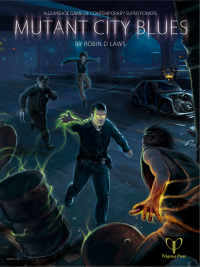
Quick Read Review - Mutant City Blues

Ten years ago, one percent of the population gained mutant powers. But one percent of the citizens means one percent of the criminals – and you're the cops who clean up the mess.

As you may have gleaned from the blurb, this RPG is set in the near future, after a virus event seemingly grants a significant percentage of the population beneficial mutations – of the super-powers variety.

Surprisingly, the world is not radically changed by this – not everyone decides to become a superhero or supervillain, not everyone wants to cash in on their abilities, and so some people go on with their lives trying to hide and forget that they have powers and abilities far beyond those of mere mortals.

But enough do, and some of them commit crimes, and that’s where you come in.

Powered by the Gumshoe system – a game system focused on investigation-oriented adventures – Mutant City Blues allows you to solve super-powered crimes and capers committed by a cast that could be taken from Heroes with a tone ranging from Castle’s light-hearted banter to Law & Order’s gritty procedurals.

One of the more interesting elements of this game is the Quade diagram. While most RPGs involving super-powers make a big deal out of being able to replicate any power in the comic books, Mutant City Blues imposes limits and definite patterns to metahuman abilities. In game terms, abilities connected to other abilities with a solid line are free; abilities connected to other abilities with a dotted line cost 2 points for each ability traversed; and abilities not connected cannot be purchased (you have to trace the web of lines to get to the ability you want).

This intriguing part of the game has two immediately obvious effects: (1) it suggests that in this particular setting, there is a predictability to meta-human powers, making professional crime-solving more about investigation, research, and deduction rather than a brainstorming / argument session about what weird combination of abilities was most likely to have been used to perpetrate the crime; (2) it makes certain combinations of abilities more desirable and other combinations of abilities too damn expensive to build.

Mutant City Blues looks like an RPG worthy of the mini-series treatment: build characters and play for a “season” of 3 to 6 episodes, then step back and evaluate how your campaign is going. If there’s promise, then make tweaks and start into the second season.

Suggested campaign inspirations: Law & Order, Heroes, Touching Evil, Castle, X-files, Warehouse 13 and Wire in the Blood.