Thursday, October 17, 2013

Tuesday, October 15, 2013

Lords of Pandius: Conversion Test Drive

Well, I've returned to my conversion of Mystaran Immortals to Lords of Olympus and found that my conversion still needs tweaking. Let's take a look at the first pass on the first five Immortals (in alphabetical order):


As you can see, the STR conversion results in Heroic and Mortal Might for Immortals from Immortal Levels 3 to 32! That's wrong, so I have to re-tool that bit.

The others seem to work out, but the Natural AC base seems to be far too stratified, wherein an Immortal with only a -1 difference in AC will automatically grant superiority over others. May have to fix that too.

However, I'm also dissatisfied with the fact that some of these Immortals have very different INT values, some higher than their STR values, going into the 90s ranges; surely that should have an impact on their abilities somewhere?

I think I'll finish all the Mystaran Immortals first, though, before starting to retool again.

Thursday, October 10, 2013

Night's Black Agents: U.N.I.T. Freelancers


Good things of day begin to droop and drowse; While night's black agents to their preys do rouse.
Macbeth, Act III, Scene 2
I was thinking about a Night's Black Agents + Esoterrorists + Mutant City Blues: a different system for a U.N.I.T. meets Torchwood campaign in America. And was looking at old TV shows for additional inspiration.

Instead of working for the government (which the U.S. might take issue to, given that they probably have a slew of anti-alien agencies already), I was thinking of a campaign where a small U.N.I.T. CRASH team is assembled from freelancers, ala Global Frequency meets Masquerade.

For the spooky, conspiracy-laden humans vs. aliens atmosphere, I'd look at shows like:

  • X-files
  • Kolchak
  • Fringe
For the setting, with super-spies, private eyes, talented amateurs, and multi-national agencies:
  • I-Spy
  • The Man from U.N.C.L.E.
  • the Equalizer
  • The A-team
  • MacGyver
  • The Pretender
  • Stingray
  • Strange Luck
  • Charlie's Angels
  • Burn Notice
For banter and ensemble teams:
  • Magnum PI
  • Simon & Simon
  • Remington Steele
  • Moonlighting
  • Ten Speed & Brownshoe
  • Castle
  • Starsky & Hutch
For Science Fiction / Fantasy Weirdness:
  • The Six Million Dollar Man
  • The Bionic Woman
  • The Immortal
  • The Tomorrow People
  • Sapphire & Steel
  • Torchwood
  • Warehouse 13
  • Knight Rider
  • UFO
  • Project UFO
  • Fringe

Friday, October 4, 2013

Tracing the Wheel Kingdoms: Setting Wishlist

In my past posts on the Kingdom of the Wheel & other Wheel Kingdoms, I mentioned how different cities were included in these kingdoms, sometimes with different Saeculum governing the abilities and magic of theses places.

This was really meant to give me a kind of way to tie together some of my favorite D&D settings (and other fantasy settings) in my very own kitchen sink setting.

But what settings would I include? Off the top of my head:

  • Mystara -- of course, as a classic inspiration to many of the worlds and arguably one of the major players in the War for the Wheel Kingdoms.
  • The City from Weird Adventures -- although, perhaps, the true connection to the Wheel Kingdoms would be one of the older cities in the world.
  • Red Tide -- a nice, tightly contained setting that is also a threat that might infect the rest of the realms of the Wheel Kingdoms.
  • Poryphyry: World of the Burn -- a setting that I must convert from its current system eventually, but is very rich with potential for fantasy post-apocalyptic adventuring, and different types of magic.
  • Carcosa -- a walled-off segment of one of the Broken Wheels, but still accessible by occasional intersections of the Grand Orrery.
  • Enigmundia -- a cobbled together setting of my own, based on a fantasy Philippines being colonized by fantasy equivalent of Spain.
  • All the Blackmoors -- each Blackmoor would house a greater key of the Wheel Kingdoms.
  • Megadungeons -- rationale needed for them as ruins or fallen or secret points on the Wheel Kingdoms.
Well, that's it for now. Time to read and think.

Wednesday, September 25, 2013

Isle Imperium 1.47: Pasver's Keep

We finally discover that the
undead-themed shard that
Mantius has been favoring
is also a scholar in its
Essentialized form.
VARIAN broaches the subject of fealty to the Memory of Loyalty shard, thereby learning that the shard entity actually objects to the legions and “the way you fight your war”. Nevertheless, feeling beholden to its rescuers, the shard insists on swearing fealty, despite Ian’s assurances that such action is not necessary. BREGAN obliges by donning the Memory of Loyalty in order to physically swear to ARCTURUS in his capacity as the flagbearer Phantom Herald. As a consequence, the former is grievously reminded of all the children who have suffered in the course of war, including his own child.

Ian’s conversation with the Truesilver Pardoner shard is more cordial, although this time it is the shard’s turn to be taken aback by Ian’s revelation that its legion, the former Crystalline Steel, has been transformed into Platin. After Ian explains that the First cannot at present provide a mount with which KELMEN might investigate the veracity of this claim, it agrees to wait for the First to either find it a mount or bring it into company with Master Mirage, also late of Steel. In the course of this conversation, the number further learns that the Dweomer Keeper and Truesilver Mocker shards likewise originate from Steel (with some contempt from Kelmen in the case of the latter); and, from KHIMERE, that the ‘dissolution’ of Steel stemmed from a disagreement between its male and female mounts, and that the writ used by Platin is still that of Steel.

After taking amiable leave of the affable GELDARIUS, Merchant of Marvels, the First land on a peaceful plain, where ALECTO consults with the nearest scholar—OSSIS POTIOR EXCELSIS—as to the next step of their mission. In addition to roundly scolding Aly’s Saint of Consonance regarding the costs the latter has been levying and remitting a sum of 100,000 bright light to the mystified Aly, Mr. Potior conveys the following information:
  1. In the midst of a small catastrophe, use Pasver’s key in Pasver’s vault—which is at the heart of Pasver’s Keep—to acquire the Luna Noxus Triptych.
  2. The Keep lies where Pasver’s lord secreted it in order to save his people, accessible through a sphere of oblivion within the Tortured Swath of Legatum in the region of Gromon.
  3. Along the way, the Swath itself will attempt to prevent entry by means of the creatures it produces, “an unholy mingling of life and undeath”.
  4. Defeating each of these creatures will give the group a piece of the shattered statue of Legatum, god of ill gains; these pieces in turn will add to their probability of being able to enter the sphere.
  5. Only certain taxonomies—including cleric, warrior, and forester—will function at optimum capability within the Swath. Others—including wizard and elementalist—will be all but useless, while still others will be at half capacity.
This revealed, MANTIUS and Kim work together to get the First just outside the Tortured Swath, Kim boosting his Phantasmic Gate to bridge the enormous distance. There, all party members but Mantius use their clasps from Geldarius in order to reshard and reslot in compliance, opting to use their full complement of warders so as to bolster those without more suitable taxonomies in their repertoire. They then enter the Swath, whereupon they are promptly attacked, CATALINA being instrumental in freeing her trapped comrades and later keeping the hostile forest at bay through her woodscape authority and—by linking with Aly’s phylactery-lent forester taxonomy—being able to share her wood walk support with her companions.

Progressing onward, Ian spots one of the creatures of the Swath, whereupon the creature sees them and draws them toward it so that it can launch a preemptive strike. Accords prove invaluable in this and several later battles, in the course of which:

  1. Arc assumes dragon form and is stuck that way for the time being.
  2. Aly’s Devoted Warder learns a new ability, shield of devotion, as a result of repeated backlash from creature death.
  3. Mantius’s clerical and death-defying abilities prove critical time and again, particularly when—
  4. Ian experiences the misfortune of having a tree grow right through him, shredding his body.
With six creatures destroyed and six corresponding statue shards collected, the First decide to try breaching the sphere of oblivion, at which they succeed, entering a strange place in which Pasver’s Keep appears to be perched upon some enormous, curled-up, evidently dormant creature. They make their way into the Keep itself, soon realizing that its inhabitants are long passed away—and discovering soon after that that several of these have been transformed by long exposure to chaos and/or catastrophe into shards. (Please refer to ‘Shards with the First’ for a full accounting.) Arriving at the vault itself, they learn, through Cat’s ideation, that only the person to whom Pasver’s lord entrusted the key—“the one with the greatest understanding of piety”—can open the vault.

Accordingly, then, Mantius dons Pasver’s Almoner in order to enter the vault, wherein he finds not only the Luna Noxus Triptych but also a small chest and Pasver’s seal, both of which the shard urges him to take along. With all mounts feeling sorrow over the fate of Pasver’s people (and, in the case of Ian, the Keep itself) the First departs as the structure begins to fall.

Carefully bearing the triptych, they return to the plain they departed from earlier, where Mantius learns the drawbacks as well as the incredible benefits associated with Pasver’s Almoner, not least of which is the reduction of all action purchase costs to zero. Resolving to keep Pasver’s shards a secret among them for the time being, they head for a nearby farmstead to ask permission to put up shelter as they prepare to make their next move.

Monday, September 23, 2013

Blog Wandering - The Seasons of the Doctor

from: http://siskoid.blogspot.com/

Blog Wandering: Taking a brief break from writing stuff to point you at great content (possibly gaming related) that I chance upon on on the web.

Happened upon this while researching about the Doctor's Companions for some possible Victorian era outfits - Siskoid's Blog of Geekery. It has many things, but the posts that I've latched onto are a treasure trove of posts that provide stats beyond the current sourcebooks of the Doctor Who: Adventures in Time and Space RPG.

There are stats for the Doctors, the Companions, and for the NPCs and monsters in each episode.

Furthermore, Siskoid writes about each season as though the shifting and changing showrunners, actors, plotlines and arcs were all part of a tabletop RPG -- a very politically / dramatically charged one. Here's a starter list:

Character Sheets:

The Sixth Doctor
Peri
The Fifth Doctor
Turlough & Kamelion
Tegan
Nyssa
Adric
The Fourth Doctor
Romana II and K-9

Seasons:

Doctor Who RPG: Season 23
Doctor Who RPG: Season 22
Doctor Who RPG: Season 21
Doctor Who RPG: Season 20
Doctor Who RPG: Season 19
Doctor Who RPG: Season 18
Doctor Who RPG: Season 17

It's a really impressive series of posts, considering that he's also doing reviews of each of the episodes in those seasons, sharing his evaluations and insights into the shifts and changes in character and plotline, as well as (I assume) some of his knowledge on what was going on behind the camera.

For those interested, the official sourcebooks for the First & Second Doctors are available here:


Blog Wandering: Krull, Ergo, and a Cyclops!

from http://goodwillhunting4geeks.blogspot.com/

Blog Wandering: Taking a brief break from writing stuff to point you at great content (possibly gaming related) that I chance upon on on the web.

I was thinking of a mini-series on nabbing memorable NPCs from TV and Movies and recasting them in D&D worlds, when I remembered the movie Krull and the character Ergo the Magnificent.

There were two quotes from this character that really stuck with me in a film rife with liftable NPCs (the main characters, not so much). The first quote is a fantastic establishing line, reverberating with false bravado mixed with caution, quite appropriate for a half-competent mage in a dangerous world:

"I am Ergo the magnificent. Short in stature, tall in power, narrow of purpose and wide of vision. And I do not travel with peasants and beggars. Goodbye!"

The other one, a quote mixed with regret, was said to the Rell the Cyclops when actually forced to bid adieu to an almost-friend:

"... we never had the time."

The latter one is harder to verify, unless I hunt down a copy of the film. But it does speak to the hint of a great friendship, had Rell survived the movie. In any case, I was thinking of finding or statting out the two almost-friends in a partnership for encounters in bars, roads, or even dungeons in a D&D world.

But then I found a page on the blog Goodwill Hunting 4 Geeks on a possible updating and retrofitting of the movie (plot and recasting). I like the premise of the terrible evil they are fighting to be an equivalent of the Borg, being the techno element of the technofantasy adventure, and the more fantasy elements being native to the world.

I also like the inspired casting of Tommy Lee Jones as Ynyr the Old One, and Hellen Mirren as the Widow of the Web. Perhaps, instead of merely an NPC write up, an entire mini-campaign should be crafted!

However, they really need to rename the central weapon of the hero -- the Glaive -- as people will be confused in this modern era why the named this thing after a very different looking pole arm.

Friday, September 20, 2013

Inspiration: Way of Kings


So, there's gonna be ten books of this? Cool -- honestly though, I don't know how he'll keep all this up. So Brandon Sanderson's work has been at the edges of my perception for years now; may have to get caught up on that Mistborn stuff too.

I like a lot of the elements of the setting, but am content to let it unravel slowly. I prefer the character progression and plot to take precedence over the world building (heck, that's what appendices are for, right), anyway.

Friday, September 13, 2013

Inspiration: DC's 52


From a gamer's perspective, I enjoyed the weekly comic from DC that was called 52. Apparently, the name seems to have really struck a nerve, because the launch of the current revised timeline was and is still called New 52.

With some years' distance, I think I can see why I did. From a continuity end, it succeeded in giving a broadstroke view of the impact that super-technology and superpowers might have on the geo-political landscape. Rather than individual or super-team comics, this one gave off the feel of the movies or mini-series that have a huge cast of characters, whose plotlines criss-cross and intersect and make the world strange and wonderful and different. I had some issues, of course, with little details and odd changes in characterization.

I'll take a look at each major storyline, and how it might work with my Earth-641 setting (a combined Marvel & DC Universe milieu). Some storylines are:

Question to Question


This storyline, involving The Question (Vic Sage), the soon-to-be-new Question (Renee Montoya), and Batwoman (Kathy Kane) basically explores the activities of a super-technology criminal agency known as Intergang and their local and international dealings.

It starts in the city, but eventual ranges far around the world, crossing over into the storyline of Black Adam's emergence as a world superpower, before returning to the resolution of its own storyline.

In a superhero campaign, this type of storyline is a good inspiration and exploration of the effect of vigilante wildcards: the street-level supers who sometimes step out of their respective cities and combat organized crime on an international level.

When Everyone Is Special...


Lex Luthor, fresh from the criminal scandal that ejected him from the presidency, embarks on a special project: the ability to grant any human metahuman abilities. For this, he targets John Henry Irons.

The ability of a villain, or a corporation, to create designer metahumans is not new. However, the impact of such a thing in an ongoing timeline, and the scale of this granted of abilities, definitely raised questions: how will they be policed and controlled? who gets to decide if powers can be implemented and what powers are granted? and why is the corporation really doing this? and won't other countries and nations want in on this destabilizing technology?

And what about people with feelings of entitlement -- the ones that believe that all they need is this one thing to make themselves special, make themselves great? Wouldn't that just accelerate the potential future that we saw in Kingdom Come?

Political Power


Black Adam comes into his own by becoming the ruler of Kahndaq, and creating his own Marvel family, and expanding the political influence of his country -- banking on his own status as sovereign monarch and major supervillain -- to change the world.

This is of interest, because Superman-level heroes (and villains) do have the ability to change the world, and not just physically (but that's pretty intimidating already). How would the rest of the world deal with this kind of scenario? Would they take advantage of it? Would they treat it as another arms race? And what kind of stresses -- internal and external -- might collapse such a delicate house of cards predicated on a single, unique individual?

Monday, September 9, 2013

D&D 30day Challenge: Day06 - Favorite Deity

I've been posting about a lot of deities (mostly from the Roman / Greek tradition), and if the question were really just about them, I'd name Minerva / Athena and probably Apollo and Zeus. But really, almost any of the ones I've covered in this blog are of interest to me.

But this is a D&D challenge question, so I 'd assume it's somehow related to D&D gaming or reading experiences, and I really don't have any that jump to mind.

If Immortals count as deities (in Mystara, they're not gods, y'know), then I'd actually cite Rad (a.k.a. Etienne d'Amberville) who, despite being cast as something of a villain in Wrath of the Immortals, benefits from some familiarity in D&D modules as the person 'released' by adventurers in the X2 module Castle Amber (Chateau d'Ambreville). He comes across as a young Immortal eager to shake up the ways things are done and acts as a sort of controversial POV character who could be counted as a 'contemporary' of adventurers, despite his rather high ranking amongst his kind.

Other gods that have caught my interest in the past were:
  • Seker from the Egyptian pantheon, primarily for his anti-undead abilities according to the AD&D Deities and Demigods book;
  • St. Cuthbert from Greyhawk, who made me wonder at a very young age how saints figured into the D&D game, as I didn't know he wasn't a real saint;
  • Waukeen from Forgotten Realms, due to his ties with commerce, triggering the creation of an overt and covert set of societies in my derailed campaign that would have worked to counter bad trade practices round the Realms.

Friday, September 6, 2013

D&D 30day Challenge: Day05 - Favorite Dice Set / Die Type

It's the d6, and my special set of d6 dice. I carry all of them in this metal Lucky Strike tin.

The Big Blue dice are for damage in Hero System, or Die Pools in games like Shadowrun or the Star Wars / Ghostbusters D6 system. I like to think they roll high.

The White dice are for half dice in Hero System, or Wild Dice in games like the Star Wars / Ghostbusters D6 System. I also like to think they roll high.

The smaller multi-colored dice replaced my lost (sob) black dice with red pips for rolling low in Hero System, for all the attack rolls and skill rolls.

I pack a pair of unusual D10s for percentile rolls and the odd need for a D20 or D10 in any given game.

I loved bringing this around as a compact dice set for conventions and games at friends' houses. Gone were the days when I used to bring around huge stacks of dice; I always knew exactly which dice I had to have with me when I went home.


Wednesday, September 4, 2013

Lords of Pandius 08 - Primary Ability conversion

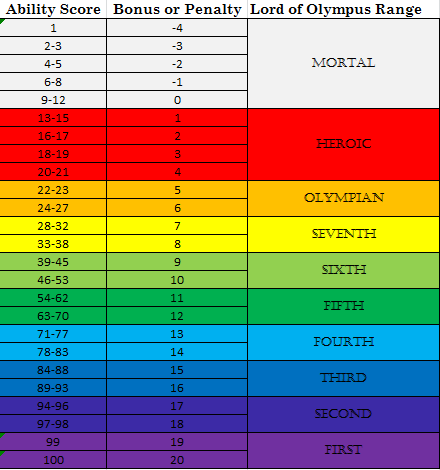
So, here are my conversion summaries for the various Lords Of Olympus Primary Abilities, assuming Wrath of the Immortals-style stats for Mystaran Immortals:

Might

Start by looking at their Strength Attribute, then compare to the chart. Then check Immortal Rank -- if it's below Empyreal, consider it a Tied Class.


Fortitude

For this one, simply find the Immortal Rank and compare with the chart.


Ego

For the attribute governing mental abilities and powers, find their actual Immortal Level (a numeric value) and consult the chart below.


Prowess

For tactical, strategic, and combat ability, consult the Immortal's natural Armor Class (which is actually based on the Immortal Level) on the following chart:


And that's all I have for now.

Observations and Possible Adjustments

Might & Fortitude are somewhat compressed in comparison to the Ego and Prowess Attributes. Perhaps I should expand their Class ranges a bit to give a more expansive feel to the power rankings of these abilities. Doubling them might work.

If left as is, however, it would seem that Fortitude and Might are compressed in terms of ranges, perhaps suggesting that the gaps in the costs should be higher. A more close distribution of Primary Ability costs are suggested by the Ego and Prowess classes. But maybe that's just me.

It may help to start converting some Immortals next, to see how it works out.

D&D 30day Challenge: Day04 - Fave Setting

Seriously, it's Mystara. I post about it often enough on this blog for Pandius's sake. It's partially nostalgia, but it hits that sweet spot of familiarity, being filled in just enough, but not too much, etc.

So here's an excerpt from a recent post about it for a recent RPG Blog Carnival:

Key Posts: I've made a number of Mystara-oriented posts over the years; these are the ones relevant to this particular campaign.
  • A Mad God in the Machine - how to have a campaign premise that allows for multiple PCs coming and going, but still retaining continuity, and allowing PCs to rub elbows with gods and kings early on in their careers; just have to be careful that they don't get overshadowed by the mad god who runs into them once in a while. 
  • Dark Corners of Mystara: Strange Waters - when they're being sent on missions by the Mad God, they may not be traveling overland exclusively. This is, of course, inspired by the river-based campaign from WFRP's Enemy Within campaign. Speaking of WFRP...
  • Stealing From WFRP: Roadwardens - and yet another campaign premise for the PCs when they've finished their river adventures.
  • Some Geography is in order - taking from my Enigmundia posts, I underscore the key elements that I'd like to emphasize for the setting.
  • Fate, Fortune, and the Adventurer - my own rationale for things like hit points and levels and the movers and shakers of the world being so powerful compared to the normals of the world.
  • Gods, Magic, and the World - a series of posts that deal with my take on the cosmology of Mystara's universe
    • Spheres, Magical Fields, and Outsiders - the gods and the magical field they created and maintain protects reality from things outside it.
    • Dark Corners of Mystara: Dwarves & the Hounds of Tindalos - highlights my preference for a slightly stranger feel for the campaign, preferably lurking just beneath the surface of a normal (albeit tumultuous) campaign world. I like the idea of Old Ones and Ancient Things being something that the Immortals keep at bay while they pursue their own twisted schemes of power.
    • Pagan Magic-Users: Pythagorean Mathemagicians - how the magic of the world is skinned, based on a given pantheon. Yes, it assumes that magicians invoke the names of gods in their spells, and 'pagan' ones at that.
    • Pagan Spells of Mercury - A sample listing and rationale of several 1st level magic spells attributed to Mercury.
    • Pagan Spells of Apollo - A sample listing and rationale of several 1st level magic spells attributed to Apollo.
    • Pflarr and Hermanubis - an attempt to merge the Pflarr of Mystara with an actual Jackal-headed Roman god (with a picture of the statue in a museum).
    • Cults of Orcus - an attempt to merge the Orcus of myth with his portrayal in D&D's pantheon.
    • Sleep, Dream, Fantasy, and Nightmare - the gods of the underworld, where many an adventure spends time, are stranger and more powerful than you think
  • Additions and Expansions
    • Add: Ravenloft - adding to the mystery of the powers of the Outsiders and the corruption of the Sphere of Entropy, I wanted to mix little of the Demi-plane of Dread
    • Add: Spartacus - to really push the decadence and the skill of the Thyatian gladiator class, some liberal lifting from this show.

Tuesday, September 3, 2013

D&D 30day Challenge: Day03 - Favorite Playable Class

My answer: the multi-classed character!

No, it's not quite dodging the question. In AD&D, where the class is separate from the race, I always wanted to multi-class. My choice, was not the ever popular Elven Fighter / Magic-User; it was a Half-Elven Fighter / Thief.

There was a particular type of fighter -- the lightly armored, sneaky, finesse-oriented fighter -- that I wanted to emulate.

I was actually overjoyed by ease of multi-classing in D&D 3E, until the sheer weight of Feats (with all their Pre-requisites) in all the sourcebooks and class expansion rules killed the fun of character creation for me. And as a HERO System gamer that's saying something. The shift to 3.5, followed by 4E killed my interest in the entire D&D line. Ah, but that's another story.

I still toy with the idea of running a very lean, bare minimum 3E rulebook-based campaign some time in the future. But it's not a likely future.

Monday, September 2, 2013

D&D 30day Challenge: Day02 - Favorite Playable Race

Halflings.

I never really got to play them, as my original gaming group in the U.S. was very anti-halfling and anti-elf (though they tolerated half-elves). But as I mentioned in my old post, "Halflings are hard-core!", the Jeff Dee halfling was my inspiration for a fun playable race -- certainly not the singing and dancing hobbits of LOTR (though I enjoyed their stories, mind you). I wanted the lean, tough, dangerous halflings that I saw on the early modules.

I even tried to rebuild the halflings of old in 3E, though it ran counter to the 'iconic' Halfling Thief there. Perhaps I shall do a tour of halflings in all the OSR books that I own (plus 3E, not 3.5) to review how they've changed over the years.

Perhaps we should encourage shifting away from the old naming conventions, to reflect a different kind of nature to this race -- names that evoke awe and fear!

Kill that orc, Godzilla Tyson! For the glory of the Shire!

Sunday, September 1, 2013

D&D 30day Challenge: Day01 - How I Got Started

Here's my first post for the D&D 30 day challenge. Interestingly enough, I've already written about this before, in this post about my early gaming years.

I'll just post some of the highlights:

I bought a module first, because I didn't know any better

I was a young boy studying Karate at a friend's house and encountered them playing a game that I would later discover was AD&D (after much wheedling and whining). Since this was the Philippines during the 70s, I faced three obstacles: availability of the source material, occasional "news stories" on the 700 Club telling me and my family how demonic it was, and a lack of understanding about the actual concept of RPGs!
I didn't read it closely enough, and probably wouldn't have understood why you needed to buy another rules set to use this so-called module anyway. All I saw was the "introductory module" bought, and the cool Jeff Dee art, and I was hooked.
Yes, that was T1 -- The Village of Hommlet.

You mean Advanced doesn't come after Basic and Expert?

My first attempt at gaming was therefore stymied by a lack of a ruleset, but I set about rectifying that by trying to find the Dungeons & Dragons rules that I could use to play this module -- 
-- But I bought these (Basic & Expert D&D boxed sets with the Erol Otus covers) instead. Bummer.
Don't get me wrong, I loved this ruleset. Even today, I'm impressed by the organization, the layout and the art (though I may be biased by nostalgia) and how it all pulled together to draw me into this other fantasy realm and communicated very clearly how that could be done. And the list of books in the back sent me on a hunting frenzy at the local bookstores.
Unfortunately, I was of the mind that you needed the AD&D ruleset to use an AD&D module, so I was a bit perturbed. Thank goodness for the Keep on the Borderlands and Isle of Dread modules that came in these boxed sets.
A couple of years later, I did eventually pick up the AD&D ruleset and while I was relieved to finally lay my hands on the proper set of rules to use my modules with, I must say that this rulebook did a better job in communicating the 'otherworldliness' and sense of wonder in a more consistent manner. AD&D had too many in-jokes and 'break the fourth wall' humor to sustain that epic feel -- though it did exceed the D&D B/X rulesets in key areas (the "Paladin in Hell" image comes to mind). This was my go-to ruleset for that "sense of wonder" fix.

And that's how I got started. I never actually got to play in a game of D&D until I was in the U.S. of A, however, with regular AD&D group at the Beresford Rec Center in San Mateo. But that's another story.

Friday, August 30, 2013

D&D 30 Day Challenge - Intriguing

I saw this on Tim Brannan's blog, and I decided to take it on. Primarily because the questions themselves triggered many memories of joy playing this oldest of games in my repertoire.

What say you, blogosphere? Does it trigger the same things with you? If so, you may wish to share with the rest of us.


Tuesday, August 27, 2013

My 3E Campaign: Failed Faerun

My Forgotten Realms campaign, using the 3rd Edition rules, kind of evaporated many years ago due to various changes in the lives of all the players. But once in a while, I like to go back to it and see if I can resurrect it in terms of a campaign premise.

Caravan to the World

My inspiration was threefold: the new Forgotten Realms sourcebook for D&D 3E, the short stories set in Sembia as started off in The Halls of Stormweather anthology and Dragon Magazine at the time, and the Lord of the Rings (but perhaps not for the reasons you might think).

I was certainly interested in running a proper long-term campaign, and one in a setting that had a lot of pre-built baddies and well-fleshed out material (that I felt comfortable with tweaking here and there). With Faerun as the prime setting, it was a natural choice -- even if I'd shunned it back in my D&D / AD&D days.

The Sembia short stories granted an insight into what a different type of D&D adventuring might be: a city-based sort of adventuring, a politically motivated series of adventures, and the importance of trade, commerce, and power in cities that were embracing civilization in the face of existence-ending threats like liches and dragons and a thousand other entities. Also, the reference to the King in Yellow in one of the short stories made me want to introduce those Elder Gods of Lovecraftian origin into the mix.

Lord of the Rings inspired me because, among many things, it was a novel that showed off its milieu. There was a storyline that forced the viewpoint characters to leave their homes and explore quite a bit of the world that Tolkien had crafted.

Of course, I didn't want to go the route of the quest -- too stereotypical. Also I wanted PCs to be able to appear and disappear, to bring in new characters if they wished, or to retire other ones while still keeping the spine of the story line intact. What other campaign premise / frame could I use? With Sembia and the Dales as an inspiration, I decided upon a trade caravan.

Yes, a trade caravan would bring the PCs from the breadbasket of the Dales to Sembia, and through other points in between. They might encounter Zhentish opposition (or aid), if they discovered a threat to caravans in Drow-infested woodlands; they might chill at hints of foul cults praying to forgotten Elder Gods in cities; they might discover strange trends the cities that regular denizens might not, as few stray from their lands of birth...

At the same time, I wanted to recreate something I hadn't found a word for yet: sandbox play. The option for players to leave the caravan when it dissolved at its ending point, and to join another bound for another city. Or perhaps to become involved in another type of campaign premise: expeditions to hidden cities and treasure.

Alas, it was not to be. But perhaps I can resurrect some of the ideas in Mystara one of these days. There's certainly at least one caravan in Karameikos...

Sunday, August 25, 2013

Armchair Review: Rocket Age

Rocket Age a love-letter to the era of pulp planetary romances. Radium-powered rocket ships are zooming humanity (and other alien races in the solar system) all around, with 1930s versions of the U.S.A., Britain, and France coming into conflict with the proto-Axis versions of Germany, Italy, and Japan. Aliens from Mars and Venus, and a rich tapestry of rocket age technology, expansionist policies, and interplanetary politics provide a fantastic backdrop for your planet-hopping adventures.

The Vortex system, which captured the neo-pulp feel of the newer adventures of Doctor Who (also by Cubicle 7), really reinforces the swiftness of action and the fly-by-the-seat-of-your-pants tone of the genre.

An example of the interior art -- a stylized map of the Rocket Age solar system.
I really enjoyed the meatiness of this book: the black & white art, which somehow gave modern era weight and gravitas to the classic alien and rocketship imagery from this well-known genre; the tour of the solar system, which gives the broad strokes of each planet as a mini-setting, along with locations and characters of note, and loads of plot hooks; the clearly laid out tables, the illustrations of planets and aliens to help GMs and players visualize the setting -- the love of the genre and the project is quite evident in the density of material in the Rocket Age RPG.

All in all, a fine RPG to add to the library of this pulp subgenre.


Saturday, August 24, 2013

Armchair Review: DWAITAS -- The Second Doctor Sourcebook

Doctor Who: Adventures in Time and Space -- The Second Doctor Sourcebook is a must-have for Doctor Who
completists. But it is also a wonderful resource for any DWAITAS campaign, because of the detailed stats for different Cybermen incarnations, Daleks from this era, and the Ice Warriors of Mars -- this is, after all, when The Doctor began leading the charge as a hero, instead of being a more manipulative mastermind (as in his prior incarnation).

Book Breakdown

Once again, a lot of black & white pictures from the series to help give a visual grasp of this era of The Doctor. The Doctor and his Companions are statted out, along with his villains in the era:

  • Cybermen (Marks 2 through 4, Cybermat, Cyber-Controller, Partial Cyberman, etc.)
  • Daleks (Black, Humanised, Emperor, etc.)
  • The Great Intelligence (Robotic Servents, Yetis Mark I and II)
  • Ice Warriors
Lots of tips and tricks to capture the feel and themes of this era as well.

And of course, synopses and adventure hooks for the episodes of The Second Doctor. It's a great look into the resonant themes of this era in British Science Fiction -- and a great source of RPG ideas for our modern times.


Thursday, August 22, 2013

Isle Imperium 1.46: The Merchant of Marvels and the Eldest of Dragons

Master AUDEN delays his own and the First’s departure somewhat by presenting the Stalwart Warder to VARIAN, who opts to take said shard along in place of the Cerulean Mediator. From there, the First proceeds to the waypoint just outside Peerdin, only to realize that it is no longer viable. KHIMERE is able to solve this difficulty, however, with the result that MANTIUS is able to transport the team to the last known location of Alina’s ship.

Unfortunately, the ship itself is no longer present, so the mounts splash into the ocean, eventually managing to extricate themselves in various fashions. ARCTURUS then manifests a frostweave gate to one of Diamond’s bright light facilities, where all soon suffer terrible backlash from ALECTO and CATALINA’s disastrous attempt to synergize intuition and ideation in order to learn more about their task of finding or forming a new writ. Notwithstanding this—and the cost of 100,000 bright light to access Aly’s Saint of Scholars ability—they are able to glean the following options for the first step of the mission:
  1. Go to the tower of Ephesus in the desert of salt; find the widow of the Pheran heresy, who will tell how to find Izurei, the writ-maker.
  2. Go to the labyrinth of Ionika in the steppes of Garanth; find the horned god IONIKA, who will give the key to Pasver’s vault.
  3. Go to Kortheos, the city of the dead, in the Iapinian archipelago; speak to the necrosages, who will give the harmonic cylix.
Further investigation reveals that all three choices contribute an equal percentage to long-term mission success—0.5%--but that the second will make the group happy “if they have bright light”. With no solid reason to choose otherwise, they select that one, and Ian contacts the Imperial Civilar of Nova Aeternus, who graciously provides directions to the steppes of Garanth. Through ideation, Cat also learns that Ionika is the fourth eldest dragon, a wicked and greedy devourer of shards, but by then the First has already made its choice, and are unable to change this decision. Mantius takes them there with a phantasmic gate.

The steppes prove to be a viciously wind-blasted plain, such that the mounts are barely able to remain standing. Kim constructs a buffer out of earth, which gives her the breathing space (after one of her four summoned elemental scouts goes flying into the air) to conceive of spiral steps that lead up to the floating land mass discovered by Cat and interpreted by Aly as the actual labyrinth. With Ian buttressing (and prettifying) the stair, the First move upward, where Arc and Kim discover that contact with the underside of the land mass allows them to reverse their gravitic orientation. The group does so and, via a trench again made by Kim and improved by Ian, enters a shaft in the underside, at the bottom of which Aly and Mantius determine that there is one human-sized person in the large chamber directly ‘below’ them, from which numerous tunnels and pathways branch off.

Following a cautious entry in which the First separates into forward and reserve teams, they regroup upon meeting GELDARIUS, mounted by the legendary Merchant of Marvels. Despite the fact that they do not possess the requisite ‘proof’ to enable them to purchase his more marvelous creations (after which the nature of his “curse” would apparently compel him to once again shift location), he is kind enough to offer them the opportunity to purchase some of the less wondrous items created by his former apprentices, now itinerant journeymen. After a nerve-wracking bidding session (in which Arc and Cat, particularly, endear themselves to Geldarius through the high value they place on the merchandise), they are able to acquire many useful items at breathtaking expense, though this amount is later generously returned to them by Geldarius, along with clasps that not only hold their shards securely, but allow them to alter their raiment and reshard once per day at the time of their choice, in lieu of one of their usual resharding windows.

After pleasantries, a meal, and some tension with Aly, the Merchant of Marvels demonstrates his kindness even further by accompanying them to the lair of Ionika. Upon their arrival, the dragon promptly attacks, but is stayed by a defensive sphere erected by Geldarius. Ionika continues to batter at the sphere even as Cat leads the negotiation, finally arriving at the painful agreement of one contingency shard and two of the First’s shards in exchange for the key to Pasver’s vault and two of the shards in Ionika’s possession, among which Aly identifies, as positive-seeming possibilities, the following:
  1. Truesilver Pardoner
  2. Fearfeather Battleharper
  3. Shrouded Kinslayer
  4. Cognate of Pillars
  5. Glimmervale Crusader
  6. Cyclopean Gladiator
  7. Memory of Loyalty

Gilded Cannoneer and Stalwart Warder having been the shards reluctantly proffered in the exchange, Arc and Ian select the Memory of Loyalty and Truesilver Pardoner—moments before Geldarius, having burnt out several rings in his efforts to hold the dragon back, sends the First hurrying away from the lair. He attempts to bluff Ionika, but it decides to attack regardless, whereupon the Merchant of Marvels uses an ability to declare the dragon’s eyes “marvelous”, ripping them from its head.

Grabbing the waiting Cat and BREGAN, Geldarius hastens away as well, as the blinded dragon begins to smash through the walls in pursuit of the group. Aly is meant to be caught and devoured, but Arc takes her place with martyr’s blow, whereupon her Saint of Widows synergizes the efforts of Mantius, Brand, Cat, Ian, and Kim to smash the dragon’s face and snatch Arc literally from the jaws of death. The eight mounts are thus able to flee to Geldarius’s home, which the Merchant instantly commands to move away, also triggering commands that somehow ‘fold away’ the floating land containing the dragon’s lair.

Viewers are then treated to the sight of the Stalwart Warder shard rising up and glowing among the many shards that surround it within the lair. Answering gleams herald the other shards’ rising, as they unite to attack the weakened dragon.

sundry information:
1.    Athenos: a name mentioned by Geldarius
2.    The Saint of Widows says she has “three lives left”