There've been some new posts on the official Fading Suns forums since the last time I posted, but this post is not about that.
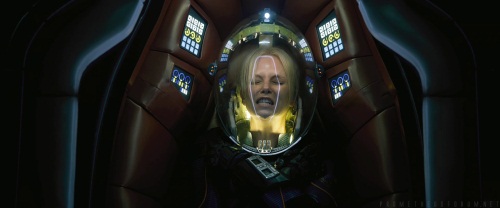
No, this post is about the upcoming movie Prometheus (by some guy named Ridley Scott -- why is that name familiar?) and how so many of the visuals, when taken out of the movie context as stills, trigger story ideas and memories of things from the Fading Suns books.
Here are just a few examples.
Interface
Could be considered a look inside one of those terraforming machines on the colonized planets of the Known Worlds.
Stoneface
Aside from the obvious Annunaki reference, it also triggers the much-repeated parallel between the Space Jockeys and the Lovecraftian Old Ones. Plus, one wonders if the repeated images of 'human' faces weren't so much a reflection of the creators, but of an 'in vogue' art style. And perhaps the creation of humans was the 'in thing' at the time.
Surface
Again, ruins of the Annunaki are often interpreted by later races in terms of their own experiences and the discovered utility of the artifacts. But what if these are just the tip of the iceberg? What if, like the Coke bottle in the movie The Gods Must Be Crazy, the hardness of the glass is only incidental to the material it's supposed to contain?
Scareface
I'm struck by the parallel between this and the sarcophagi of Ancient Egypt. Perhaps these ancient pyramidal structures were ancient space / dimension traveling devices that required the travelers to encase themselves in protective coffins complete with readouts and dials for the long travel ahead? And perhaps our own colossal monuments are pitiful cargo cult attempts to recapture that grandeur and promised immortality?
And what happens when they come back?
Thursday, March 15, 2012
Wednesday, March 14, 2012
Megabat: Giant Golden Crowned Flying Fox
When someone asks you what a giant bat looks like, just show them this picture (taken by one Allen Olaez here in the Philippines).
Wikipedia says
The giant golden-crowned flying fox gets its species name from the golden fur around the head, in sharp contrast to the black body. Like all other fruit bats, they have no tail. They are among the largest bats, with a wingspan of 1.5–1.7 m (4 ft 10 in–5 ft 7 in) and weighing 0.7–1.2 kg (1.5–2.6 lb).
and it does look huge, despite a little bit of play with the visual cues -- check out the positioning of the tree that it's attached to.
I'd freak out if this thing came diving at my face; thank god they eat fruits.
And yes, it is a megabat.
Tuesday, March 13, 2012
A Filipino Western: Julio Valiente in San Basilio
![]() |
| Most would think that shooting at a knife in your hand is, well, crazy and dangerous. But not Julio Valiente -- it's a way to save bullets. |
Filipino Westerns can be considered an early sort of interstitial or cross-genre movie. They grabbed many existents and tropes of, er, Western Westerns and stuck them in the tropical clime of the Philippines, and liberally mixed them in with pulp tropes. Hence, masked heroes with horses and six shooters riding past nipa huts and trees native to our tropical clime.
Here's a series of clips strung together with the theme music from one of those Filipino Westerns: San Basilio. The most memorable part of the film is the part when two villains are running away from the hero Julio Valiente, and he decides to execute them with his last bullet (ignoring the ones on his arms, of course) by shooting through his knife -- the implication is that his knife split the bullet in two, allowing him to kill two people with one bullet. The actor -- Lito Lapid -- is currently a Senator.
Saturday, March 10, 2012
Enigmundia: Cults of Orcus
The Cults of Orcus are many and varied in name and goals. They tend to be more secretive in cities, grow in organization and influence in the rural areas, and consolidate into masses of followers in the wilderness.
A common trait to these cults is a fondness for vows and oaths -- every rise in rank and stature in the cult is accompanied by a new, very eruditely composed oath that is added to all the prior ones. Politicking and jockeying for position is commonly characterized by attempts to get opponents to directly or indirectly break oaths to their lord and master.
Cult Depictions
The depiction of Orcus as a goat-headed lord of the undead seems to stem from his Panthenian roots, where he was considered to be one of the first cthonic gods and therefore one of the princes of the vast Underworld of myth.
Even back then, his demesne was Oaths, and he was a feared punisher of oath-breakers -- a much-replicated image in the museum of Imperian relics depicts him as a wild-haired, non-descript old man effortlessly heaving two muscled oathbreakers off a cliff as punishment. Sages have pointed to the strange stygian colorations of the cliff, starkly contrasted with the sylvan splendor found above, as an indication that the punished are being cast down into one of the many Pits to the Underworld.
There is another series of depictions of Orcus that is found in the foul tomes of the Oathbound (sorcerers who have entered into pacts with demons and devils). He is shown as a young, whiskerless man wielding a wand when the Oathbound first make their pacts, then as an immaculately robed patrician a rod when warning them against potential violations of their oaths, and -- his most fearsome aspect -- a grey-haired, bearded old man with long nails and piercing eyes when claiming them for breaking their pacts.
Lord of the Undead
His association with the undead seems to be tied to his purported role as overseer of contracts and agreements between demons and the sentients of the mortal realm. There are a variety of cults that are not dedicated to Orcus per se, but call upon him to officiate the sealing of pacts with demons and devils. It is rumored that the undead that serve him tend to be those that he's punished for failing to live up to their vows in life, and now must uphold foul oaths in death.
Other more discerning scholars of his cults have suggested a different reason: they theorize that Oathbreakers and those they make pacts with are often unaware of certain clauses inserted into their agreements -- clauses that bind both demons and sentients to the service of Orcus if either of the two violate the terms of their contracts.
If this is true, then the power of Orcus is fearsome indeed. Centuries of broken pacts between demons and sentients of the sunlit realms make for a terrible Underworld army at his command.
Orcs, Ogres and Orcus
Few orc and ogre tribes worship Orcus, yet he is known to them all as the father of their races. Their animal cunning, their distrust of words and equivocation, and their seemingly inherent treachery seem to be totally at odds with the fiercely cerebral, meticulously literal, and oath-sensitive nature of their progenitor god -- which is perhaps why a number of cults sponsor expeditions, crusades, and wars against orcs all across Enigmundia.
A few have theorized that the races were attempts to create his own minion race -- one to replace the hordes of humanity on Enigmundia -- that were cursed by other gods. Others have suggested that they are the personification of his own brutal nature, driven out (mostly) from his person.
It is likely that the truth will never be known, as no scripture or writing seems to speak of the incident, leaving the matter to apocryphal oral traditions in the humanoid tribes.
A common trait to these cults is a fondness for vows and oaths -- every rise in rank and stature in the cult is accompanied by a new, very eruditely composed oath that is added to all the prior ones. Politicking and jockeying for position is commonly characterized by attempts to get opponents to directly or indirectly break oaths to their lord and master.
Cult Depictions
The depiction of Orcus as a goat-headed lord of the undead seems to stem from his Panthenian roots, where he was considered to be one of the first cthonic gods and therefore one of the princes of the vast Underworld of myth.
Even back then, his demesne was Oaths, and he was a feared punisher of oath-breakers -- a much-replicated image in the museum of Imperian relics depicts him as a wild-haired, non-descript old man effortlessly heaving two muscled oathbreakers off a cliff as punishment. Sages have pointed to the strange stygian colorations of the cliff, starkly contrasted with the sylvan splendor found above, as an indication that the punished are being cast down into one of the many Pits to the Underworld.
There is another series of depictions of Orcus that is found in the foul tomes of the Oathbound (sorcerers who have entered into pacts with demons and devils). He is shown as a young, whiskerless man wielding a wand when the Oathbound first make their pacts, then as an immaculately robed patrician a rod when warning them against potential violations of their oaths, and -- his most fearsome aspect -- a grey-haired, bearded old man with long nails and piercing eyes when claiming them for breaking their pacts.
Lord of the Undead
His association with the undead seems to be tied to his purported role as overseer of contracts and agreements between demons and the sentients of the mortal realm. There are a variety of cults that are not dedicated to Orcus per se, but call upon him to officiate the sealing of pacts with demons and devils. It is rumored that the undead that serve him tend to be those that he's punished for failing to live up to their vows in life, and now must uphold foul oaths in death.
Other more discerning scholars of his cults have suggested a different reason: they theorize that Oathbreakers and those they make pacts with are often unaware of certain clauses inserted into their agreements -- clauses that bind both demons and sentients to the service of Orcus if either of the two violate the terms of their contracts.
If this is true, then the power of Orcus is fearsome indeed. Centuries of broken pacts between demons and sentients of the sunlit realms make for a terrible Underworld army at his command.
Orcs, Ogres and Orcus
Few orc and ogre tribes worship Orcus, yet he is known to them all as the father of their races. Their animal cunning, their distrust of words and equivocation, and their seemingly inherent treachery seem to be totally at odds with the fiercely cerebral, meticulously literal, and oath-sensitive nature of their progenitor god -- which is perhaps why a number of cults sponsor expeditions, crusades, and wars against orcs all across Enigmundia.
A few have theorized that the races were attempts to create his own minion race -- one to replace the hordes of humanity on Enigmundia -- that were cursed by other gods. Others have suggested that they are the personification of his own brutal nature, driven out (mostly) from his person.
It is likely that the truth will never be known, as no scripture or writing seems to speak of the incident, leaving the matter to apocryphal oral traditions in the humanoid tribes.
Thursday, March 8, 2012
Inspiration: the Dyosa Fantaserye
The Philippines has had its share of fantaseryes, all of which have had to contend with budget constraints in realizing their respective counter-realist visions. Another series that caught my attention with its core concept and occasional sparks of budget- and industry-transcending brilliance was Dyosa.
Dyosa ("Goddess") was a TV show about a young woman who, at the age of 18, discovers that she belongs to a divine lineage. Here's the upshot from Wikipedia:
Now, like most local teleseryes, this show certainly had its share of romantic and domestic drama, but there were some scenes that truly sparkled because of some surprising humorous situations written into otherwise cliched scenes. I felt that they really overreached in terms of the three forms of the goddess -- it was just too expensive and time consuming to solve the issues of animation and SFX cleanly. The most problematic was the centaur form, due to the motion of the horse and trying to stitch the upper half of the lead onto it. But, it was ambitious and who am I to say they shouldn't have tried to push the boundaries of local fantasy shows in terms of concept and SFX?
Gaming Inspiration
Despite the modern setting of the series, I'm intrigued by the idea of the goddess taking multiple forms.
Should be an interesting delving into classic mythical creatures.
Dyosa ("Goddess") was a TV show about a young woman who, at the age of 18, discovers that she belongs to a divine lineage. Here's the upshot from Wikipedia:
Josephine is a young orphan who finally finds out she is no ordinary mortal after reaching the age of 18. After years of being raised by her foster parents, Josephine finds out she is the 'Takda' or Chosen One with divine powers and must help save the world from the Kasamyan, who are evil creatures from Lower Earth. After becoming a full-fledged goddess, Josephine also discovers that she has the power of the earth, air and water. To harness these powers, she takes the form of Dyosa Tierra, a centauride, Dyosa Agua, a mermaid, and Dyosa Cielo, a harpy.
Now, like most local teleseryes, this show certainly had its share of romantic and domestic drama, but there were some scenes that truly sparkled because of some surprising humorous situations written into otherwise cliched scenes. I felt that they really overreached in terms of the three forms of the goddess -- it was just too expensive and time consuming to solve the issues of animation and SFX cleanly. The most problematic was the centaur form, due to the motion of the horse and trying to stitch the upper half of the lead onto it. But, it was ambitious and who am I to say they shouldn't have tried to push the boundaries of local fantasy shows in terms of concept and SFX?
Gaming Inspiration
Despite the modern setting of the series, I'm intrigued by the idea of the goddess taking multiple forms.
Should be an interesting delving into classic mythical creatures.
Less than 24 hours left to avail of the sale!
Check out DriveThruRPG and RPGNow for the items on sale! There's less than a day left, so decide now and pick up those items you've always wanted to get for your GM! It all ends March 7, 2012!
See my original post on the GM's Day Sale for recommendations.
Wednesday, March 7, 2012
OGG HERO House Rules: Aborting to a Defensive Action
My Old Gaming Group (OGG) has been enjoying a renaissance of HERO gaming in the supers genre, and there have been a flurry of e-mails about rules clarifications and house ruling. If not obvious in our past post, or in this one, let me just say that in terms of gaming preferences:
The most recent e-mail discussions covered the classic Aborting to a Defensive Action maneuver.
Subsequent replies generally went like this:
So ultimately:
- we play at a high power level
- we are concerned with both tactical combat and character roleplaying
- we place a high premium (at least when running Champions) on the mechanics and dice rolls speaking for themselves despite story directions for adventure or character plotline
The most recent e-mail discussions covered the classic Aborting to a Defensive Action maneuver.
Page 361-362 of 5th ed revised: Aborting an Action: "A character may perform more than one defensive Action wihle Aborting - such as Aborting to Dodge and activating a Defensive Power - provided they are not mutually exclusive."
This means you can abort to reallocate a multipower, activate a force field and missile deflect, allocate levels to missile deflect, then perform the missile deflection.
I am not sure that we want to do this, because it makes levels a lot more powerful, as well as multipowers, but the bad guys will have it too, so it is kind of balanced. This could make a character with a bunch of levels very dangerous.
For example, if Musashi puts all his levels into location and damage to hit an agent in the eye with his tetsubo on phase 12 so he can get a massive presence attack for having the guy's head spiked on a 4 inch by 4 inch piece of steel. On phase two, a villain who is unimpressed by the action flies up and tries to spike him with a move through. He pulls ahead to block, reallocates all of his levels to OCV and blocks. Even though he might not have a high enough speed, he can continue to block because he has a lot of levels.
This makes aborting very defensively powerful, but since you cannot pull ahead past your next phase it still has limitations. It will force people to be a lot more judicious with reserved actions - reserve your action until an opponent makes a move, then be sure you attack them on that same phase.
Subsequent replies generally went like this:
The one down side I see is that it makes combat LESS lethal, which in turn means combats take longer, which in turn means role playing is shortened, since combats already take long enough. You better have a massive OCV when attacking guys, because you can be sure they are going to block you, or you HAVE to wait till they go in the phase you act so they cant abort to a block.
So ultimately:
It makes multipowers and levels way too tough. If you can abort to reallocate a multi, I would buy everything as ultra slots, have a 150 point multi with Attacks and defenses, have some def outside the multi, time a massive attack to go on dex count 1 of a phase, abort the second the next segment comes to apply ridiculous defenses. The points I save on the slots I would use to buy extra speed only to abort phases.
Imagine a character with 6 speed (9 with the limitation) doing this with maybe a 210 point multipower. you could easily make this powerhouse in High powered game, have a 60 pd/ed hardened force field, and a 28d6 EB at 0 End - not a lot of drawbacks there.
I think we should stick with the old way. That way there are consequences to level allocation and to multipower allocation.
Monday, March 5, 2012
Mystara: Slouching Towards Specularum
Retro-clones, neo-clones, and the upcoming 5th Edition of D&D (which promises to have some weird kind of backward compatibility) make it enticing to dream of a Mystara Reborn!
And indeed, there's much buzz online about it -- but where's a good place to start?
Well, in addition to somehow wrangling a copy of the Rules Cyclopedia (RC) and grabbing a couple of the classic modules (B2, X1, X2, etc.), the logical place to start is the Gazetteers.
The Age of Ravens blog has an excellent series of reviews on the Gazetters:
GAZ5: The Elves of Alfheim
GAZ6: The Dwarves of Rockhome
GAZ7: The Northern Reaches
GAZ8: The Five Shires
GAZ9: The Minrothad Guilds
Dreams in the Lich House also posted a bunch of interesting links on Mystara, including:
Interestingly, someone raised the issue of a Mystara Megadungeon. There are comments that many were mentioned in the Gazetteers and source material, but none actually was fully detailed.
Interesting idea for a project, but which one?
Anyway, we shouldn't worry about stocking it, as the blog Stocking the Dungeon has several ideas for that. However, another big draw are, of course, the statted out versions of the D&D cartoon characters as ready-made NPCs in Mystara:
Can't wait for the Acrobat and the Cavalier.
And indeed, there's much buzz online about it -- but where's a good place to start?
Well, in addition to somehow wrangling a copy of the Rules Cyclopedia (RC) and grabbing a couple of the classic modules (B2, X1, X2, etc.), the logical place to start is the Gazetteers.
The Age of Ravens blog has an excellent series of reviews on the Gazetters:
GAZ5: The Elves of Alfheim
GAZ6: The Dwarves of Rockhome
GAZ7: The Northern Reaches
GAZ8: The Five Shires
GAZ9: The Minrothad Guilds
Dreams in the Lich House also posted a bunch of interesting links on Mystara, including:
- Bruce Heard's aggregated Facebook interview on Bruce's own blog
- A Post on Glantri
- An Ode to Mystara
Interestingly, someone raised the issue of a Mystara Megadungeon. There are comments that many were mentioned in the Gazetteers and source material, but none actually was fully detailed.
Interesting idea for a project, but which one?
Anyway, we shouldn't worry about stocking it, as the blog Stocking the Dungeon has several ideas for that. However, another big draw are, of course, the statted out versions of the D&D cartoon characters as ready-made NPCs in Mystara:
Can't wait for the Acrobat and the Cavalier.
Mythic Hero: A New Kickstarter by Steven S. Long
One of the minds behind the 5th and 6th Edition of the Hero System has a new kickstarter project. It's called Mythic Hero.
Mythic Hero is your guide to the mythologies of the world for gaming. It describes dozens of mythoi, with character sheets for gods, heroes, monsters, and other mythological beings, as well as information on their cosmologies, magical practices, and more. Right now the list of mythologies I plan to cover includes:
American Indian (split into six sub-chapters covering major cultural groups)
Armenian
Assyro-Babylonian
Aztec and Mayan
Canaanite*
Celtic
Chinese
Demonology (medieval Christian demons like Belial, Moloch, and so on; may also include some angels)
Egyptian
Etruscan*
Filipino*
Finnish
Greek and Roman
Hawaiian and Polynesian/Oceanic (possibly split into two chapters)
Hindu
Hittite*
Hungarian*
Inca
Japanese
Maori*
Masai*
Mongolian/Turkic*
Norse
Slavic/Russian
South American* (possibly combined with Inca)
Sumerian
Voodoo
Yoruban
Miscellaneous
(Entries with a * after them are subject to being demoted into the “Miscellaneous” chapter based on how my research goes.)
Additionally, Mythic Hero covers common divine abilities, how to incorporate gods into your campaign (including how characters interact with and even fight them), how to create your own pantheons for your games, and how to run Mythic Hero campaigns.
Other books have covered mythology for gaming to varying degrees, but many of them are out of print and I don’t believe any of them are nearly as comprehensive and thorough as Mythic Hero will be. Currently I estimate the book will be 300-400 pages long (it could easily exceed that), with a color soft cover and black-and-white interior art, and retail for approximately $59.99 (if I can produce enough to sell beyond the Kickstarter). All that’s subject to change as the project progresses and I get a better idea of what it will look like in the end, of course.
Seems like an interesting endeavor. What say you, blogoverse? I love mythology reference material.
Sunday, March 4, 2012
Armchair Review: Marvel Heroic Roleplaying
Here's my review for Marvel Heroic Roleplaying:
I guess the most difficult thing for me is dealing with the narrative mechanics. It really twists my mind in non-traditional directions, much like the Fate rulesets always have. In fact, I'm more comfortable with the World of Darkness rules, which I consider more traditional, than these types of rules. But with Marvel Heroic Roleplaying, I have a better feel and understanding of why they might work in emulating the genre.
Right off the bat, I have to warn you: Marvel Heroic Roleplaying is a mashup of different RPG philosophies and may not be what you're expecting from a super-hero RPG. If you give it a chance, if you accept that not all of it may necessarily flow down traditional RPG design paths, I think that you'll find it's an excellent RPG.
It uses Cortex Plus, which -- as anyone whose even leafed through another Cortex Plus rulebook can tell you -- doesn't necessarily guarantee the exact same ruleset. This variant still creates dice pools, but the sources of these dice pools (Affiliations, Distinctions, Power Sets, and Specialities) are different enough from the Smallville version to claim that it's a different game altogether.
I do like the Affiliations (which differentiate character power levels when operating as part of a team, as a buddy, or solo) and the Distinctions (which give both bonuses and "penalties" based on character "tags" or "schticks") a lot because of the narrative / comic book feel they give the game.
I like the Power Sets with some reservations. While the Power Sets (with their related SFX, Stunts, and Limits) do allow for very broad, yet customizable abilities that can fit on one page, the absence of a coherent point-based approach really throws me off when trying to determine relative power levels. They also may pose problems for GMs and Players with less solid character concepts and more rules lawyer-oriented philosophies.
The Specialties are a nice way to cover skill groups quickly, in pretty much the same fast-and-loose way that comics tends to handle skills. I wish that there was a little bit more gradation in the skill levels though.
Of course, it does mean that Character Creation can be very fast, and can be tweaked as the game goes along.
As far as task resolution, GMing, and scene / adventure / campaign rules go -- it's very much got a narrativist / indie feel (game milestones that grant XP that you can spend to tweak the game, several mechanics that feel very much like Fate), but with just enough crunch to pencil in justifiable rankings on the abilities of a given character.
The art is fantastic, and -- since most of it was taken from comics in the past decade -- it has a very modern feel to it as well.
The mini-event that comes with the game, and the characters with ready stats, are all taken from the New Avengers storyline that preceded the whole Civil War, Dark Reign, and Siege storylines.
Overall, it's a fantastic RPG that somehow manages to grant that feeling of playing in a modern Marvel comic book, somehow gives mechanics to the somewhat elastic power levels found in their pages, and somehow allows the players to recreate the narrative ebb and flow of adventure and drama in the genre.
Most important -- it's an RPG that makes me want to play! Avengers Assemble!
I guess the most difficult thing for me is dealing with the narrative mechanics. It really twists my mind in non-traditional directions, much like the Fate rulesets always have. In fact, I'm more comfortable with the World of Darkness rules, which I consider more traditional, than these types of rules. But with Marvel Heroic Roleplaying, I have a better feel and understanding of why they might work in emulating the genre.
The AGE of Mystara
Ever since I joined the Mystara Reborn group on Facebook, I've been seeing a lot of activity and discussion on Mystara, and it triggered a review of some of the Mystara I have with me.
I was then reminded of the work done by Byron D. Molix on the Dragon Age / AGE conversion of Mystara. And then I found out that he'd just recently released another book with many of the adversaries of the Mystaran world.
Time for a closer review of Dragon Age and of these fan-made sourcebooks. They look nice! I wonder where the art came from; I don't recognize it.
I was then reminded of the work done by Byron D. Molix on the Dragon Age / AGE conversion of Mystara. And then I found out that he'd just recently released another book with many of the adversaries of the Mystaran world.
Time for a closer review of Dragon Age and of these fan-made sourcebooks. They look nice! I wonder where the art came from; I don't recognize it.
|
|
How long is that bow? How long is that arrow?
I was doing some image research and came across this picture of a Philippine "aboriginal war long bow and arrow" with a indigenous native in the "Investigating US History" pages of the CUNY website.
Now, we're not known for our height, and I'd assume that the longbow is about right, based on longbow pictures and their relative size to caucasian bearers. But that arrow seems, well, huge! Is it just me, or does it rate extra damage dice? If we assume that the user is less than 5 feet tall, does that make the size of that arrowhead more in line with regular arrowheads? It looks like a spear being launched by bow!
By the way, for my non-Filipino site visitors, Negrito -- which, as you might guess, means "little black person" -- isn't really looked upon fondly as a term to reference one of the 'races' of early indigenous residents in our archipelago despite its use elsewhere in the region.
Then again, we're used to the naming game, having been called Indios at one point (the Spanish word for 'Indian') because European explorers kept mistaking different places for India. Other names included "Luzones Indios" (a reference to the northern region of the archipelago), "Manilamen" (a reference to the city), and "Indios Bravos" during the time of the Manila-Acapulco Galleon Trade.
Now, we're not known for our height, and I'd assume that the longbow is about right, based on longbow pictures and their relative size to caucasian bearers. But that arrow seems, well, huge! Is it just me, or does it rate extra damage dice? If we assume that the user is less than 5 feet tall, does that make the size of that arrowhead more in line with regular arrowheads? It looks like a spear being launched by bow!
![]() |
| "Speak softly, but carry a big -- holy frijoles -- is that a longbow?" |
Then again, we're used to the naming game, having been called Indios at one point (the Spanish word for 'Indian') because European explorers kept mistaking different places for India. Other names included "Luzones Indios" (a reference to the northern region of the archipelago), "Manilamen" (a reference to the city), and "Indios Bravos" during the time of the Manila-Acapulco Galleon Trade.
Saturday, March 3, 2012
Setting Expeditions: Code Black -- Part IIIb
So to wrap up Code: Black, the setting can easily incorporate source material from a variety of horror RPGs.
Fabulous Monster Hunters
For your standard monster hunting thrills, you can use the source material already in the book and add in things from Supernatural by Margaret Weis Productions or the Buffy the Vampire Slayer / Angel RPGs by Eden Studios. Look no further than White Wolf's World of Darkness and New World of Darkness for different spins on classic monsters.
Keep in mind, however, that the primary approach toward monsters in Code: Black is that -- at their core -- all these monsters are also former inmates on Prison: Earth. They're evil, and because they're not human, they tend to be more touch by Evil than humans. Of course, some humans could probably give them a run for their money; and maybe one or two are 'redeemable' by human standards. But those are few and far between. Most monsters are for killing, pure and simple. It's just that there are enough numbers of them that all out war between the monsters and humans would make things very messy, especially for those born without The Sight -- the ability to truly see things for what they are. So there's an uneasy truce, and killings are only countenanced in set rules of engagement.
Stalking the Mythos
For modern Cthulhu-inspired horrors, look to the newish The Laundry RPG, the semi-newish Trail of Cthulhu, and the older Delta Green for different takes on organizations taking on the mythos in modern society.
The Laundry contributes an interesting take on the nature of the Deep Ones and the greater powers of a mythos-choked Earth, and the tenuous detente with the various occult organizations of the world. It also posits a math-based basis for magic and summoning of creatures that was explained more fully in the novels of Charles Stross. Furthermore, it gives source material on the possible structure of anti-mythos government agencies not only in the U.K., but also around the world.
Trail of Cthulhu has a plethora of adventures set in modern times that will challenge the agents of Code: Black's Brotherhood of Gilgamesh; Delta Green will give an example of a cell-structure based conspiracy of mythos-fighters in the American idiom that can be easily tweaked to avoid contradictions with the material from The Laundry.
Exploring True Reality
For strange invaders from alternate dimensions that may or may not be heaven or hell, try to find a copy of Kult and pick up JAGS Wonderland and JAGS Book of Knots. Esoterrorists is another must-read for this type of horror exploration.
Kult's main proposition -- that the true reality is the city known as Metropolis, and our reality is a prison meant to keep humanity from awakening to their true nature -- is very in sync with the cosmology of Code: Black. Furthermore, the creatures and monstrosities that fill the RPG are more inspired by the Hellraiser and Nightmare on Elm Street movies and books -- and perhaps the Silent Hill series of games, which can make for a different change of pace adventure as well.
JAGS Wonderland & Book of Knots are very similar, though realized through a wonderfully dark and consistent use of the Alice novels as both inspiration and metaphor for humans dealing with the dangers of different levels of reality.
Esoterrorists tackles agents struggling to stop the breakdown of our reality, and covering up the attempts of Esoterrorists to release imprisoned intellects and entities and extradimensional realities into our own.
All in all, Code: Black is a lovely kitchen sink setting that allows GMs and players to make use of almost any horror RPG material.
Fabulous Monster Hunters
For your standard monster hunting thrills, you can use the source material already in the book and add in things from Supernatural by Margaret Weis Productions or the Buffy the Vampire Slayer / Angel RPGs by Eden Studios. Look no further than White Wolf's World of Darkness and New World of Darkness for different spins on classic monsters.
Keep in mind, however, that the primary approach toward monsters in Code: Black is that -- at their core -- all these monsters are also former inmates on Prison: Earth. They're evil, and because they're not human, they tend to be more touch by Evil than humans. Of course, some humans could probably give them a run for their money; and maybe one or two are 'redeemable' by human standards. But those are few and far between. Most monsters are for killing, pure and simple. It's just that there are enough numbers of them that all out war between the monsters and humans would make things very messy, especially for those born without The Sight -- the ability to truly see things for what they are. So there's an uneasy truce, and killings are only countenanced in set rules of engagement.
Stalking the Mythos
For modern Cthulhu-inspired horrors, look to the newish The Laundry RPG, the semi-newish Trail of Cthulhu, and the older Delta Green for different takes on organizations taking on the mythos in modern society.
The Laundry contributes an interesting take on the nature of the Deep Ones and the greater powers of a mythos-choked Earth, and the tenuous detente with the various occult organizations of the world. It also posits a math-based basis for magic and summoning of creatures that was explained more fully in the novels of Charles Stross. Furthermore, it gives source material on the possible structure of anti-mythos government agencies not only in the U.K., but also around the world.
Trail of Cthulhu has a plethora of adventures set in modern times that will challenge the agents of Code: Black's Brotherhood of Gilgamesh; Delta Green will give an example of a cell-structure based conspiracy of mythos-fighters in the American idiom that can be easily tweaked to avoid contradictions with the material from The Laundry.
Exploring True Reality
For strange invaders from alternate dimensions that may or may not be heaven or hell, try to find a copy of Kult and pick up JAGS Wonderland and JAGS Book of Knots. Esoterrorists is another must-read for this type of horror exploration.
Kult's main proposition -- that the true reality is the city known as Metropolis, and our reality is a prison meant to keep humanity from awakening to their true nature -- is very in sync with the cosmology of Code: Black. Furthermore, the creatures and monstrosities that fill the RPG are more inspired by the Hellraiser and Nightmare on Elm Street movies and books -- and perhaps the Silent Hill series of games, which can make for a different change of pace adventure as well.
JAGS Wonderland & Book of Knots are very similar, though realized through a wonderfully dark and consistent use of the Alice novels as both inspiration and metaphor for humans dealing with the dangers of different levels of reality.
Esoterrorists tackles agents struggling to stop the breakdown of our reality, and covering up the attempts of Esoterrorists to release imprisoned intellects and entities and extradimensional realities into our own.
All in all, Code: Black is a lovely kitchen sink setting that allows GMs and players to make use of almost any horror RPG material.
Friday, March 2, 2012
Big Ol' Sale on a ton of books at DriveThruRPG & RPGNow
This is one of the biggest sales of the year from DriveThruRPG, and they've only got it up until Mar 7, 2012. They call it their GM's Day Sale -- most, if not all, the books on sale are really geared towards making a GM's life easier.
And we players want that, right? It means we get more gaming time in, and occasionally get to try out new RPGs or settings without having to run it ourselves.
So go out and buy your GM a new RPG or RPG sourcebook today!
Noteworthy Items
Old school game collectors may want to pick up PDF copies of Bushido, Space Opera, Aftermath!, and Flashing Blades for archival purposes.
A Call of Cthulhu fan? Look at all the Chaosium items on sale!
One of the few Elric game groups and looking to buy your GM a whole slew of old school Elric! and 4th edition Stormbringer rulebooks and source material? Always wanted to play Hawkmoon? Looking for some more material for that Legend RPG you heard about that's based on the last Runequest rules incarnation under Mongoose? Want to pick up some Traveller stuff on the cheap? Go to Mongoose's page and browse for some deals.
Want to complete your Heavy Gear collection of sourcebooks, or get all the ship diagrams for your Jovian Chronicles-inspired campaign? Visit Dream Pod 9's page.Looking to grab all the older sourcebooks for Fading Suns from Holistic Design to prepare for RedBrick's release of the 3rd edition rulebooks later this year? A fan of Cubicle 7's Doctor Who, The Laundry, Qin, Clockwork & Chivalry, or Airship Pirates RPGs? Been itching to try the Marvel Heroic Roleplaying RPG? Or the other Cortex Plus stuff like Smallville and Leverage and Supernatural?
Go to this sale! I mean, even Eden Studios has their Army of Darkness and the Buffy Corebooks marked down by 50%!
Shopping Tips
Go through the sale, and just keep adding stuff to your wishlist. Don't think, just do it! When you're done, then begin picking from your wishlist and select the things you REALLY REALLY want, add them to your shopping cart and buy them.
Once you're done, share the wishlist (with all your remaining items) with your family, friends, and fellow RPG players with a subtle hint that they can do their birthday / Christmas shopping early buy availing of this one week sale!
Thursday, March 1, 2012
i09 Post on John Carter and Michael Chabon gives D&D insight
In an io9 article titled "Michael Chabon's 17-year Quest to Write a Mars Adventure Movie" (which tackles an io9 interview of Michael Chabon and the upcoming John Carter film), there is an interesting quote that I feel has direct bearing on the once-prevalent post-apocalyptic fantasy flavor of D&D:
And then another related quote:
This can, perhaps, inform not only the PCs we create, but also the higher level NPCs -- the movers and shakers of the land -- who are perhaps closer to the former glory, are perhaps long-lived survivors of that fall, are perhaps seeking to recapture that former greatness.
And the seeds to that greatness may lie in some forgotten ruin. Somewhere.
As the 19th century turned into the 20th century and archeologists started to press deeper in to the jungles of Central and South America and into the deserts of Mesopotamia and India, they began to encounter clear evidence of many civilizations that had attained some level of technological greatness. You look around at these places and you see the living descendants of these people living without the incredibly sophisticated caliber of technology that their forebears had invented. I think it's a very haunting, stark memento mori for a representative of any civilization.
And then another related quote:
The rise and fall of civilization is this inevitable process, to which we must all eventually succumb. Nobody's going got be more haunted by that thinking than a parvenu, an ariviste who's kind of new to it all. The person who's most worried about losing everything is the person who's had it the least amount of time.
This can, perhaps, inform not only the PCs we create, but also the higher level NPCs -- the movers and shakers of the land -- who are perhaps closer to the former glory, are perhaps long-lived survivors of that fall, are perhaps seeking to recapture that former greatness.
And the seeds to that greatness may lie in some forgotten ruin. Somewhere.
Tuesday, February 28, 2012
Weird Adventures: List of Adventurer Templates
| One of the many excellent illustrations in the book Weird Adventures. |
Along these lines, I began organizing a starting list of package deals (the standard HERO way of doing things), but looked at tweaking them more as templates ala the classic d6 Star Wars RPG, for faster character generation.
Here's my first pass on the list of customizable templates I'll be building for my attempt at Weird Adventures in the HERO System:
MUSCLE
Famous Athlete
Crusading Cop
Tough Gangster
Great White Hunter
Hulking Sailor
Sharp-eyed Soldier
Two-fisted hero
Wild Man
SMARTS
Eccentric Archeologist
Amateur Detective
Bookish Professor
Nosy Reporter
Curious Scientist
Sultry Spy
EXPERTISE
Reckless Aviator
Suave Dilettante
Grizzled Explorer
Eager Gadgeteer
Grease Monkey
Jazz Musician
Thrillseeking Criminal
ARCANA
Traveling Priest
Haunted Missionary
Gifted Innocent
Craven Wizard
Exotic Sorceress
I'm going back to the book to find out if I've missed some more setting-appropriate terminology for the templates.
Sunday, February 26, 2012
Fantasy Philippines: Nosfecatu & Hari Ragat posts
![]() |
| One of the GSL release of Nosfecatu. |
- Nosfecatu Publishing's blog; and
- Dariel Quiogue's Hari Ragat blog.
I also visit various jungle-related posts on Fire in the Jungle.
Here are several posts that have caught my eye:
- Buan: The Kadatohan
- Hari Ragat: Of Men Gods & Spirits I
- Hari Ragat: Of Men Gods & Spirits II
- Hari Ragat: Of Men Gods & Spirits III
- Hari Ragat: Of Men Gods & Spirits IV
- FitJ: Hunting in the Jungle
Enjoy!
Amaya Post: Rate the Armor Class
![]() |
| photo by: dencio isungga |
Armor Class questions pop up from some promotional pics for the series ender of Amaya showcasing the attire of the lead character Amaya (played by Marian Rivera) and a visiting Magellan (played by Marian's real life beau, Dingdong Dantes).
Spaniard attire
![]() |
| No shoes, no skirt, no service. (photo by: dencio isungga) |
He's got some armor on the upper half of his body, primarily covering the torso area.
The rest of it seems to be just unreasonably warm and fashion-oriented for our tropical country, and may not offer much protection.
I know that the attire of the show is meant to be historically accurate (within budget constraints), and I wish that the promotional material would cover that aspect. Alas, most watchers of the show don't really care and follow it for the fantasy and dramatic elements -- and the popularity of the celebrities of course -- making such efforts a wasted marketing exercise, really.
I think this thing's out in DVD, and may try to see if a copy is available... somewhere. I hope to actually watch the entire thing to mine it of period elements.
The lovely Amaya
![]() |
| (photo by: dencio isungga) |
Again, only the torso seems to provide any protection -- but I love the just-below the knee leg coverings, especially the native woven patterns (the Philippines had a strong weaving and complex weaving craft at the time). It really speaks to the 'fighting on a treacherous beach' vibe of the outfit.
I also like the scabbard and the way the grips on the dagger and the sword are done, though I wish there pic of them drawn.
I wonder what the torso armor is supposed to be -- some kind of leather mail? Perhaps some folks out there in D&D land can hazard an educated guess.
Saturday, February 25, 2012
About Sourcebooks: Some Initial Thoughts on Types
The Event Strategy of Marvel Heroic Roleplaying -- a series of sourcebooks centered around comic book events -- makes sense for comic books. While comic books like Astro City are obviously centered around a specific location, a majority of the ongoing series are centered around storylines.
It made me start thinking about the common types of sourcebooks that have come out for RPGs.
Location Sourcebooks
The most common type of sourcebook, aside from the rules expansions, tends to be tied to a location. In fact, if you think about the earliest non-rules RPG books, they were mostly locations: dungeons. And I've been fascinated by them -- now that I think about it, the very first RPG book that I bought (a module) was a location-centered module: T1 - The Village of Hommlet. Locations then expanded to the setting boxed sets and books that dominated TSR & WOTC lines.
Character Option Sourcebooks
Another common sourcebook is one that gives character options. White Wolf really milked this one with the clan books (I think that they're called splatbooks -- dunno why). I think it was an important strategy for them, especially with Vampire: the Masquerade not only trying to break the older stereotypes of vampires (castles, counts, and the Carpathians), but also the more modern stereotype kicked off by the juggernaut series of novels from Anne Rice -- to show what kinds of vamp characters are open for play in a modern setting.
Storyline Sourcebooks
I don't know exactly when the storyline sourcebook can be considered to have started. Some might point to Ravenloft and of course the Dragonlance series of modules, some might cite Paizo's Adventure Paths, others might cite the influence of the Storyteller folks at White Wolf. Or we might go back to some of the earliest D&D modules and revisit them as disguised storylines. In any case, I always looked for some kind of our adventure support in an RPG.
When I think of this type of sourcebook, I think of popular choices like Call of Cthulhu's Masks of Nyarlathotep, Warhammer Fantasy's The Enemy Within, and Shadowrun's epic Universal Brotherhood. But I also think of the Fading Suns shards, the Cyberpunk collection of adventures titled Tales from the Forlorn Hope, and the Over The Edge adventures.
NPC Sourcebooks
Normally tied into one of the other sourcebooks, sometimes they come out with these: sources of NPCs. Sometimes they're combinations of allies, enemies, and neutrals. Over the Edge had a killer collection of characters -- all with interesting names -- not only in one sourcebook, but also in their CCG!
But sometimes they're all enemies like WOTC's excellent 3rd Edition Forgotten Realms sourcebook Champions of Darkness, or the series of Enemies sourcebooks from Hero Games.
I don't really see that many of these, but it's hard to actually come up with interesting characters in this situation. Super-villains tend to try to cover all bases, but definitely end up with some that will never be used. Is it the same for other genres?
Observations
So far, the non-rules expansion sourcebooks essentially break down into
It made me start thinking about the common types of sourcebooks that have come out for RPGs.
Location Sourcebooks
The most common type of sourcebook, aside from the rules expansions, tends to be tied to a location. In fact, if you think about the earliest non-rules RPG books, they were mostly locations: dungeons. And I've been fascinated by them -- now that I think about it, the very first RPG book that I bought (a module) was a location-centered module: T1 - The Village of Hommlet. Locations then expanded to the setting boxed sets and books that dominated TSR & WOTC lines.
Character Option Sourcebooks
Another common sourcebook is one that gives character options. White Wolf really milked this one with the clan books (I think that they're called splatbooks -- dunno why). I think it was an important strategy for them, especially with Vampire: the Masquerade not only trying to break the older stereotypes of vampires (castles, counts, and the Carpathians), but also the more modern stereotype kicked off by the juggernaut series of novels from Anne Rice -- to show what kinds of vamp characters are open for play in a modern setting.
Storyline Sourcebooks
I don't know exactly when the storyline sourcebook can be considered to have started. Some might point to Ravenloft and of course the Dragonlance series of modules, some might cite Paizo's Adventure Paths, others might cite the influence of the Storyteller folks at White Wolf. Or we might go back to some of the earliest D&D modules and revisit them as disguised storylines. In any case, I always looked for some kind of our adventure support in an RPG.
When I think of this type of sourcebook, I think of popular choices like Call of Cthulhu's Masks of Nyarlathotep, Warhammer Fantasy's The Enemy Within, and Shadowrun's epic Universal Brotherhood. But I also think of the Fading Suns shards, the Cyberpunk collection of adventures titled Tales from the Forlorn Hope, and the Over The Edge adventures.
NPC Sourcebooks
Normally tied into one of the other sourcebooks, sometimes they come out with these: sources of NPCs. Sometimes they're combinations of allies, enemies, and neutrals. Over the Edge had a killer collection of characters -- all with interesting names -- not only in one sourcebook, but also in their CCG!But sometimes they're all enemies like WOTC's excellent 3rd Edition Forgotten Realms sourcebook Champions of Darkness, or the series of Enemies sourcebooks from Hero Games.
I don't really see that many of these, but it's hard to actually come up with interesting characters in this situation. Super-villains tend to try to cover all bases, but definitely end up with some that will never be used. Is it the same for other genres?
Observations
So far, the non-rules expansion sourcebooks essentially break down into
- character
- plot and metaplot
- setting and milieu
Thursday, February 23, 2012
A Weis Strategy? Events for Marvel Heroic Roleplaying
The news article on the Margaret Weis website regarding future releases for Marvel Heroic Roleplaying reports something interesting:
If I understand this correctly, Premium Editions essentially reprint the entire Operations Manual from the Basic Game in addition to the full 'campaign' material for the Event in question.
In contrast, Essential Editions do not include the Operations Manual -- which is great for all the people who got it with the Basic Game.
What does this mean?
Each MARVEL HEROES Event builds on the Marvel Heroic Roleplaying Basic Game and best-selling Marvel publishing events to provide a complete open-ended super hero game experience. The Event Book is the central product, with Event Supplements adding characters and expanding play.
Essential Editions are full color casebound hardcovers priced at 29.99 and include a full MARVEL HEROES campaign, with character rosters, locations, and expanded rules. Best value for those who already have the Operations Manual from the MARVEL HEROES Basic Game.
Premium Editions are full color prestige hardcovers priced at 39.99 and include all the Essentials Edition content plus the Operations Manual and additional resources.
If I understand this correctly, Premium Editions essentially reprint the entire Operations Manual from the Basic Game in addition to the full 'campaign' material for the Event in question.
In contrast, Essential Editions do not include the Operations Manual -- which is great for all the people who got it with the Basic Game.
What does this mean?
- Premium Editions are essentially 'complete RPGs' with core rules + additional rules + setting + timelines + characters.
- Essential Editions are the equivalent of a standard RPG sourcebook, with additional rules + setting + timeline + characters.
Wednesday, February 22, 2012
Enigmundia: Pagan Spells -- Light, Continual Light, Magic Missile, and Protection from Evil
Here are four spells that have one god in common -- one god with different epithets.
The god is known as Apollo Phoebus, who is interesting because he is one of the few gods who had no direct equivalent during the transition from the Parthenian Age to the Imperian Age. His Parthenian name was Apollo; his Imperian names included Apollo Phoebus (in his aspect as god of light) and Apollo Helius (in his aspect as god of the sun.
There are other reputed invocations that call upon Helios and Sol as sole names, not as epithets of Apollo -- most of them deal with aspects of the power of the sun.
For now, let's take a look at how Light & Magic Missile are handled as part of the Imperian magical tradition.
Light (1) and Continual Light (2)
Invocations to the spells for Light and Continual Light are to Apollo Phoebus, which is a source of surprise to many. As god of light, it would seem that granting Continual Light would be an easier spell to cast, but it is theorized that all gods are concerned about granted permanence to their spells being to easy. Another theory is that the prison that binds the old gods makes such permanent boons difficult, hence the presence of the easier to cast Light spell.
Magic Missile (1)
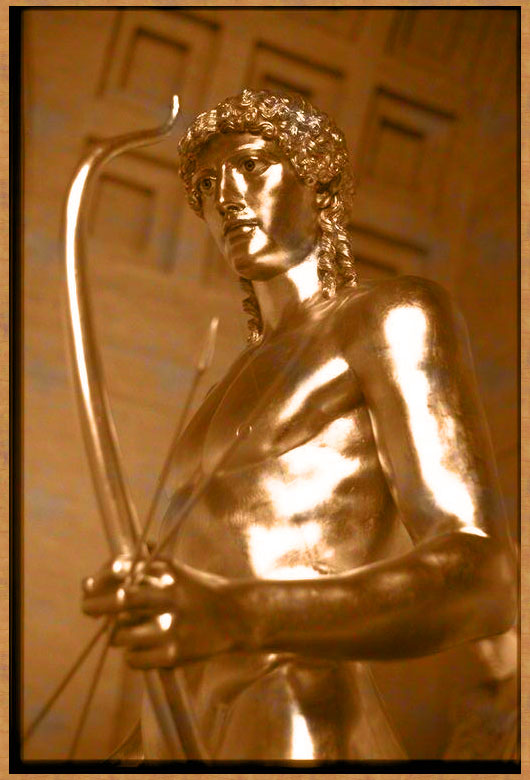
There are many distance spells open to mages, but one of the most dangerous and accurate spells is magic missile. The signifier of light-kissed arrows flying unerringly to their target is a sure sign of Apollo Aphetor -- his aspect as god of archery.
Protection from Evil (1)
As Apollo Alexicacus, his aspect as protector and warder against evil, comes to the fore. Mages with a number of spells already from his portfolio tend to call upon him for this spell, as they have already formed a familiarity with his particular brand of power.
However, most mages seem to prefer to spread their invocations across several sources -- there are rumors of benefits and banes to spellcasters that tend to favor a single source.
The god is known as Apollo Phoebus, who is interesting because he is one of the few gods who had no direct equivalent during the transition from the Parthenian Age to the Imperian Age. His Parthenian name was Apollo; his Imperian names included Apollo Phoebus (in his aspect as god of light) and Apollo Helius (in his aspect as god of the sun.
There are other reputed invocations that call upon Helios and Sol as sole names, not as epithets of Apollo -- most of them deal with aspects of the power of the sun.
For now, let's take a look at how Light & Magic Missile are handled as part of the Imperian magical tradition.
Light (1) and Continual Light (2)
Invocations to the spells for Light and Continual Light are to Apollo Phoebus, which is a source of surprise to many. As god of light, it would seem that granting Continual Light would be an easier spell to cast, but it is theorized that all gods are concerned about granted permanence to their spells being to easy. Another theory is that the prison that binds the old gods makes such permanent boons difficult, hence the presence of the easier to cast Light spell.
Magic Missile (1)
There are many distance spells open to mages, but one of the most dangerous and accurate spells is magic missile. The signifier of light-kissed arrows flying unerringly to their target is a sure sign of Apollo Aphetor -- his aspect as god of archery.
Protection from Evil (1)
As Apollo Alexicacus, his aspect as protector and warder against evil, comes to the fore. Mages with a number of spells already from his portfolio tend to call upon him for this spell, as they have already formed a familiarity with his particular brand of power.
However, most mages seem to prefer to spread their invocations across several sources -- there are rumors of benefits and banes to spellcasters that tend to favor a single source.
Subscribe to:
Posts (Atom)