Wednesday, March 30, 2011

GM Dariel and Hari Ragat

Looks nasty. What if the
residents of the abode this
picture adorns were of a
similar look?
I've been posting some stuff on the Hinirang setting, and on the work involved in creating a Filipino-inspired setting.

But GM Dariel, author of a couple of free RPGs and a long-time gamer who was interviewed on this blog last year has been busily cranking out material for his own Filipino-inspired setting.

I'm particularly tickled by his mention of William Henry Scott, whose books I've been wanting to purchase if not for the lack of funds.

Look here for his series of posts on the Hari Ragat setting.

He is also a photographer of some repute, as evidenced by his work to the left, gleefully taken from this other blog of his.

Tuesday, March 29, 2011

HEROic D&D -- Part 4

Philosophical Underpinnings
I've been avoiding doing this as I've been writing, but after having wrestled with the prior posts, I feel a bit more confident about posting this now. Plus, I guess it's important to remind myself about these things as I begin to tackle character creation and classes and whatnot.

Fast Character Creation - more Basic D&D than HERO influence here, and that's not a knock against the time it takes to create a character in HERO. Creating a character in Basic D&D is faster than AD&D -- roll up your abilities (and pray your DM is lenient if your initial abilities suck), select your class (which already includes race), roll up your money and shop, and then copy down all the appropriate benefits from tables (hell, the To Hit table is the same no matter what class you select).

And there's a reason that's there -- low-level characters tend to die and not get resurrected. Spent time making a backstory? Sorry, it's all gone unless he's got a brother who's also a fighter...

One of the first steps in HERO is character concept. In Basic D&D, presumably because they were targeting people unfamiliar with the idea of roleplaying, many initial broad-stroke stereotypes are done for you already: the strong but brusque fighter, the intelligent but unwise magic-user, the charismatic but weak halfling. Training wheels (and disposable ones) for the early levels until you've become HERO enough to survive).

Okay, too much philosophy. Back to work.

Players of 1st Level Characters are always afraid - For 1st Level Characters, Armor Class is king, as is Surprise, as is a 3rd level Cleric in the party. Why? The maximum hit die is 1d8. With the oh-so-rare maximum attribute bonus from an 18 Con of +3, you get 11 hit points.

Three kobolds that find you bathing naked could kill you in the 1st round, and will probably kill you in the second round.

Based on this principles, I've decided: 1st Level Characters are Standard Normals.

God, that sucks.

Given the vast difference in experience gain between HERO and D&D, this could be very problematic. I remind myself as I begin to consider the implications that we should try it out a bit and see what happens -- we can change our minds at a later date anyway. Do the due diligence first.

How do I build a magic-user on those points?

Silence, mental me.

Rough Allocation of Points

Standard Normal gets a Total of 25 points assuming you ignore Complications, which I assume would be allocated as follows:

Characteristics: 10 points
Skills/Perks/Talents/Powers: 15 points

I figured on the 10 points for Characteristics by first figuring out how much it would cost to get characteristic one-above average (7 points as seen below):

Str: 11 (1 pt.)
Dex: 11 (2 pts.)
Con: 11 (1 pt.)
Int: 11 (1 pts.)
Ego: 11 (1 pt.)
Pre: 11 (1 pt.)

...and rounded up for an easy to remember number. Technically, you have 3 extra points to tweak your character -- perhaps by buying up your Body, or your Stun. Or you could stick every fricking point you have into getting +1 Speed. Even this puny stat spread is better than what you get by randomly rolling up your stats using 3d6 in exact ability sequence.

As for Skills and Perks and whatnot -- those 15 points go pretty quick. So much for lengthy character creation!

For my next trick, I shall try to build the following on these points and see if I end up a withered husk of a man:
fighter - sort of the most basic class
rogue - a skill-ish counterpoint to the fighter
magic-user - most problematic since we have to handle the magic system

Non-Weekend Roundup Links of Awesomeness

I have been remiss in my blogging duties due to the move, and a singular lack of consistent internet access.

Here are some links that caught my interest when all I could count on was a quick "browse and link-save" online:

Saturday, March 26, 2011

Key Elements of My Mystara

I gotta say that while I identify
with them dark-skinned natives --
they've got a crappy Armor Class
and are going to get killed, man!
Mystara has a hold on my imagination, as well as a strong (and well-deserved) association with D&D.

Paramount in the list is GAZ 1: The Grand Duchy or Karameikos. Several aspects of this setting that I love are:
  •  the two clashing / merging cultures that characterize the humans of that land -- the Thyatians and Traladarans;
  • the Vyalia and Callari Elves (who encounter problems with the Shadow Elves during the War of the Immortals);
  • the Black Eagle Barony;
  • a home for the locations of modules B2: Keep on the Borderlands and B5: Horror on the Hill;
  • the Grand Duke and his family and the Karameikan court (which is filled with interesting characters).
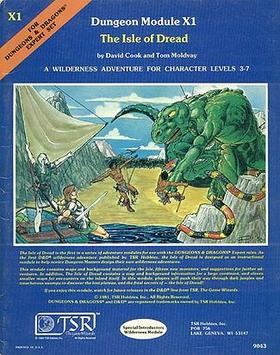
Next in the list are the modules X1: Isle of Dread and X2: Castle Amber (Chateau d'Amberville). Both modules that I absolutely enjoyed due to the implied break and expansion of the 'generic' D&D setting. X1 was one of the earliest modules I owned (and absolutely loved due to the lost world feel though I did not yet have that term in my vocabulary). X2 really broke the mold of dungeon crawls for me, and though I never played or ran that damn module, it really gave me a sense of history and story just be reading through it.

A lot of other modules in the B-series of modules and the Gazetteer series round out my list, which I should probably visit in more posts in "Mining Mystara" series.

Friday, March 25, 2011

And The Sky Full of Stars... Without Number!

He only lasted
one season, but
he had one of
the most
memorable
and haunting
character arcs.
"The sky was full of stars... and every star was an exploding ship. One of ours."
- Commander Jeffrey Sinclair, "The Gathering"

Done with my character, but the move has kind of killed off the excitement of building and posting it.

However, I did unearth a bunch of my Babylon 5 collection stuff (I was and am a big fan despite all the limitations, weaknesses, and missteps) and it started me thinking about the many RPG incarnations.

There was the Chameleon Eclectic RPG called The Babylon Project, and then Mongoose's valiant effort at a sustained and supported Babylon 5 RPG which managed two editions -- both of which I may post about on some later date.

And then I realized several things:
  1. the last Babylon 5 RPG was an OGL-based system
  2. Stars Without Number is also founded on the same principles
  3. both Mongoose and Stars Without Number have rules systems dealing with factions, though from different viewpoints 
  4. both have the ability to focus on ship-to-ship combat in addition to human scale conflict resolution 
  5. conversion should be fun, but perhaps a slightly modified setting would be better!
But before I go off on another mad project that promises to fizzle out without an actual game, I'm going to let it simmer for a while and put together a strategy for a sustained series of posts that will (hopefully) not succumb to RPG project ennui.

Tuesday, March 22, 2011

3rd Edition and the Old School Feel

I'm reminded of all my memories of D&D because we've moved house, and I've been forced to cull my gaming material mercilessly. This has brought to light how much old school stuff I actually have, and how much 3rd Edition stuff I also bought. (I never picked up anything 3.5 or later though.)

The first rumblings of 3rd Edition came for me when I was working in Hong Kong, and I actually bought my PHB 3e from a WOTC-associated store there.

Did I like it? Yes. It felt like a re-imagining or reinvigoration of an old game. Great art (despite the strange penchant for painful-looking armor) and layout, a cleaned up ruleset and game engine (with the Ascending Armor Class and unified experience chart being my faves). I liked the Feats (despite the pre-requisites) with a hope that they would eventually take the Hero System route and expose the Feat-building rules to allow GMs to tinker with the Feats appropriate to their campaigns.

There was, however, a slow erosion of the style of gameplay I associated with D&D. What I know now as a sandbox campaign was given a nod in the books, but story-oriented play dominated source material with a brief rationale about how a dungeon could be considered as something akin to a - for want of a better term - railroad adventure. An inexact analogy to be sure, since the dungeon allows the return to prior rooms while most story adventures don't really allow going back in time to revisit past scenes.

I remember planning on collecting all Greyhawk and Mystara 3e stuff coming out, and racking my brains as to how to convert the creatures in my Gazetteer collection.

I'm quite thankful for all the online resources available now, and for the OSR movement's take on important aspects of the D&D experience that I feel were not given as much emphasis in the 3E/D20 boom. And I'm thankful for the community's determination to 'reclaim' the hobby -- there are always new gamers waiting to be discovered and not all of them may want the pure-story gaming experience.

Here's hoping that, as in the past, D&D will once again enjoy a resurgence as a recreational and creative experience. Whatever the catalyst may be this time.

Thursday, March 17, 2011

Rock On, Roslof

Heard the news from here and here.

And I remembered that artist's name. I think it was around the time that I began to realize that art didn't just magically appear in RPGs and comic books, and I remember seeing the distinctive Roslof name.

Two pics that are most memorable for me are the following:

This image vies with Marvel's Mighty Thor and
Bill Willingham's Thor from the Elementals when
I conjure up a mental image of this Norse God.
   
I loved this pic because of the dynamism of the composition, and
the two fighters with their backs to the viewer! Fight on!

Mr. Roslof, I don't know you, but your work was part of the RPGs that shaped parts of my life -- and more importantly your work fired the imagination of a young boy who dreamed about lands and worlds beyond the roads and schoolrooms that he knew.

Wednesday, March 16, 2011

Character Names That Stick With You

Quite a number of friends have come up with memorable PC names (though the characters themselves may not be as memorable). The fact that I still remember them means that they've got something special that found hooks in psyche for some reason.

Here are just a few:
  • Chastity Ironthighs - D&D, Arduin
  • Johnny Zen - Rifts
  • PAD (Power Armored Dude) - Champions
  • BDM (Bladed Death Machine) - Champions
  • Gambucks Rhotiart - Star Wars
  • Braumeister - Champions
  • Johnny Surprise - Traveller
  • The Giggling Phantom - Champions
  • Xerran Hazat - Fading Suns
  • Hellguard Trellane - Call of Cthulhu  
What character's names have stayed with you for some unfathomable reason?

Fading Suns 3rd Edition: News from the Official Blogs

I regularly check the official Fading Suns blog posts on the RedBrick website to find out more on the progress of the 3rd Edition of one of my favorite RPGs. The two blogs are:

Void Transmissions; and
The Reborn Sun

Both have new blog posts that I haven't covered yet on my blog at the time of this writing, but I will once the move to the new place has finished.

"Void Transmissions" talks about the progress of putting the books (setting and art-wise) together, while "The Reborn Sun" seems to focus on changes to the ruleset and the treatment of the setting through those rules. But the again, since these are blogs, there is some variance in the posting as well.

Tuesday, March 15, 2011

Isle Imperium: Episode 1.08

VARIAN having discerned the imminent eruption of the volcano, the party is forced to leave the secret sanctuary in search of better shelter, taking the despairing nymph NERISSE in tow with them. After becoming lost on the difficult journey through further worsened ashfall, they are finally able to locate an isolated shrine to Apollo, all but buried under the blanket of ash, now several feet thick.

They are able to enter through the rooftop door of the shrine, in which they soon deduce that at least one priestess was buried or suffocated in her chambers by an inundation of ash that had managed to enter her rooms. The shrine is otherwise deserted except for the rather unwelcoming spirit of what seems to be the god himself (sensed only by Varian), as well as an unidentified holy object in the shape of an ornate box.

Although most of their companions are dead set against the idea, CATALINA and Varian secretly hatch a plan to try and use the box to petition the god’s aid. All prayers prove in vain, however, as the lava flow reaches the shrine and the group comes closer than ever before to dying.

Fortunately, they are saved through the forbidden intervention of their shards, led by the defiant Ossis Potior. With the aid of the other ‘accomplished’ shards, the personification of the Bone Collector manages to recover the missing Sanomagus shard and force the completion of those close to accomplishment, including the Aduromagus, thus adding to the strength of their collective.

Despite Aduromagus’s vituperative objections, the assembled shards manage to preserve their mounts, channeling their various abilities through the sacrifice of the Vitualamen Ex Vesperis. With the exception of the unfortunate Nerisse, the party awakens—soon learning how their survival was accomplished—in a shrine entwined inside and out with ivy, emerging later into a sunlit environment finally free of the malignant ashfall.

All is not quite rosy, however, as MARTA soon spots some sort of massive serpent tunneling through the fallen ash. The group attempts to retreat into the shrine, only to realize that they will be trapped if the serpent—which was apparently drawn there by its appetite for the ivy—falls asleep or, worse, dies on top of the shrine.

Accordingly, they choose to attack the serpent, Catalina stunning the creature through the use of her abilities as Parvulus Mentis. The others are thereafter able to deal with the serpent, as well as the second one that soon appears in its wake. They are all wondering what to do next when they spy a sailing ship moving through the sky.

The ship comes to meet them, and they make the acquaintance of its captain, ROGELIO, a lone shard bearer who was abandoned by his three companions and thereby left shorthanded, particularly in the matter of his commitment to acquire the Eye of Pluto and deliver it to the Diamond Coast of Attica, or face death. The party comes to an agreement to help Rogelio with his predicament in exchange for transport to Brianna’s palisade and one other destination of their choice thereafter.

Rogelio proves an amiable host, and not only feeds the group but offers to sell them certain supplies that he has managed to accumulate. Discovering that the captain is a Minder like herself, Catalina learns some details concerning his erstwhile comrades’ betrayal, which leads to a certain feeling of kinship between them and his generous agreement to help DUMAS in the matter of his daughter prior to Rogelio’s own concern. The eight bearers and the sentient ship therefore set sail for Brianna’s palisade.

Sunday, March 13, 2011

Imagineers: Erol Otus

Imagineers is a series of posts about the art that inspired me throughout my gaming experiences -- dedicated to Jenny & Tom

I'll be honest. At some point in my gaming career -- after I had 'graduated' from dungeon crawls to wilderness and city adventures, after I had left D&D and begun exploring systems like Traveller and Champions (before it became the Hero System) and Mekton II and Warhammer Fantasy Roleplay, after the sudden dominance of cynical, style-over-substance, cybersubtle art and Tragically Hip worlds of darkness with dark, brooding imagery -- I didn't hold the art of Erol Otus in very high esteem.

Not knowing much about art and the necessary techniques needed to achieve textures, contrast, composition, and other things that I'm now slightly more aware of -- I was more drawn to more photorealistic fantasy art.

In retrospect, I feel that part of that is the feeling of replusiveness that his art evokes. And I feel that part of that repulsiveness, I think, stems from fear -- fear of the unknown, and the unknowable.
Amazing piece from B2: Keep on the Borderlands that manages to communicate a variety of wilderland textures
through pen & ink techniques -- cross-hatching, thin and thick lines, and skillful use of negative space. I
especially love the obscured image of the mad hermit, whose tenuous humanity is always suspect.

This is of course quite understandable given some of his work on monsters. In his interpretations and creations of monstrous creatures, I find discomfort in looking at them. There is a wrongness, a mysterious air about them, and a creeping sense that their internal workings may not be fathomable by science or modern knowledge. And yet there a rightness, and a certainty as well -- a quiet confidence that tells the viewer: you may not understand how, but this thing is dangerous.

It's a testament to the skill of the artist that I remember this in color!

But what is fascinating (and more appreciated now by an older, more mature me) is how he manages to achieve this in his human creations. There is a subtle subtext to his character work that suggests that there are hidden depths and unfathomable motivations in these people -- and indeed in all people we know.

Are wizards dividing spoils subtle and quick to anger?
I'm quite delighted that his art once again graces the pages of D&D / OSR works, and will probably put together a post on that ("Eight from Erol"? "One from Otus"?).

In the meantime, for more Erol Otus goodness, visit JRients's Erol Otus Shrine.

HEROic D&D -- Part 3

Where do we go from here?

In order not to get lost in the hugeness that is an RPG, I'm putting down a short post on where I plan to go next in this from-the-hip conversion / re-creation of a classic RPG.

Classes: I think it's time to tackle the classes from a balance standpoint, before I go back and refine everything I've stated before. I also think it's time to figure out things that go AGAINST the concept of classes (i.e. stuff that everyone can do) above and beyond the issue with thieves mentioned in the last post. Will probably start with fighters, move on to thieves, and handle the human spellcasters last (magic will be a pain to handle).

Random Ability Scores: there was a post on rolling up characters that reminded me how much system impacts the feel of a game:
"3d6-in-order transports you into an entirely different world. Characters are not, can not be, emulations of gym-sculpted model-turned-actors or their kinetic caricatures in digital paintings. Characters become people. People who are sometimes stupid or weak or clumsy and are vulnerable. This vulnerability, this frailty, this lack of choreographed slickness makes old-school, for me, a far more appealing option."
While the randomness of rolling up a character sometimes resulted in DM-approved (and surreptitiously performed) re-rolls of character ability score, along with utterly useless characters and ridiculously smart, strong, charismatic and wise characters -- they did serve to reinforce that feel of "we're just ordinary joes trying to survive long enough to become heroes". Must think on this and try to preserve some of that feel in a point-buy system.

Monsters: A monster's ability to hit is based on Hit Dice. In HERO terms, this means that the tougher the monster is the better the chance it has of hitting you ABOVE AND BEYOND any special abilities it may have or any nasty multiple attack abilities (like the famous claw/claw/bite). What does this mean? It means that bigger isn't necessarily slower or less accurate in combat. Think that the Storm Giants might be crappier at fighting humans than Hill Giants? Think again. Also, there's the abstract AC issue again -- I'll have to find an easy way to extract DCV and PD/ED from creature armor classes.

End Goals: Why am I doing this again? Well, one of my personal things is to find a way to run characters built in HEROic D&D through some old modules and not cry about how much of a pain it is to convert the damn module over to HERO. I want to see how the experience of these old modules changes with the system (ignoring for now the whole "if you have a good GM, you don't need a good system" debate), and see if there is hope for creating 24-page adventure modules for Fantasy Hero.

If I dream big, I'd want to see if I could do the same for Star Hero... but then I'd have to be able to create my own subgenre of science fiction RPGing can handle a specialized (but not too narrow) set of SF genres without too much tweaking. But that's way down the line.

Saturday, March 12, 2011

Weekend Roundup: March 12, 2011


Not necessarily the week in review as far as blog posts is concerned, but certainly a roundup of blog posts that caught my eye this week.


On System:
Bat In The Attic - Mechanical Complexity of D&D Part I
Bat In The Attic - Mechanical Complexity of D&D Part II
Lord Kilgore - Multiple Attacks
Lord Kilgore - Momentum

As a system tinkerer, I was drawn not only to the exploration of rules from various incarnations of D&D by Rob Conley, but also to Lord Kilgore's continuous tinkering with his D&D-inspired ruleset.

On Setting:
Bat In The Attic - Medieval Farming Year
Ever curious about verisimilitude in a pseudo-medieval fantasy setting, I enjoyed the post and the links on medieval farming (and the sheer number of resources dedicated to it in a given society), and realized how burning a series of farmland's entire yield of crops could easily be considered grounds for bloody retribution.

Blood of Prokopius - Mining Some Circa 1981 Gold
Always fond of FrDave's posts on religion and D&D, I found this post echoing my own thoughts on monotheistic religions not only in fantasy settings, but also in science fiction settings. Perhaps this was part of the appeal that Fading Suns had on me. Must recruit this guy into Fading Suns when 3rd Edition comes out! Or at least tap him as a resource.

From the Sorceror's Skull - In Any Language
The art posted here from the Swedish RPG Drakar och Demoner (Dragons & Demons) is awesome, but it also reminds me how by just changing the art and the rules treatment of monsters in fantasy RPGs can give gameplay that unpredictable, exploratory feel.

Fire in the Jungle - Tunnels in the Jungle
While the post on Vietnam tunnels does ignite some rationale for dungeons and stirs memories about the Iwo Jima tunnels in WWII, it is the plaster-filled ant colony image that really stirs the imagination and dredges up ancient memories of a Bill Homeyer campaign where a seemingly infinite (and oddly monsterless) staircase stretches down into the pits of hell. Awesome.

On OSR:
Lands of Ara - Top 15 Classic OSR Blog Posts: On Game Design and Campaign Resources
The Society of Torch Pole and Rope - An Evaluation of Watchfires & Thrones: Year One
Swords Against The Outer Dark - My Message to the OSR
Salon.com - How Dungeons & Dragons Changed My Life

Though I don't really game OSR these days, out of nostalgia and an attempt to understand the effect that D&D (and the hobby of RPGs as a whole) has had on my life, I find myself drawn to these posts for various reasons.

On a lighter note: Hot Elf from the Philippines


Okay, solidarity with OSR folk: here's a local representative for hot elves (and other favorite cosplay characters) -- Alodia Gosiengfiao.

'Nuff said.

Friday, March 11, 2011

Real Life News: So Far, No Tsunami Effects here

We are fortunate that, so far, no ill effects have been suffered in the Philippines from the Japan Tsunami.

However, our hearts and prayers go out those who have been affected, particularly the people of Japan (who are closest to the epicenter of the quakes, and to the effects of the Tsunami).

I'd post links, but I'm sure that the search engines have the best news out there.

A bellcurve for d20

The thought just struck me: what would the impact of using alternative dice rolling have on To-Hit Rolls in D&D / Labyrinth Lord / Castles & Crusades?

The dice mechanic I'm looking at to generate a bell curve for the roll wouldn't be a 3d6, but the JAGS use of four modified d6s rolling 0 to 5.

The bellcurve looks like this (courtesy of anydice.com)


Now I have to figure out what that means in terms of hitting Armor Classes (Ascending or Descending).

Thursday, March 10, 2011

Sneak Peek: Skyward Steel

I cracked open the pages to Skyward Steel and found it jam-packed with content. Really useful details on running a space navy campaign.

A bit skimpy on the art, but here's one of the two (?) pieces of internal art.

Yes, it's a groundside pic, but the cover gives you lots to chew on in terms of spaceships and star fields.

I'm really thinking of running a message board based game using this ruleset, but:

(1) there are many demands on my time;
(2) I already started a Play-by-Post game on a message board using Labyrinth Lord and was unable to continue the commitment as GM;
(3) I really should try to resurrect that game first before doing anything else.

Inspirations: Stories from Hinirang

The anthology of Alfar's work, only
locally available at this time, I think.
I'll admit that I wanted a Filipino Fantasy setting, but until I began to read the stories set in Hinirang (a sort of shared fantasy world for certain Filipino writers) I was locked into that whole "I gotta be slavishly historical to the setting" mindset, ignoring the fact that D&D and many other fantasy RPGs were: (1) not historical; (2) set in a somewhat generic pseudo-medieval fantasy setting inspired by various sources and the imaginations of the setting creators.

There are a number of Hinirang authors, but the most active is Dean Francis Alfar. And many of these stories are available online to read for free -- let me share them with you.

First mention must go to L'Aquilone du Estrellas (The Kite of Stars), which -- at the time of this writing -- still appears (where it made its original debut) on Strange Horizons. This short story made it into The Year's Best Fantasy & Horror Seventeenth Annual Collection. In addition to the strength of the story itself, it comes the closest to giving a travelogue of the whole of Hinirang.

Other Hinirang stories you may wish to read online:
  • The Middle Prince (an iconoclasticly plotted fairy tale)
  • How Rosang Taba Won a Race (an unusually structured folk tale and soon-to-be-published children's book set in Ciudad Meiora -- the Hinirang equivalent of Manila)
  • Terminos (a Hinirang shuttlebop story) 
Art by Carl Zeno Manalo for the story "The Middle Prince"
Sadly, one of my favorite stories after "L'Aquilone" is not online, though an excerpt appears on his blog. The story is Sabados con Fray Villalobos (Saturdays with Fray Villalobos). I thoroughly enjoy this partially because of the showdown between the Katao mambarang (a riff on the Filipino mambabarang - a sorceror who specializes in insect-based curses) and the Inspancialo priest; the other reason I enjoy it is the recipes and the way those recipes are ultimately tied into the mambarang's come-uppance.

Another Hinirang story not by Alfar, but by Vincent Michael Simbulan is In the Arms of Beishu, a story about the Tsino (the Hinirang equivalent of the Filipino-Chinese who've been here since before the Spaniards came).

Yet another Hinirang story -- one by Nikki Alfar -- is set outside of the land of Hinirang, but in the world of Hinirang still, and is called EmberWild.

Of course, other stories are out there, and I plan to add to the collection of stories set in Hinirang some day, but for now I'm taking stock of the canon -- and I'm eagerly awaiting the latest installment that Alfar assures me involves the Heroes of Hinirang and the representatives of the Pio Familia in the land of Hinirang.

Or maybe I can dispense with writing stories altogether and just do the sourcebook I've wanted to do for a long time.

Wednesday, March 9, 2011

Two from Nosfecatu

Since I've been posting about Filipino stuff, I think I'd be remiss in my duties if I didn't point out that there are already some inexpensive sources of Filipino D&D material out from Nosfecatu. It's all for 4e, but you can probably get some decent conversions of their abilities from the source material.

Here's the cover and description for Asuang - Shapechanging Horrors:
Hey lady, you dropped your
lower half down there...
A malevolent hunger stirs in the dark corners of the woods. With their inhuman forms they crawl, they fly, and they leap; inching closer toward the sound of the rolling ocean waves, toward the town and its lively chorus. You stop as you sense their otherworldly eyes watching you, their tongues longing for the taste of your entrails. You brace yourself as they step out of the darkness - and are surprised to see that they can wear a human form just like you.
Asuang: Shapechanging Horrors is an illustrated, 18-page product that showcases some of the iconic monsters of Philippine folklore. It tackles the different stories common folk tell regarding these creatures, as well as storytelling themes that a gamemaster can use to integrate these creatures into any campaign. Intended for the 4th Edition of the Dungeons and Dragons game, this product presents eight new monsters ranging from levels 4 to 18 - all in a new, updated statblock format. Some of these monsters include:
The tianak: Undead creatures created from unborn children infused with an asuang's blood.
The sigbin: Shadowborn asuangs that can assume the form of misshapen black hounds.
The manananggal: Malevolent spellcasters who sprout wings and segment their torsos to fly off into the night to hunt prey. 
And here's the cover to Tikbalang - Guardians of Kalikasan:
Do you know that there is/was
a band called "Tame the Tikbalang"?
You gained some sort of boon if
you did so, since Tikbalangs aren't
always considered nice folklore-wise.
The Buan Campaign Setting starts here! Explore Kalupaan with the Tikbalang, one of the most iconic creatures of Philippine Mythology. These feyborn creatures bear an affinity with the winds, and they protect the gateways leading to the fey realms with the subtlety of the breeze and the fury of the cyclone.
Tikbalang: Guardians of Kalikasan presents the players with a new character race - their motivations and culture, as well as the myths other races have regarding them.Game masters are likewise presented with three new tikbalang monsters, all at the lower paragon tier, as well as a skill challenge that can make for a memorable tikbalang encounter.
I wonder if the GSL prevents them from re-releasing in other systems. Also, I'm reminded of the Tiqbarangs from the Hinirang setting that various local Filipino writers write about. In fact, I should probably post that outline of a setting book I have lying around my file folders somewhere.

Tuesday, March 8, 2011

Musings: Conquistadors in the Archipelago -- a first look

Die, Spanish-speaking, armored symbol
of colonialism and oppression. Crom!
As I said, I'm not going for all out historical accuracy, but historical research does turn up interesting information that can improve your setting's verisimilitude.

Now, one major element of a Philippine fantasy setting -- assuming you're planning on dealing with that period of history anyway -- are the Spaniards.

Despite this wonderfully patriotic, nationalist pride-stirring image, we eventually succumbed to the colonization efforts of Spain (and the reasons are manifold and the subject of heated academic debate). But some research on conquistadors elsewhere reveals some surprising information.

According to About.com, the mental image we have of the conquistadors (who weren't called that in their lifetimes) is very different from the reality:
There were two sorts of Spanish conquistadors: horsemen or cavalry and foot soldiers or infantry... Cavalrymen received a much higher share of the treasure than foot soldiers when the spoils were divided.
The Spanish horsemen generally had two sorts of weapons: lances and swords. Their lances were long wooden spears with iron or steel points on the ends, used to devastating effect on masses of native foot soldiers. In closer combat, a rider would use his sword. Steel Spanish swords of the conquest were about three feet long and relatively narrow, sharp on both sides.
Spanish footsoldiers could use a variety of weapons. Many people incorrectly think that it was firearms that doomed the New World natives, but that’s not the case. Some Spanish soldiers used a harquebus, a sort of early musket. The harquebus was undeniably effective against any one opponent, but they are slow to load, heavy, and firing one is a complicated process involving the use of a wick which must be kept lit.
Furthermore, according to the Cabrillo National Monument site under npr.gov...
...this was not a nationally subsidized army. There was no such thing as a uniform, no two Spanish soldiers looked the same, nor did they want to. These were disciplined soldiers but they were also rugged individualists. Each man provided his own equipment and except for the nobility and very wealthy it was usually a mixed bag of whatever the soldier could find and afford.
Sounds a lot like the traditional D&D fighters buying and upgrading their weapons and armor as they came into money. And speaking of quality weapons, here's what's said about that Toledo steel:
The Spanish city of Toledo was known as one of the best places in the world for making arms and armor and a fine Toledo sword was a valuable weapon indeed: the finely made weapons did not pass inspection until they could bend in a half-circle and survive a full-force impact with a metal helmet. The fine Spanish steel sword was such an advantage that for some time after the conquest, it was illegal for natives to have one.
Could be an equivalent of the +1 swords in D&D being restricted to ownership by the occupying forces, yes?

HEROic D&D -- Part 2

Dancing around Classes
HERO is kind of a counter-class RPG in terms of philosophy, making it counter to D&D which pretty much defines the core mechanics of your character. The problem with that kind of approach is revealed here by OSR blogger jrients and his work on the Thief class:

"According to page B22 everybody has a 1 in 6 chance of finding a trap, except for dwarves who get 2 in 6. Labyrinth Lord has the same language. But starting B/X thieves only have a 10% chance to find traps, with the LL version getting a mighty 14% at first level. Page 13 of my Labyrinth Lord rulebook specifies that thieves only get one chance to find any given trap. That would make them actually worse at finding traps than everyone else in the party."

Leading me to two inescapable conclusions:
(1) I'll eventually have to compare all the starting packages/templates to determine just how balanced these classes are to each other in HERO terms;
(2) I need to address the tensions between the Basic D&D design philosophy and the HERO design philosophy soon.

Revisiting the "To Hit" table and "Armor Class"
I wasn't happy with my prior handling for several reasons:

1. while I do want fighters (and other fight-y character classes) to be better at combat, it seems to run counter to the feel of Basic D&D to give a bonus right away. How to handle it?

Weapon Familiarities comes to mind as a possible solution. Taking a cue from 3E, Fighters have most of the Weapon Familiarities, other fight-y related classes have less, and Magic-Users are stuck with the Everyman equivalents.

2. Armor Class is essentially reflects Armor in the Basic D&D rules. It's on the table and the equipment charts. The rules mention improvements to one's AC based on Dex briefly, though not as often as the shield. Armor Class is about armor, therefore it's different from the "Dex adjustment" to AC.

HEROic D&D's biggest departure therefore at this point is how it handles this. No Armor Class, just DCV based on Dex (and perhaps some levels).

I can see I'm going to have to define my hybrid design philosophy soon, but first some real work.

Other Characteristics: PD and ED
Keep 'em at default or allow slight tweaking for race and character concept. I doesn't impact my impending headache with handling damage because most weapons are killing attacks and ignore PD and ED.

There may be a problem down the line with non-edged weapons, but not everything can be a killing attack.

Punch it in the nose, man.
Other Characteristics: SPD
Keep at base! At higher levels (if we look at the Expert Set and the D&D Cyclopedia) you get more than one attack per round, but that's later.

Other Characteristics: Saving Throws
Are saving throws a characteristic / ability? Well, they seem to be one.

But they may not be in HERO terms. If we look at 3E, we see that the various saving throws have been reduced to three saves, all based on one's ability scores, and racial/class bonuses. If we look at Castles & Crusades, we see that concept extended to ALL abilities -- each ability gets an associated saving throw. Furthermore, not all spells and special abilities are impacted by saving throws.

Therefore, in HEROic D&D, spells, spell-like abilities, and other effects that you would avoid or mitigate with a saving throw can be addressed with a characteristic roll.

Example 1 -- the Sleep spell. In Basic D&D, there's no save listed. So it's purchased (don't ask me the costs, I'm not yet there -- don't stress me out, man) with no associated limitation like "doesn't work against someone who makes a successful EGO roll +1/2".

Example 2 -- Wands, Rods, and Staves. Theoretically avoidable by 'dodging' the beam, and can be bought with a "doesn't work against someone who makes a successful DEX roll +1/2".

In the end, though, it seems to disappear into the background given the options open to a HERO ruleset. Many of these saving throws were rules abstractions whose purposes were unknown to me. I think I only found out about the "avoiding the beam of the Wands, Rods, and Staves" element by reading Dragon Magazine's Sage Advice, and possibly some other passage in the old AD&D manual. Which STILL doesn't make sense given that some wands cast Area Effect spells, so how does THAT work?

Okay, to sum up: Saving Throws are essentially a limitation that can be put onto certain types of spells, special abilities, and so on... and can be resolved by pre-defining characteristic rolls to general groups of spells, special abilities, and so on.

Other Characteristics: REC and END
The usefulness of REC for recovering from unconsciousness remains, but the END stat is a bit problematic given that it adds a lot of book keeping. Will keep both in as is for now, since there may be implications when we get to spells.

Or not.