Thursday, January 26, 2012
Ships in the Night: Reference Sites for Star Trek, Star Wars, and Babylon 5
Here are three links to cool reference sites for these venerable Science Fiction series:
Enjoy!
What? No, no one's preparing for any sort of SF campaign with lost technology from star systems with very different tech levels and specializations. What makes you say that?
Wednesday, January 25, 2012
More Glorantha
As a result of my earlier post on The Design Mechanism, RuneQuest, and the $1 sourcebook sale, I visited the Moon Design site. Now I'm looking for my HeroQuest PDF, and contemplating picking up both the Sartar: Kingdom of Heroes and the upcoming Pavis: Gateway to Adventure books from them.
Sunday, January 22, 2012
Runequest, The Design Mechanism, and $1 Sourcebooks
This is not about Legend, but about Runequest. But I'll talk briefly about Legend first.
As you may know, Legend is Mongoose's current open ruleset that is pretty much their current take on the original Runequest rules (they had two prior takes on it in the past), but separated from the Runequest name and setting. Perhaps due to its $1 price, it has remained at the top of the RPGNow bestseller list for a couple of months and was mentioned favorably in Mongoose's end-of-year public wrap up report known as "State of the Mongoose".
So what happened to Runequest and the Glorantha setting?
Apparently, a company known as The Design Mechanism has picked up the IP and is having their own $1 sale. Just look at some of the products currently available at that price:
Looks awesome. Will try to find out more about this company.
As you may know, Legend is Mongoose's current open ruleset that is pretty much their current take on the original Runequest rules (they had two prior takes on it in the past), but separated from the Runequest name and setting. Perhaps due to its $1 price, it has remained at the top of the RPGNow bestseller list for a couple of months and was mentioned favorably in Mongoose's end-of-year public wrap up report known as "State of the Mongoose".
So what happened to Runequest and the Glorantha setting?
Apparently, a company known as The Design Mechanism has picked up the IP and is having their own $1 sale. Just look at some of the products currently available at that price:
- Glorantha - The Second Age (Core Rulebook)
- Cults of Glorantha
- Trolls: Guide to the Uz
- Elfs: Guide to the Aldryami
- Dwarfs: Guide to the Mostali
- Ducks: Guide to the Durulz
- Dragonewts: Guide to the Eravssar
- Epic Campaign Sourcebook:Dara Hapa Stirs
- Epic Campaign Sourcebook: Pavis Rises
- Adventure: Blood of Orlanth
- "The Design Mechanism will be producing the sixth published edition of RQ for an early 2012 release."
- "We will be publishing the core rules and all future supplements in partnership with Moon Design. This allows us to call upon their resources for a wide range of things that would be too costly for us to develop singly."
- "Working with Moon we also have access to Glorantha, meaning that RuneQuest material for both Second and Third Age Glorantha will be not just possible, but a reality."
Looks awesome. Will try to find out more about this company.
Saturday, January 21, 2012
Armchair Reviews: Mystic Empyrean RPG Corebook
Here's the thing. I obviously read a bunch of RPG material, and I occasionally pick up nice shiny things and read them as part of my gamer explorations. I picked up the Mystic Empyrean RPG Corebook and gave it a read.
Despite the fact that I've never really playtested this thing, after reading it -- I can say it's really not my thing.
And yet, it's a good book. It does a lot of things well. It explains the core premise of the game, it exhaustively covers the setting (written explanations interspersed with lists), it provides examples of gameplay to really illustrate for players and GMs how a game in this off-the-beaten path setting and ruleset might play out. It has good art, nicely laid out pages, well-organized text.
Ultimately though, it's not the kind of game or the kind of premise that I'd be interested in playing in for an extended campaign. However, I'm re-reading it for some way to do a quicker character and campaign progression since the ability to create multiple universes does intrigue me -- just not for very long campaigns really.
I don't know if it's a good game, but it seems to be a well put together RPG corebook for a setting that I wouldn't be interested in running, but maybe I would be interested in playing it for short mini-campaigns.
And for that reason, I give it four stars.
That's the truth though, I think it's well put together as a book but that it may be my preference that really took the wind out of its sails.
Enigmundia: Wheel Kingdoms
As an expansion to my past posts on the Kingdom of the Wheel, I extended the core idea into something I call the Wheel Kingdoms.
Essentially, this posits the idea of multiple iterations of the Kingdom of the Wheel, each one circumscribing a set kingdom with its own sovereign, its own set of cities along the circumference of influence, its own set of Saeculum (a term for both the rules of magic that are dominant within its purview and the metagame rules that govern gameplay). There are special cities known as Intercities where two (or more) Wheel Kingdoms intersect, and those cities are semi-independent and follow their own set of rules geared at sustaining diplomatic relations and trade between the Kingdoms in question.
All kingdoms are governed by the Overking and his Adamantine Court, who sponsor the efforts to rebuilt the entire network of Wheel Kingdoms against the end of all things.
The purpose of this: an attempt to create a glorious sandbox of interlinked kingdoms with their own Megadungeons and nearby threats and concerns, along with a rationale for sending players into vastly different cities and landscapes quickly and cheaply (the teleportation spires of the Wheel Kingdoms), and a rationale for different rules of magic and artifacts and cultures.
Essentially, this posits the idea of multiple iterations of the Kingdom of the Wheel, each one circumscribing a set kingdom with its own sovereign, its own set of cities along the circumference of influence, its own set of Saeculum (a term for both the rules of magic that are dominant within its purview and the metagame rules that govern gameplay). There are special cities known as Intercities where two (or more) Wheel Kingdoms intersect, and those cities are semi-independent and follow their own set of rules geared at sustaining diplomatic relations and trade between the Kingdoms in question.
All kingdoms are governed by the Overking and his Adamantine Court, who sponsor the efforts to rebuilt the entire network of Wheel Kingdoms against the end of all things.
The purpose of this: an attempt to create a glorious sandbox of interlinked kingdoms with their own Megadungeons and nearby threats and concerns, along with a rationale for sending players into vastly different cities and landscapes quickly and cheaply (the teleportation spires of the Wheel Kingdoms), and a rationale for different rules of magic and artifacts and cultures.
Friday, January 20, 2012
Plans within plans: Legend, Weird Adventures, D&D, Fading Suns
I want to read Legend. So okay, I'm going read it.
But I am also interested in using Hero (probably 5th or 6th), doing a combination of Fantasy Hero and Pulp Hero for Weird Adventures stats.
Enigmundia's Wheel Kingdoms call to me and my fascination with the D&D related systems.
And in the wings: Fading Suns.
But I am also interested in using Hero (probably 5th or 6th), doing a combination of Fantasy Hero and Pulp Hero for Weird Adventures stats.
Enigmundia's Wheel Kingdoms call to me and my fascination with the D&D related systems.
And in the wings: Fading Suns.
Wednesday, January 18, 2012
Enigmundia: Mage Culture -- Wands, Rods, and Staves
![]() |
| Even a king of the coreward kingdoms may favor the length of the staff to symbolize his power and prestige. |
It doesn't have to be wood. A wizard's implement of magical dominion of the natural world may be made of metal or some other material. Ultimately, what matters is length.
In essence, the longer the length, the more spells and spellpower the wand can store. This is viewed in several ways.
First, a wizard stepping out of his house with a staff is the equivalent of a modern day military specialist walking around with a bazooka or a stinger missile or .50 machine gun or worse. That mage is ready for a fight, ready to kick ass and take names and chew bubblegum. Or whatever. These mages tend to be bound for adventure outside of the cities of the Wheel.
However, a wizard stepping out with a cane (essentially a stylized rod) is reasonably powerful, but acceptably restrained for most magic-friendly cities in the Kingdoms of the Wheel. Some have had crafted coiled rods -- effectively staff-length implements if straightened out -- as the equivalent of concealed weapons, but these are frowned upon and dealt with harshly in certain quarters. Silver-grip rod-canes are currently in fashion in the coreward kingdoms, while the crooked root walking canes fetch greater use in the outer kingdoms.
Rare is the wizard with a single wand in the cities of the Wheel Kingdoms. Wand-wielders are spellcasters who have multiple wands -- the right tool for the right job. They have bandoliers and sleeve-hoops to hide their implements of craft, and tend to be quick on the draw when threatened.
Monday, January 16, 2012
Monday Merchandise: the Leverage RPG
Good only until Feb 12, 2012, DriveThruRPG and RPGNow have a discount code that gives you 20% off several items.
One of them: the Leverage RPG!
This uses the same Cortex system that the other Margaret Weis products seem to use -- well, sort of. As I understand it they customize it slightly for each RPG to reflect the flavor of the property they're trying to emulate.
Still, the Leverage TV show seems to have a strong RPG-friendly bias, with a team of specialists all working together toward a common goal.
The SupportCode: HotJanuary2012
One of them: the Leverage RPG!
This uses the same Cortex system that the other Margaret Weis products seem to use -- well, sort of. As I understand it they customize it slightly for each RPG to reflect the flavor of the property they're trying to emulate.
Still, the Leverage TV show seems to have a strong RPG-friendly bias, with a team of specialists all working together toward a common goal.
The SupportCode: HotJanuary2012
Sunday, January 15, 2012
Lessons Learned: D&D, Call of Cthulhu, and Champions
On Creating Characters, Game Balance and Min/Maxing
The D&D experience
The main reason I bought modules for D&D and AD&D was because I couldn't figure out encounter balance. I didn't even have a phrase for it when I was trying to play back in grade school.
I didn't even think that monster hit dice was roughly equivalent to the levels of the party, and was perturbed by how many 1/2 HD monsters would be a match for four 1st level characters. Was it really just a matter of adding up HD and comparing against levels? What about magic or special abilities? And did that mean that creatures with lots of magical abilities necessarily had more hit points and no lesser weaknesses? I didn't have a wargaming background and didn't really think strategically at the time. Most of my understandings of game balance came from actualy gameplay successes and errors, and examples explicitly stated in rules.
As a player, I felt that the main thing was to be cautious and circumspect until you got enough hit points, gathered a lot of magical weapons, armor, and miscellaneous items, and just avoided situations with poison or death rays or any instant death saves -- because I hated risking everything I'd invested in the character on one dice roll.
This emergent philosophy dictated that I would tend to play a thief, or a fighter/thief. Someone who fought, but wasn't meant to be on the front lines. Of course, as a thief you were often asked to check for traps which involved poison -- hence the dual-class approach: "I never said I was a thief; how dare you insinuate such a thing?"
It tended to work out well as I gradually got a little more aware about real tactics and strategies (timing, judicious utilization of resources, finding ways to merge role-playing and meta-game techniques) to ensure a greater amount of survivability & success in dungeons.
An optimum build for a character was subject to a good set of rolls, good choices of equipment (and spells and so on), but how you played the character was just as important. While we had some paladins that somehow survived just barreling through everything, and striking first did -- on reflection -- have some merit tactically, prudence was often the better part of valor.
The Call of Cthulhu experience
When I first tried Call of Cthulhu, I still didn't quite grasp role-playing that well. To me, there was this long build-up period until you encountered a cultist group, and then a long build-up period until you encountered the big bad of the adventure, and then you either died horribly and quickly or you went insane or you somehow succeeded in surviving the encounter.
I did feel the atmosphere and the build-up of fear, thanks in no small part to the skill of the Keeper and his insistence on gaming in the garage at a table lit by candles.
But after perusing the Field Manual of the Theron Marks Society (a lovely gaming prop I wish they could do a more modern version of), I suddenly realized not only how important investigation and investigation techniques and roleplaying and an understanding of how civilization and society worked (I was a shy, introverted boy largely into books) when playing the game; I also realized that there was a reason my old D&D buddies would try to find out rumors in bars, and why there were rumor tables in the modules I'd purchased.
Preparation! Investigation! Getting a better sense of what was likely to be an obstacle rather than generally being ready for anything rather than being overloaded like a pack mule! All new concepts to me, as was not acting like a guy just waiting for the next dust-up to commence (especially since it was so easy to die in the game system).
The Champions experience
And then when I began playing Champions, and therefore adventuring in the modern world, I had my first experience in a point-based, classless system, I started to understand more things about attempts to get some kind of game balance.
I understood that two characters built on the same number of points were arguably equivalent to each other in terms of game balance, but that also depended on where the points were spent and how optimized the build was. I mean, you could build the world's greatest detective and the world's handsomest man on the same amount of points, but they just weren't going to be equal in a fight (which tends to happen a lot in the super-hero genre).
I also appreciated little lessons from building and playing characters in Champions -- while you can play any reasonable character build (and yes, there are many unreasonable builds) to survive and even triumph in a game, the best approach is to build a character with an idea as to your non-combat and combat use of the character. For example, if you choose to play a martial artist, in general you've chosen to adopt a strategy of not getting hit, rather than being able to soak up damage; if you choose to play a tough guy, you want to focus on being able to take a hit and keep on clobberin' foes.
All together now
The weird result of all these philosophies is a polarization of gameplay styles. If the game does grant me the ability to optimize a character build, I give some though to how I'll play the PC before beginning to allocate points or make choices. If the game doesn't, or does so in a bad way, I tend to fall back on my Call of Cthulhu and D&D training -- don't go looking for fights, but if you have to, strike hard, strike fast, strike often, and strike first!
The D&D experience
The main reason I bought modules for D&D and AD&D was because I couldn't figure out encounter balance. I didn't even have a phrase for it when I was trying to play back in grade school.
I didn't even think that monster hit dice was roughly equivalent to the levels of the party, and was perturbed by how many 1/2 HD monsters would be a match for four 1st level characters. Was it really just a matter of adding up HD and comparing against levels? What about magic or special abilities? And did that mean that creatures with lots of magical abilities necessarily had more hit points and no lesser weaknesses? I didn't have a wargaming background and didn't really think strategically at the time. Most of my understandings of game balance came from actualy gameplay successes and errors, and examples explicitly stated in rules.
As a player, I felt that the main thing was to be cautious and circumspect until you got enough hit points, gathered a lot of magical weapons, armor, and miscellaneous items, and just avoided situations with poison or death rays or any instant death saves -- because I hated risking everything I'd invested in the character on one dice roll.
This emergent philosophy dictated that I would tend to play a thief, or a fighter/thief. Someone who fought, but wasn't meant to be on the front lines. Of course, as a thief you were often asked to check for traps which involved poison -- hence the dual-class approach: "I never said I was a thief; how dare you insinuate such a thing?"
It tended to work out well as I gradually got a little more aware about real tactics and strategies (timing, judicious utilization of resources, finding ways to merge role-playing and meta-game techniques) to ensure a greater amount of survivability & success in dungeons.
An optimum build for a character was subject to a good set of rolls, good choices of equipment (and spells and so on), but how you played the character was just as important. While we had some paladins that somehow survived just barreling through everything, and striking first did -- on reflection -- have some merit tactically, prudence was often the better part of valor.
The Call of Cthulhu experience
When I first tried Call of Cthulhu, I still didn't quite grasp role-playing that well. To me, there was this long build-up period until you encountered a cultist group, and then a long build-up period until you encountered the big bad of the adventure, and then you either died horribly and quickly or you went insane or you somehow succeeded in surviving the encounter.
I did feel the atmosphere and the build-up of fear, thanks in no small part to the skill of the Keeper and his insistence on gaming in the garage at a table lit by candles.
But after perusing the Field Manual of the Theron Marks Society (a lovely gaming prop I wish they could do a more modern version of), I suddenly realized not only how important investigation and investigation techniques and roleplaying and an understanding of how civilization and society worked (I was a shy, introverted boy largely into books) when playing the game; I also realized that there was a reason my old D&D buddies would try to find out rumors in bars, and why there were rumor tables in the modules I'd purchased.
Preparation! Investigation! Getting a better sense of what was likely to be an obstacle rather than generally being ready for anything rather than being overloaded like a pack mule! All new concepts to me, as was not acting like a guy just waiting for the next dust-up to commence (especially since it was so easy to die in the game system).
The Champions experience
And then when I began playing Champions, and therefore adventuring in the modern world, I had my first experience in a point-based, classless system, I started to understand more things about attempts to get some kind of game balance.
I understood that two characters built on the same number of points were arguably equivalent to each other in terms of game balance, but that also depended on where the points were spent and how optimized the build was. I mean, you could build the world's greatest detective and the world's handsomest man on the same amount of points, but they just weren't going to be equal in a fight (which tends to happen a lot in the super-hero genre).
I also appreciated little lessons from building and playing characters in Champions -- while you can play any reasonable character build (and yes, there are many unreasonable builds) to survive and even triumph in a game, the best approach is to build a character with an idea as to your non-combat and combat use of the character. For example, if you choose to play a martial artist, in general you've chosen to adopt a strategy of not getting hit, rather than being able to soak up damage; if you choose to play a tough guy, you want to focus on being able to take a hit and keep on clobberin' foes.
All together now
The weird result of all these philosophies is a polarization of gameplay styles. If the game does grant me the ability to optimize a character build, I give some though to how I'll play the PC before beginning to allocate points or make choices. If the game doesn't, or does so in a bad way, I tend to fall back on my Call of Cthulhu and D&D training -- don't go looking for fights, but if you have to, strike hard, strike fast, strike often, and strike first!
Friday, January 13, 2012
Armchair Reviews: The Cursed Chateau
Here's my short review for the neo-classic adventure module The Cursed Chateau:
Of course, it goes without saying that I haven't had a chance to run the thing, so this isn't a playtested review.
I'm only familiar with one of the stated inspirations for The Cursed Chateau -- the classic D&D Module X2 Chateau D'Amberville (Castle Amber), and as such that framed a lot of my expectations for the adventure.
In general, I liked the setup of the map and the anticipated flow of adventurers through the Chateau -- initial encounters being more weird than fatal (unless the adventurers take unnecessary risks), and later encounters becoming more challenging. Of course, the overall setup of the adventure is primarily one of running through a gauntlet until certain conditions are met.
Of course, that's the main issue I had with the adventure: keeping track of whether or not conditions have been met actually ends up consuming a fair amount of the DM's time when running this neoretro-module and I wonder -- if followed as written - that may be some unnecessary overhead to the DM's work.
I loved the artwork -- very atmospheric and evocative of the strangeness DMs should be striving for when showing the strangeness and the horrors of the Chateau. The latter rooms also felt a lot like classic Castle Amber, where players begin encountering evidence of the former resident's life choices and their inevitable ends as they stumble towards their ultimate release from the Chateau.
All in all, a very solid module to run -- though the record keeping associated with the core conceit of the module may have to be handwaved for DMs adverse to it.
Of course, it goes without saying that I haven't had a chance to run the thing, so this isn't a playtested review.
Thursday, January 12, 2012
Mining Firebirds: Living Steel & the Seven Swords
I always had this in the back of my mind when I ran the Fading Suns campaign: the conceit of the Living Steel RPG.
In this classic RPG powered by a variant of the Phoenix Command system, players had a chance to play characters from a faction of an idealistic space nation that had fallen to the Imperial power -- characters that had been placed in suspended animation and revived to save humanity, and espouse the ideals that the Seven Sword Worlds had once stood for.
I'd always thought that perhaps the Second Republic wasn't as monolithic as history had painted it to be, that there were great shining beacons of the best and brightest humanity had to offer that were swallowed up by a great civil war.
In the Living Steel RPG, the code phrase given to the resurrectees via their Golems is "Apocalypse - Phoenix" -- an indication that the plan long prepared for, one where the Seven Sword Worlds would fall but ready the seeds to rise again, was finally being activated.
But above and beyond this core conceit, there was a lot of flavor text that really evoked that sense of a better world -- usually comments made by what would now be called the iconic PCs or perhaps the RPG creator's NPCs.
Here's a sampling (some memorized, some paraphrased):
I wanted to make the Firebirds -- the Second Republic coinage -- actually a part of their plans as it bore the Phoenix standard. All sorts of little technologies I'd introduce in the hands of this smallish band of beloved, well-respected military leaders...
In this classic RPG powered by a variant of the Phoenix Command system, players had a chance to play characters from a faction of an idealistic space nation that had fallen to the Imperial power -- characters that had been placed in suspended animation and revived to save humanity, and espouse the ideals that the Seven Sword Worlds had once stood for.
I'd always thought that perhaps the Second Republic wasn't as monolithic as history had painted it to be, that there were great shining beacons of the best and brightest humanity had to offer that were swallowed up by a great civil war.
In the Living Steel RPG, the code phrase given to the resurrectees via their Golems is "Apocalypse - Phoenix" -- an indication that the plan long prepared for, one where the Seven Sword Worlds would fall but ready the seeds to rise again, was finally being activated.
But above and beyond this core conceit, there was a lot of flavor text that really evoked that sense of a better world -- usually comments made by what would now be called the iconic PCs or perhaps the RPG creator's NPCs.
Here's a sampling (some memorized, some paraphrased):
- "Know only battle." -- Motto of the Black Legion
- "A live friend is worth a hundred dead enemies." -- Jason
- "Sword's path: Glory." -- Motto of the Red Legion
- "We finally unleashed the entire Black Legion. I hear some of them actually made it all the way to the Imperial Landing Zone..."
- "For the good of all." -- Motto of the Green Legion
- "As far as I'm concerned, anyone slower than me is the rearguard." -- Gill the Treacherous
- "Duty binds us all." -- Motto of the Blue Legion
- "Jason would think nothing of giving his life away to save some technician, or a Visser child. He thinks their lives are as valuable as his. Fine. I suppose that's why I follow him -- but their lives are not as valuable as his and he must never make that sacrifice."
- "For an honor greater than ourselves." -- Motto of the Silver Legion
- "Today is election day and we encourage all citizens to vote NO with their weapon of choice." -- KVSR radio
- "For the good of our people, we lend ourselves to battle." -- Motto of the Gold Legion
- "The Guard dies, but never surrenders." -- Colonel Cambrone, Imperial Guard
- "Truth." -- Motto of the White Legion
- "What do you mean our VP might be a little dead?" -- Axly Suregrip, Captain for a Day
- "Seven swords, seven worlds, one dream." -- Motto of the Seven Worlds
I wanted to make the Firebirds -- the Second Republic coinage -- actually a part of their plans as it bore the Phoenix standard. All sorts of little technologies I'd introduce in the hands of this smallish band of beloved, well-respected military leaders...
Wednesday, January 11, 2012
D&D 5E fallout - interest in other systems
After the 5th Edition news came out, I saw something unusual -- people started talking about non-4E systems.
There were several comments that Pathfinder was identified as one of the causes for D&D 4E being viewed as a misstep, and might be worth checking out. Father Dave made an observation in his ruminations of Pathfinder that 3E onwards might have been emblematic of a generational style of gaming: building a character and testing it against the game environment (similar to some CCG players fascination with Magic: the Gathering's deck building aspect). Others have defended the approach of 4E for future generations of gamers.
Other opinions on G+ and the blogosphere tackle how some people prefer OSR game system due to the faster character creation and ease and speed of play, and how WOTC might in fact plunder all these systems released under the OGL licenses to create their upcoming edition.
Finally, someone mentioned that the identified lead developer (which I have not verified at this time) actually worked on the Blue Rose RPG, which was the first (?) True20 system RPG and helped streamline game play and character creation from the original 3E structure.
End result: the announcement of the upcoming edition has stimulated interest on all flavors of D&D, and some of the system variants that came out of the OGL.
There were several comments that Pathfinder was identified as one of the causes for D&D 4E being viewed as a misstep, and might be worth checking out. Father Dave made an observation in his ruminations of Pathfinder that 3E onwards might have been emblematic of a generational style of gaming: building a character and testing it against the game environment (similar to some CCG players fascination with Magic: the Gathering's deck building aspect). Others have defended the approach of 4E for future generations of gamers.
Other opinions on G+ and the blogosphere tackle how some people prefer OSR game system due to the faster character creation and ease and speed of play, and how WOTC might in fact plunder all these systems released under the OGL licenses to create their upcoming edition.
Finally, someone mentioned that the identified lead developer (which I have not verified at this time) actually worked on the Blue Rose RPG, which was the first (?) True20 system RPG and helped streamline game play and character creation from the original 3E structure.End result: the announcement of the upcoming edition has stimulated interest on all flavors of D&D, and some of the system variants that came out of the OGL.
Tuesday, January 10, 2012
D&D 5th Edition - Orly?
Well, I saw two posts -- one of them was the inimitable Tim Brannan's post on it with almost every link on the subject so far -- and I must say I find it fascinating.
Just the other day I was telling some officemates about the various D&D editions, while simultaneously explaining to one that Computer RPGs are different from Tabletop RPGs (which used to be the only RPGs), and mentioning rumors that there'd be a 5th Edition.
I'm behind the times, truly. I should really pick up the NY Times more.
Anyway, back to reading retro/neo-clones.
Just the other day I was telling some officemates about the various D&D editions, while simultaneously explaining to one that Computer RPGs are different from Tabletop RPGs (which used to be the only RPGs), and mentioning rumors that there'd be a 5th Edition.
I'm behind the times, truly. I should really pick up the NY Times more.
Anyway, back to reading retro/neo-clones.
Sunday, January 8, 2012
Reading Room: Adventures Dark & Deep - Player's Manual (Part 2)
My last post in this series saw several Adventures Dark & Deep character classes being evaluated and assigned common roles in my Enigmundia: Zan Lasario setting.
More Character Classes
Fighter
Barbarian (Fighter sub-class)
Ranger (Fighter sub-class)
Mage
Illusionist (Mage sub-class)
Savant (Mage sub-class)
This could belong to either the Inspanialo (Spaniards) or the Katao (Filipinos) or the Tsino (Chinese) who are more concerned with these types of spells. In fact, the organization of scientists / astrologists / natural philosophers would have a number of these.
Thief
Acrobat (Thief sub-class)
Mountebank (Thief sub-class)
Overview
The exercise has been very instructive, though of course not all the classes don't quite fit my needs exactly. And character classes are very important, as they tend to define what PCs will tend to be in the game.
Still, some do fit quite well, and may add interesting twists to gameplay.
More Character Classes
Fighter
The quintessential warrior who lives to fight and fights to live. Fighters do not possess many skills, but have the broadest ability to use weapons of all sorts, and advance in fighting skill at the fastest rate of any class.A must-have character class, of course. But can it tackle all the different types of fighters? Particularly the fencers and the martial artists?
Barbarian (Fighter sub-class)
A man from the uncivilized lands who relies on skill and instinct to give him superior fighting skills. The barbarian has an innate distrust of all things magical, and must rise to higher levels before he can even associate with mages or other spell-casters. The barbarian is a sub-class of fighter.Despite the potentially offensive reference to uncivilized lands, the greater concern tends to be this weird, innate distrust of all things magical. Still, it can be argued that wilderness tribesmen only trust the druids / wise men of their own tribe and mistrust all other spellcasters.
Ranger (Fighter sub-class)
A woodsman, skilled in surviving in the wilderness, tracking prey, and the like. Rangers view themselves as guardians of civilization from the perils of the wilderness, and thus all rangers must be of good alignment. They are by nature loners, however, and groups of rangers are almost never seen. At higher levels they gain some small spell-casting ability. The ranger is a sub-class of fighter.This is actually what I'd argue would represent the native tribesmen more, leaving the Barbarians a rarer, more feared encounter. Not so sure about them being loners, but they would certainly be familiar with the perils of the wilderness.
Mage
Most of these would come from the colonizing population, with a smattering of mestizos in their ranks. It would be centralized instruction, to keep the foundation of national magical power strong and controlled.The model caster of spells, possessed of an enormous potential repertoire of spells, some effective in offense, some in divination, and some in protection. Although they begin relatively weak compared to other classes, at higher levels the spells of the mage make them the most powerful class in the game.
Illusionist (Mage sub-class)
I'd actually bring this into the Gremio Poetica grouping of classes as well -- the artists and writers and poets and performers who can make the illusory seem real. The other possibility -- it is associated with the hedge witches and perhaps a character class for the shape-changing aswang as well.
Savant (Mage sub-class)
The savant is a scholar and worker of magic whose spells are focused on divination and dealing with creatures from the other planes of existence. At higher levels, no secrets remain so from the savant. The savant is a sub-class of the mage.
This could belong to either the Inspanialo (Spaniards) or the Katao (Filipinos) or the Tsino (Chinese) who are more concerned with these types of spells. In fact, the organization of scientists / astrologists / natural philosophers would have a number of these.
Thief
The thief excels at stealth and nimbleness of hand. Whether used to steal wealth from those who cannot keep it, or to discover and disarm deadly traps, the thief’s talents are useful for going where brute force cannot take you.I actually prefer the term rogue, or LOTFP's specialist to reflect these guys. Thief, while old school, always intimates that theft is the primary goal of this class.
Acrobat (Thief sub-class)
The acrobat is a split-class; a thief of sufficiently high level and ability scores can opt to leave the thief class and become an acrobat. The acrobat is skilled at leaping, vaulting, tightrope walking, hurling weapons, and the like.Can be a street performer, or a more cultured member of the Arts & Culture crowd represented by the Gremio Poetica. Most are street performers who do extra work on the side.
Mountebank (Thief sub-class)
A skilled con-man, the mountebank uses his formidable talents at persuasion and misdirection to confuse enemies and marks alike. Beginning at middle levels, the mountebank gains the ability to cast magical spells, which he uses in the furtherance of his craft. The mountebank is a subclass of thief.An interesting class, one seldom seen, that seems to add to the interesting mix of civil strata emerging in Zan Lasario, perhaps more than con artist -- they are the default class of the various guilds and traders and businessmen in Zan Lasario.
Overview
The exercise has been very instructive, though of course not all the classes don't quite fit my needs exactly. And character classes are very important, as they tend to define what PCs will tend to be in the game.
Still, some do fit quite well, and may add interesting twists to gameplay.
RPG News: The $12 RPG Sale
| Animated GIF! Ooooh. |
On RPGNow and DriveThruRPG there's a sale currently ongoing. Twenty plus RPGs on sale at $12 apiece. Now may be the time to grab that RPG you've been wanting to get if only it were just a wee bit cheaper.
Here are just a few of the items of interest (to me, anyway):
- Arcanis: the Roleplaying Game PDF - intriguing for the Roman armor on the cover and the mysterious copy written about heroes returning to the world;
Artesia: Adventures in the Known World - one of the last few RPGs using Fuzion as the base system, lavishly illustrated by the same artist who created the comic book series; - Ashen Stars - one of my faves from Pelgrane Press;
Buffy RPG Revised Corebook - obviously based on the TV series, has a lean easy-to-learn system and is written so well it conveys the feel of the show through the RPG text; - Cthonian Stars Core Setting - Traveller + Mythos, 'nuff said; but it should be noted that it requires the Traveller Main Rulebook to play it;
- Icons - a popular, rules lite Fate-derived RPG that has a lot of followers and support;
- Mutant City Blues - for a more gritty taste of metahuman abilities and a game centered around investigating metahuman crimes, this one's for you;
- Mutants & Masterminds Hero's Handbook - the 3rd edition of a system that not only took from and improved on the D20 ruleset, but also snagged some of the best parts of the old Marvel RPG and DC Heroes RPG and blendered them in;
- Swashbucklers of the 7 Skies - flying ships and swashbuckling; what's not to like?
- Traveller Main Rulebook - some of that new old school Science Fiction gaming that spurred a lot of 3rd party support for the setting;
- Wild Talents 2nd Edition - a much celebrated one-roll-engine powered superhero game system.
Which ones piqued your interest?
Saturday, January 7, 2012
RPG News: Pelgrane-Hero-Redbrick
What happened in the past year for some Game Publishers of note? And what lies in store in the future? Here's an initial roundup of several publishers I keep track of:
Pelgrane Press
According to their December post, Pelgrane enjoyed a good year in 2011 - more sales, more review, more rewards, and more people playing their games (which, as an armchair gamer, I understand as not necessarily being the same as sales).
Apparently, the Trail of Cthulhu campaign frame Bookhounds of London had a limited edition run which included "The Book of the Smoke", which was a sleeper hit. A sleeper hit? Fine, am gonna hunt that down then -- it's only visible on their site though, and doesn't appear to be in DriveThruRPG/RPGNow or in the PDF copy of Bookhounds. Grrrr.
Ashen Stars, their science fiction offering for Gumshoe broke even, which is good because I rather liked the setting and have decided that combat-light, exploration & investigation-heavy games might be good for short-run play-by-post online games this year. Next year, we can expect a larger campaign book for Ashen Stars called Terra Nova in January.
Other things we can look forward to:
Hero Games
In the wake of the reduction of Hero Games's regular workforce by two-thirds, there's apparently a kickstarter out for an RPG supplement called Book of the Empress. The empress in question would be a multiverse-conquering villainess (well known to longtime Hero 5th Edition followers) who has set her sights on Earth: Istvatha V'han.
Also, we can expect the revised 3rd party license for new Hero products out soon - after current licensees review it and give feedback.
Redbrick
A forum post on the new site last year reveals that we can expect four Fading Suns releases from Redbrick every year onwards, starting this year. In Q1, the Fading Suns Player's Guide, and in Q2, the Fading Suns Zoomba Guide -- just kidding -- the Fading Suns Game Master's Guide. Quite a gap between the two, but we're assured that much of the second book is source material and therefore not necessarily a hinderance to longtime fans of the setting.
Some longtime fans wonder: "when in Q1?" Well, according to a translated French site -- January 2012! Then again, it refers back to the forum pages of Redbrick and I can't seem to find that particular date.
As for Q3 and Q4, we can expect two of the following books to come out: House of the Lion [to be written by Angus McNicholl], House of the Mantis [to be written by Gabriel Zarate], Universal Church [to be written by Vidar Edland], Forbidden Lore: Heresies [to be written by Vidar Edland],
Pirates of the Jumpweb [to be written by Todd Bogenrief].
Based on the chosen nomenclature of the books of the Houses of Nobility, one wonders what they'll be calling the books for the Li Halan, The Hazat, and the Al-Malik.
But it won't be all big books; apparently we can expect 3rd Edition shards to come out which should not only give some new gamers sample scenarios, but also let the rest of us know what the Known Worlds is like in the updated milieu.
Pelgrane Press
According to their December post, Pelgrane enjoyed a good year in 2011 - more sales, more review, more rewards, and more people playing their games (which, as an armchair gamer, I understand as not necessarily being the same as sales).
Apparently, the Trail of Cthulhu campaign frame Bookhounds of London had a limited edition run which included "The Book of the Smoke", which was a sleeper hit. A sleeper hit? Fine, am gonna hunt that down then -- it's only visible on their site though, and doesn't appear to be in DriveThruRPG/RPGNow or in the PDF copy of Bookhounds. Grrrr.
Ashen Stars, their science fiction offering for Gumshoe broke even, which is good because I rather liked the setting and have decided that combat-light, exploration & investigation-heavy games might be good for short-run play-by-post online games this year. Next year, we can expect a larger campaign book for Ashen Stars called Terra Nova in January.
Other things we can look forward to:
- a collection of four adventures for the Night's Black Agents RPG - a cool little RPG by Ken Hite that calls to my fascination with espionage adventures and a shadow war against supernatural forces;
- more stuff for Trail of Cthulhu
- more stuff for Esoterrorists
Hero Games
In the wake of the reduction of Hero Games's regular workforce by two-thirds, there's apparently a kickstarter out for an RPG supplement called Book of the Empress. The empress in question would be a multiverse-conquering villainess (well known to longtime Hero 5th Edition followers) who has set her sights on Earth: Istvatha V'han.
Also, we can expect the revised 3rd party license for new Hero products out soon - after current licensees review it and give feedback.
Redbrick
A forum post on the new site last year reveals that we can expect four Fading Suns releases from Redbrick every year onwards, starting this year. In Q1, the Fading Suns Player's Guide, and in Q2, the Fading Suns Zoomba Guide -- just kidding -- the Fading Suns Game Master's Guide. Quite a gap between the two, but we're assured that much of the second book is source material and therefore not necessarily a hinderance to longtime fans of the setting.
Some longtime fans wonder: "when in Q1?" Well, according to a translated French site -- January 2012! Then again, it refers back to the forum pages of Redbrick and I can't seem to find that particular date.
As for Q3 and Q4, we can expect two of the following books to come out: House of the Lion [to be written by Angus McNicholl], House of the Mantis [to be written by Gabriel Zarate], Universal Church [to be written by Vidar Edland], Forbidden Lore: Heresies [to be written by Vidar Edland],
Pirates of the Jumpweb [to be written by Todd Bogenrief].
Based on the chosen nomenclature of the books of the Houses of Nobility, one wonders what they'll be calling the books for the Li Halan, The Hazat, and the Al-Malik.
But it won't be all big books; apparently we can expect 3rd Edition shards to come out which should not only give some new gamers sample scenarios, but also let the rest of us know what the Known Worlds is like in the updated milieu.
Thursday, January 5, 2012
Inspiration: Nexus
| Nexus flies to deliver his judgement to an unsuspecting mass murderer. |
| Judah battling a Gucci Quattro to enter the chambers of Nexus. |
The mass murderers are interesting as well, especially the first one executed -- Horatio's own father -- and of course the father of the Loomis sisters.
I like Ylum and the asylum it provides to political refugees. I like the Heads and their telekinetic abilities (and the ability to apparently aid in fusionkasting energies from the hearts of stars).
Ah, I'm going to read that series again soon -- research for my upcoming Hero System campaign in a super-powered Terran Empire setting.
Update
There's a fantastic summary of the history of the protagonist here -- with pictures!
RPG News: Pre-orders for Marvel Heroic Roleplaying
According to the Margaret Weis Productions website, pre-orders for the upcoming Marvel Super-Heroes RPG titled Marvel Heroic Roleplaying are currently being accepted.
Marvel Heroic Roleplaying will use the Cortex Plus system -- the system that they've used for Smallville, though it's assumed that the character creation system will be modified somewhat -- and will be tied into some kind of ongoing Avengers storyline that I really haven't been following.
I like that they're updated, but I don't know if I'd have preferred the more timeless approach that the DC RPG from the Green Ronin folks had taken.
In any case, this close association with Marvel hopefully means that we'll get a lot of the good art from the comics in the RPG -- it's always such a let-down when an official property RPG doesn't get to use the good imagery from the property.
The target launch for this new RPG is slated for Feb 28, 2012 -- just in time to save the world from ending this year!
Marvel Heroic Roleplaying will use the Cortex Plus system -- the system that they've used for Smallville, though it's assumed that the character creation system will be modified somewhat -- and will be tied into some kind of ongoing Avengers storyline that I really haven't been following.
I like that they're updated, but I don't know if I'd have preferred the more timeless approach that the DC RPG from the Green Ronin folks had taken.
In any case, this close association with Marvel hopefully means that we'll get a lot of the good art from the comics in the RPG -- it's always such a let-down when an official property RPG doesn't get to use the good imagery from the property.
The target launch for this new RPG is slated for Feb 28, 2012 -- just in time to save the world from ending this year!
Wednesday, January 4, 2012
Piecemeal System Reviews: Saving Throws in D&D and related systems
First Encounters
To be honest, I didn't hate saving throws at first. D&D was the only RPG I'd ever played, so I figured that saving throws were how you handled certain things.
Sadly, it was the vagueness of what those "certain things" were what initially gave me trouble. Unless it was explicitly stated in the rulebook, I didn't call for saving throws. And because of that it was hard for me to judge when -- in an adventured I'd created -- something would get a saving throw unless such a thing was stated in the monster description, or spell description, or magic item description.
I was very young back then, didn't really get the idea of 'guidelines' as opposed to 'rules', and even when that was brought up, didn't know when you could 'guidelines' something or stick to the rules because the other folks I played with would then attack with very rudimentary rules lawyering arguments.
Failed Save = Death
Eventually, a growing dissonance between the hit point mechanic and the saving throw mechanic emerged in my mind. It was too easy to die by failing a saving throw in comparison to melee combat.
You had two chances to avoid certain death: (1) a botched attack roll; or (2) a low enough damage roll, as opposed to the classic "save vs. poison or die" scenario, where a single die roll decided everything.
It was because of this, and the fact that I didn't really understand when a given saving throw would be applicable ("don't I get a saving throw vs. death every time I'm about to die?" "do I save vs. wands or save vs. magic in this instance?") I eventually began playing to avoid any situations where a saving throw might be needed - but still held the mechanic in contempt.
Departure and Return
Saving throws become a non-issue when I eventually left the system and began my march through many different RPG systems, some of which stayed with me (HERO), some of which I never wrapped my mind around (Cyborg Commando).
Then 3rd Edition happened, and there were only three saving throws -- Fortitude, Reflexes, and Willpower -- which didn't matter so much to me as a simplification, but as a revelation. I finally realized the whole character class + racial bonus/penalty = your chance to avoid something nasty. After that, I had little issue with saving throws as a mechanic.
Expanding on the Saving Throw (M&M, True20, C&C)
I've actually been interested in some of the variants on the saving throw rule since. In particular, I like Mutants & Masterminds / True20 and the way that the extended the saving throw rule to handle damage and eliminate hit points. I also like the way Castles & Crusades extended the number of classic saving throws to six so that there could be a correlation with each stat.
I wonder what other uses this old mechanic has in store in the future?
To be honest, I didn't hate saving throws at first. D&D was the only RPG I'd ever played, so I figured that saving throws were how you handled certain things.
Sadly, it was the vagueness of what those "certain things" were what initially gave me trouble. Unless it was explicitly stated in the rulebook, I didn't call for saving throws. And because of that it was hard for me to judge when -- in an adventured I'd created -- something would get a saving throw unless such a thing was stated in the monster description, or spell description, or magic item description.
I was very young back then, didn't really get the idea of 'guidelines' as opposed to 'rules', and even when that was brought up, didn't know when you could 'guidelines' something or stick to the rules because the other folks I played with would then attack with very rudimentary rules lawyering arguments.
Failed Save = Death
Eventually, a growing dissonance between the hit point mechanic and the saving throw mechanic emerged in my mind. It was too easy to die by failing a saving throw in comparison to melee combat.
You had two chances to avoid certain death: (1) a botched attack roll; or (2) a low enough damage roll, as opposed to the classic "save vs. poison or die" scenario, where a single die roll decided everything.
It was because of this, and the fact that I didn't really understand when a given saving throw would be applicable ("don't I get a saving throw vs. death every time I'm about to die?" "do I save vs. wands or save vs. magic in this instance?") I eventually began playing to avoid any situations where a saving throw might be needed - but still held the mechanic in contempt.
Departure and Return
Saving throws become a non-issue when I eventually left the system and began my march through many different RPG systems, some of which stayed with me (HERO), some of which I never wrapped my mind around (Cyborg Commando).
Then 3rd Edition happened, and there were only three saving throws -- Fortitude, Reflexes, and Willpower -- which didn't matter so much to me as a simplification, but as a revelation. I finally realized the whole character class + racial bonus/penalty = your chance to avoid something nasty. After that, I had little issue with saving throws as a mechanic.
Expanding on the Saving Throw (M&M, True20, C&C)
I've actually been interested in some of the variants on the saving throw rule since. In particular, I like Mutants & Masterminds / True20 and the way that the extended the saving throw rule to handle damage and eliminate hit points. I also like the way Castles & Crusades extended the number of classic saving throws to six so that there could be a correlation with each stat.
I wonder what other uses this old mechanic has in store in the future?
Monday, January 2, 2012
Enigmundia: Pio Famila, History, and Crosses
![]() |
| Image taken from the Hill of Crosses in Lithuania |
Once again, I'll be borrowing from the Hinirang body of stories and expanding on the Pio Familia (Holy Family) religion and the most popular branch of that religion, the Tres Hermanas (three sisters), but adding my own tweaks and twists.
A Brief History of the Pio Famila
The story stretches back to the era of the Remanian Empire, when a small religious movement that gathered sufficient clout to become a concern had to be put down. The most prominent members of that religion were a family, and were rumored to have displayed miraculous abilities. They were all persecuted and killed and the most prominent members that were arrested and tried together were publicly crucified.
Weeks later, however, their bodies disappeared from their graves, and their most ardent followers were given vision as to the locations of these now-sacred corporal relics of the founders of the faith. Decades later, when the various sects reconnected and reconciled with one another, the main body of the Pio Famila was composed of the following:
- Santo Padre (1) -- the father of the family, crucified with the main body of the family
- Santa Madre (1) -- the mother of the family, crucified with the main body of the family
- El Hermano Mayor (1) -- the eldest son, a prodigal who spread the faith to the corners of the Remanian Empire, and was the last to be caught and crucified
- Tres Hermanas (3) -- the three middle sisters, crucified with the main body of the family
- El Hermano Menor (1) -- the youngest son, faithful and dutiful, killed during the arrest of the main body of the family
- Santo Ninyo por Nacer (*) -- the unborn child of the mother, died during the crucifixion of the main body of the family
- Abuelos (4) -- grandparents who outlived their children and most of their grandchildren, their passion, cunning, and eloquence organized and galvanized the earliest incarnation of the Pio Familia religion; all were caught and exiled to remote corners of the Remulan Empire where they first transcribed their lessons and knowledge into secret writings
- The Padre crucifix normally has a defiant pose, with the crucified form staring forward;
- The Madre crucifix is normally swathed in a robe and shawl, figure is feminine, but face is hidden;
- The Hermano Mayor crucifix has a different style of cross than the others, because he was caught and killed later;
- The Tres Hermanas are rarely shown crucified and -- when shown associated with the cross -- are often represented as three draped shawls on a triple cross;
- The Hermano Minor is associated with an empty cross, as he was not crucified;
- There are mystery cults associated with the Ninyo por Nacer and few outside their numbers have seen the crucifix or cross associated with it;
- None of the Abuelos have crucifixes or crosses.
Sunday, January 1, 2012
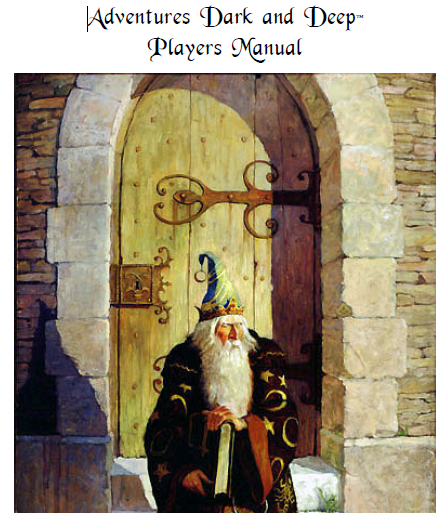
Reading Room: Adventures Dark & Deep - Player's Manual (Part 1)
Adventures Dark & Deep, an RPG written by Joseph Bloch and carefully playtested by a community of gamers at the ADD message boards, has been of interest to me for the past year.
The conceit of this set of rules (which claims not to be a retro-clone) is that it is a "what-if" type of ruleset (placing it in the Alterclone or Neoclone arena), positing that the rules contain within might be what the AD&D 2nd Edition ruleset would look like if E. Gary Gygax hadn't left TSR when he did.
I'm only covering the Player's Manual (and only a small portion of it right now), but there is a Bestiary and a Gamemaster's toolkit for the curious -- also available for free on RPGNow.
Character Classes
They key area of interest for me is the character classes, and this is primarily due to my upcoming work in Enigmundia.
In Adventures Dark & Deep, there are a series of core character classes, with several other character classes known as sub-classes -- classes that give more special abilities than the core class but also have more stringent requirements. Let's take a look at them, how they are described in the book, and how I plan to use them:
Bard
Jester (Bard sub-class)
Cavalier
Paladin (Cavalier sub-class)
Cleric
Druid (Cleric sub-class)
Mystic (Cleric sub-class)
Next Up:
Fighter, Barbarian (Fighter sub-class), Ranger (Fighter sub-class)
Mage, Illusionist (Mage sub-class), Savant (Mage sub-class)
Thief, Acrobat (Thief sub-class), Mountebank (Thief sub-class)
The conceit of this set of rules (which claims not to be a retro-clone) is that it is a "what-if" type of ruleset (placing it in the Alterclone or Neoclone arena), positing that the rules contain within might be what the AD&D 2nd Edition ruleset would look like if E. Gary Gygax hadn't left TSR when he did.
I'm only covering the Player's Manual (and only a small portion of it right now), but there is a Bestiary and a Gamemaster's toolkit for the curious -- also available for free on RPGNow.
Character Classes
They key area of interest for me is the character classes, and this is primarily due to my upcoming work in Enigmundia.
In Adventures Dark & Deep, there are a series of core character classes, with several other character classes known as sub-classes -- classes that give more special abilities than the core class but also have more stringent requirements. Let's take a look at them, how they are described in the book, and how I plan to use them:
Bard
A performer and entertainer, but one with the ability to cast spells through their music and songs. They specialize in manipulating the emotions and feelings of others.I can use this in my Zan Lazario setting, though I'd prefer to expand this to other performing arts such as stage plays and storytelling. Just to break away from the image of the lute-playing bard. This tradition would probably come from both the "Spanish" equivalent and the "Filipino" equivalent cultures.
Jester (Bard sub-class)
Another sort of performer, but focused on distraction and misdirection. They rely mostly on their verbal patter and entertainment skills, but at higher levels gain some ability to cast spells.Interesting, and comes across as an alternative to the more traditionally-trained bards, it's curious that it's a sub-class instead. May have to study it further as to integration into the setting.
Cavalier
The proverbial knight in shining armor who follows a strict code of chivalry. The cavalier is a skilled warrior, with a focus on horsemanship and melee weapons. They are forbidden most sorts of missile weapons, feeling them to be less than chivalrous.Huh, that's interesting -- a class with missile weapons proscribed. Not so sure how that will work given the existence of gunpowder at the time, but it can help with the feel by reducing the presence of bows and arrows with the higher up military types. These guys can be from the Ispanialo (Spanish) noble families or from the warrior culture of the Katao (indigenous Filipinos).
Paladin (Cavalier sub-class)
A holy warrior. All paladins must be of lawful good alignment, and follows a code of behavior even more strict than that of the cavalier. He possesses innate powers to help combat evil, and at higher levels gain the ability to cast clerical spells.Defenders of the faiths will be interesting in Zan Lazario, but they should be rare.
Cleric
The cleric is a priest, who may serve some deity or even an entire religious pantheon. They are skilled in combat, may wear any sort of armor, and have the ability to cast spells, most of which are geared towards healing, divination, and protection.The presence of a Catholic Church-inspired faction is very important in Enigmundia's Zan Lazario, so these are obviously a must-have.
Druid (Cleric sub-class)
A priest dedicated not to a god or gods, but to Nature itself. They are limited in the armor they can wear, but their spells are very effective in dealing with the natural world, plants, and animals. At the highest levels, they are effective at manipulating the very elements themselves.I'd make these guys to be the main mystical opposition to the clerics with a little reskinning. They're not necessarily enemies, but they're the main spell-casting opposition of the colonizers, hampered by a tendency to be anti-social and a territorial gunslinger culture.
Mystic (Cleric sub-class)
Another sort of priest, but one who attempts to come to an understanding of, and ultimately become one with, the multiverse itself. Their spells emphasize personal development and harmony with the universe.Another indigenous tradition in Zan Lazario, these guys would tend to be more mentors and spiritual advisors to the leaders of the various local kingdoms and warrior clans.
Next Up:
Fighter, Barbarian (Fighter sub-class), Ranger (Fighter sub-class)
Mage, Illusionist (Mage sub-class), Savant (Mage sub-class)
Thief, Acrobat (Thief sub-class), Mountebank (Thief sub-class)
Subscribe to:
Posts (Atom)