Friday, July 22, 2011

God, Elves, Dwarves, Giants and Monsters

So, inspired by this post, I've decided to avoid my initial idea for a post -- to be written in in-character tone -- on the ancient history of Enigmundia told from different viewpoints.

Instead I'll just write out all my thoughts at once.

There is a Creator, but also an Enemy, and eventually the Accuser. There are Those Who Were Cast Out and Those Who Fell.

Those Who Were Cast Out are the devils and demons of the universe. As to where they were imprisoned it is a place separate from the Presence of the Creator.

Those Who Fell transitioned from being mere spiritual creatures to being partially of the material universe as part of their escape from the War in the Heavens. On Enigmundia, they began manipulating the natural laws with their celestial knowledge, taking on mortal women as wives, siring children (the earliest giants), carving out many kingdoms across the land, and teaching their increasingly mortal numbers the secrets they brought. Also, for a short time, they fooled or coerced the various Heralds and Warders of the world into recognizing their false authority. When the Creator and his loyal Choirs resolved matters with Those Who Were Cast Out, eventually caught wind of the anomalous reports from Enigmundia (and other realms) igniting the War in the Realms.

High Elves and High Dwarves were among the ranks of the Heralds and Warders of the world, and the War in the Realms caused many schisms and much confusion. As it continued, ancient secrets, strange wonders, and warped powers erupted in the service of these many factions. In the aftermath, the High Elves and High Dwarves disappeared from public view -- and the more familiar forms of the 'modern' elves and dwarves began appearing.

Let's see. And the halflings were mortals creatures brought into the world to kill abominations like the giants and chimerical creatures.

Wednesday, July 20, 2011

Inspiration: Grimjack, Cynosure, and Paradise Lost

Grimjack against a chaotic demon swarm entering doomed Pdwyr.
In many ways, Grimjack was a big inspiration to the phase of my gaming where a character's backstory was as important as his present.

At this time, I was regularly playing in a Champions campaign where I played a character with a death wish. I remember that, after the first few games I'd survived, I began planning out the backstory of this martial artist character.

Much was borrowed from Grimjack there: a troubled past with betrayals and a lost love, a series of tragedies, and a tendency to throw caution to the wind when trouble reared its head. Of course, I borrowed things from other sources as well, such as the classic Daredevil and Spiderman portrayals -- tough, haunted characters who laughed and joked irreverently in the face of terrible opposition -- but Grimjack was the source of my grim and gritty before grim and gritty became the norm in comics.

I was also fascinated by the concept of Cynosure -- a city that eventually slipped into phase with ALL dimensions in the multiverse -- and the tagline: "guns work here, magic works there, swords work everywhere."

There were many characters and concepts of note here that are fun to mine for fantasy games and for Fading Suns campaigns -- and in fact I ripped the plots of a number of issues for some adventures I ran.

Characters I'd like to reimagine for Fading Suns include:
  • Kalibos -- the folly of the Free Marines; a cold, cunning, sentient machine with a too-literal love of freedom and a PRG (portable reality generator) that renders it immune to many powerful technological and magical attacks
  • Spook -- a female ghost whose intangibility and supernatural nature ebbs and flows with the magical levels found in Cynosure
  • Gordon Munden -- barkeep for Munden's Bar with his own past involving succubi and some very special knives
  • Jericho Noleski, Finance Minister Honesworth, Blacjacmac, Dancer, the Major, Jim Lanyon, too many to list!

Perhaps I'll do a series on these issues and translate them into Fading Suns adventure seeds.

Tuesday, July 19, 2011

More on the Vancian Spell System

In coming up with a rationale for the Vancian system and why it's so prevalent in the D&D worlds.

In the context of Mystara and the Thyatian / Karameikos lands, there's one possibility I've thought of that doesn't preclude the existence of other magical systems: reliability.

Thyatia is characterized as a conquering empire, one that looks at the utility of all things -- including magic. It's arguable therefore that the Vancian magic system, with:
  • verbal, somatic, and material components;
  • spell books;
  • memory space requirements;
  • etc.
are actually the most reliable spell system in the world. It's a magic system that -- assuming that the target doesn't make any potential saving throws -- will work reliably.

You'll know if you've successfully memorized something or not. You'll always cast it successfully (assuming all components are doable) if uninterrupted in combat. You'll always know how many spells you've got with you and how many more you can cast that day!

Spells and the Vancian Paradigm

Having read the various posts on Vancian magic, the stories that inspired the system, and some of the criticisms of the same, several thoughts have come to mind:

1. The core ideas --  that spells take up mental space, and that human mental space is limited -- can easily be rationalized in a setting. Whether it is because one can only memorize so many spells in a day, or because spells are semi-living things that take up certain amount of finite mental space in their hosts, or because spells are complex mathematical formulae that can be pre-cast in a finite amount of time and released with triggers, if that's the way magic works then it should be accepted as part of the setting... just like half-elves, massive underground dungeons, and a mysterious mint that continuously strikes generic gold, silver, and copper pieces for placement in treasure chests.

2. The criticism of Vancian magic seems to stem from the very specific mechanics, which vary from the portrayal of magic in stories and media that we're exposed to. In the Harry Potter universe, magic does require some learning, but once learned the spells seem to be castable at will -- and there are consequences for miscasting. In the Belgariad, the most common price of magic is to tire out the spellcasters, but there seems to be no restriction on which spells are available on a given day.

3. The wizard class itself seems to be restricted, given the restriction on swords and other weapons and armor -- which runs counter to the portrayals of spellcasters in fiction. Gandalf, of course, wielded a sword; while he may be characterized as a multi-classer, he didn't seem to be much of one and is still held up as a classic example of a wizard.

It seems that a lot of the criticisms, and the attempts to fix the magic system and magic-user class in general stem from the perception that D&D mages aren't really very generic despite their portrayal in the art.

Now, I've read somewhere in magazines (forgive my memory, this was 15 years ago) that there used to be a magic point system in the very early days of D&D, but there was a terrible effect on gameplay: mages became spell-slinging machine guns, which robbed the RPG of the flavor of mages.

These days there are many magic systems with different mechanics out there, so issues #2 and #3 are easily fixed (3E and 4E have both taken stabs at it, as have other retroclones).

How successful have they been in retaining the feel of a mage or wizard, despite / because of the chosen mechanics?

Sunday, July 17, 2011

Enigmundia: Megadungeons in the Kingdom of the Wheel

As I mentioned in my previous post, the default megadungeons in the setting are those found 'beneath' or are associated with the Spires, and the rationale is one of reclamation: this belongs to the Kingdom and we need it back before the Overking returns.

What are these megadungeons like?

Purpose of the Spires and their Megadungeons

The original purpose of the dungeons was safe mass teleportation; even in the time of the ancient (one might say epic) era of Kingdom of the Wheel, earth blocked all teleportation. To ensure that no small amount of built up dirt, kicked up by winds or movement, would interfere with the movement of troops and valuable commodities, the spire teleportation system was created.

A teleportation spire has the visible spire towering above the ground, allowing teleportation beyond the horizon. The lower half (whatever shape it becomes below the ground) drops into the earth into a large dirt-free chamber far below the surface. Around this teleport platform, there were various staging areas, corridors, security checkpoints, offices, quarters, stairs, featherfall pits and levitation tubes for the transport of the troops and commodities in and out of the underground area.

Of course, because this was underground, the dwarves of the area were involved in the construction and in some cases even linked some of their secure Underground Halls and Highways to the underground spire facility.

The Coming of Chaos

During the war with the Overking of Chaos, these underground areas were further enlarged to house wartime personnel to defend the network against the potential infiltration of the Chaos Courtiers. Because of these precautions, not all of the Spires fell to Chaos and in most cases even those that did were able to secure the auxilliary teleport chambers to allow the surviving forces of the Kingdom to mount retaliatory invasions.

However, the presence of Chaos had some effects on the size, shape, on the original layout of the underground spire complexes. Furthermore, the fall of the Overking of Chaos did not signal the end of all of his Chaos Courtiers. Most were greatly diminished in power and had to sacrifice much of their power to retain some semblance of physical existence in Enigmundia's reality. A number were enslaved or had their powers stripped and transformed by the devils and demons and lesser gods of the realm. The remaining few ensconced themselves in portions of the Spire Complexes, warping the rules of reality in a -- to them -- pitifully small area of influence to survive. It's rumored, that other Chaos Courtiers did the same to other parts of the Kingdom of the Wheel and its surrounding lands (some mountains, forests, and portions of the Dwarven Underkingdoms).

Behind the DM's Curtain

All this is a rationale for dungeons and megadungeons in the Kingdom of the Wheel, and a rationale for various patrons and industries to back megadungeoneering (particularly in the case of the Spire megadungeons) which I'll tackle in a later post.

It also allows folks interesting in using much of the online material for megadungeon creation to do so -- fitting the existence of these megadungeons into the Kingdom's backstory is pretty easy. For example, one of the 'big baddies' of Stonehell Dungeon is easily recast as a Chaos Courtier -- one whose existence can be built up with rumors and/or logs from the military archives of the bygone era.

Also, the presence of the standard goals for megadungeoneering in the Kingdom of the Wheel (map the dungeon, find the teleport areas, clear the facilities for use) is an argument for more facilities and support from the outside world for adventurers, as well as a source of fresh adventurer gossip (various failed and successful expeditions with new updates to the map).

As for a canonical map of the spires -- I don't have any. However, I'm currently considering the work of 0One for The Dungeon Under The Mountain (see the image above for a neat teaser image) as the Shadowspire megadungeon. To date (and I think they're done), there are ten levels to this interactive PDF product, and the links to each of the levels can be found below:

In addition, I'm checking various blogs for the wealth of resources on megadungeon creation, and here are the ones I've found so far... oh wait, someone's done this already.


Saturday, July 16, 2011

Enigmundia: Checklist for Kinda-Christian Religion

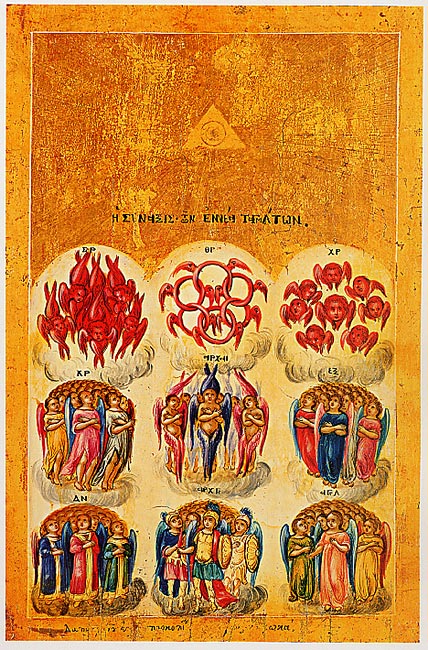
Awesome Orthodox representation of
the nine orders of angels.
The Thyatian Empire of Enigmundia has an official religion. I'm trying to put together enough elements of it to make it workable in a gaming world (adventurer priests) but still feel like the monotheistic religion it's based on. So here's my current checklist of things that this religion needs:
  1. rationale for adventurer priests
  2. rationale for usage of the cross (not crucifix) as a holy symbol
  3. detailed explanation of how the sacrifice of the Prince of the Cross saved / saves the world and its believers -- current working idea is that, by his continuous sacrifice, the world (Midgard) is walled off from direct interference from entities of the higher and lower realms
  4. rationale for the clerical spells (sacraments, blessings from angels, appeals to saints, spiritual authority, genuine miracles and gifts)
  5. hierarchy of the choirs of angels
  6. the role of high elves and high dwarves
  7. the role of elves, halflings, and dwarves
  8. the church's view of other sentient races
  9. the church's view of chimerical creatures
  10. the church's view of pagan religions and their clerical abilities
  11. the church's stance on magic (official system)
  12. the church's stance on magic (other systems)
  13. the church's hierarchy (central authority, religious orders, lay personnel, believers)
  14. the church's most prominent saints
  15. why doesn't the church just set up an assembly line of healing?
  16. what's the real reason the clerics can't use edged weaponry?

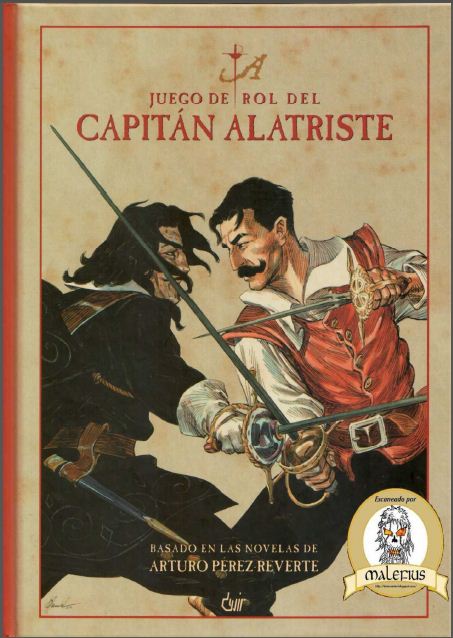
Inspiration: Capitan Alatriste RPG

Oh, I wish I had a copy of this. Preferably in English, but the Spanish would be fine as well.

As source material on Spain and swordfighting and the culture of the era, it would be as invaluable as the novels that the RPG is based on!

I have been following the author of the books, Arturo Perez y Reverte, ever since a friend introduced me to the novels The Club Dumas and The Fencing Master. When I found out about the Alatriste series, I greedily devoured them as well -- swashbuckling, but with the same sense of gritty, textured noir that pervades the other novels.

All the art is by the artist who does the covers of the novels, I'm told.

The rules system (as reviews on RPG.net have stated) appear to be a very rules lite version of GURPS. Based on what I've been able to piece together (a number of words in the Filipino tongue are also derived from the Spanish language and at a point in time, knowing Spanish and one other European language was considered a sign of class and distinction among the well-to-do families of the Philippines, so I get the gist. Plus I studied Spanish in high school and watched Sesame Street) it is a rules lite resolution system, but with a lot of emphasis placed on manuevers and tactics in combat. Especially sword fighting.

In fact, there's supposed to be a sourcebook out on various Esgrima (fencing) fighting styles already!

I want to come out with an RPG like this, but with a Philippine flavor.

Maybe when I've gotten one small RPG or sourcebook completed first.

Thursday, July 14, 2011

Reading Room: Thieves by Retro-clone

"Hah! You thought I wasn't a thief, didn't you? Well, these
are leather pants, buddy. So there!"
Similar to my entries for the Fighter and Cleric classes, I'm reading through the retro-clone descriptions of the Thief Class to get some sense of the essence of the character class before building it in HERO System 6th Edition.

Yes, there is an 6th Edition Fantasy Hero book out, and I'll be referring to it as well for the mechanics. However, I'm trying to build something that hearkens back to then essence of the D&D classes -- Fantasy Hero really broadens the definitions and gives more options to allow different types of classes so something may be lost. Anyway, HERO prides itself on allowing folks to build exactly the characters they want -- I'm just trying to figure out what I want from the classes first.

Basic Fantasy RPG says:
Thieves are those who take what they want or need by stealth, disarming traps and picking locks to get to the gold they crave; or “borrowing” money from pockets, beltpouches, etc. right under the nose of the “mark” without the victim ever knowing.

Thieves fight better than Magic-Users but not as well as Fighters. Avoidance of honest work leads Thieves to be less hardy than the other classes, though they do pull ahead of the Magic-Users at higher levels.

They may use any weapon, but may not wear metal armor as it interferes with stealthy activities, nor may they use shields of any sort. Leather armor is acceptable, however.
Clearly, Basic Fantasy RPG doesn't avoid the implications of the character class name and makes the acquisition or procurement of wealth or items as the primary motivator for someone who's entered into the profession of rogue -- THIEF, I mean.

It's interesting that they point out that thieves are better fighters than magic-users, but point out their lack in hit points (even supplying a rationale for it). I hadn't noticed the hit point edge they gain after 9th level, but it's good to know.

The infamous leather armor restriction is there, along with the rationale that it interferes with theiving activities.

Labyrinth Lord says:
Thieves have a range of unique skills associated with their profession that make them very handy companions in adventures. However, thieves can be a bit shady and they sometimes are not as trustworthy as other classes.

A thief will usually belong to a Thieves Guild from the character's local town, where he can seek shelter and information between adventures.

Because of their need of stealth and free movement, thieves cannot wear armor heavier than leather, and they cannot use shields. They have a need for using diverse weapons, and are able to use any kind.

A thief has the ability to backstab. He must catch an opponent unaware of his presence, using move silently and hide in shadows.
A bit more coy about the inherent lack of morality and ethics that come with being a Thief ("You can't trust him! He's wearing leather armor -- he'll rob you blind!"), Labyrinth Lord mentions other classic thief bits: the Guild and the backstab ability.

Swords & Wizardry says:
Note: the Thief is an optional character class that the Referee may choose to allow or forbid, depending on the campaign.

The thief is a figure in the shadows, an expert in stealth and delicate tasks. As a thief, locks, traps, and scouting are your trade; you are the eyes and ears of the adventuring party, the one who handles the perils of the dungeon itself. In many ways, you are a scholar of the world; in the course of your profession you pick up knowledge about languages and even magic.

True, in combat you are not the equal of armored Fighters or Clerics, but they have to rely on your knowledge and specialized skills to get them safely into and out of the dangerous places where treasure is to be found. You are the guide; the scout; and when necessary, the deadly blade that strikes from the shadows without warning.

In your profession, it takes great skill to survive – the life expectancy of most Thieves is very short. However, if you rise to high level, your reputation in the hidden community of tomb robbers and alley skulkers will attract followers to your side, often enough allies to place you in power as a guildmaster of Thieves.


A high-level Thief is a deadly opponent, for such an individual has learned subtlety and survival in the game’s most difficult profession.
All characer classes are, of course, subject to DM approval. Swords & Wizardy, however, goes as far as stating that explicitly, indicating that the class is optional and isn't necessarily meant to be a part of the generally available character classes of the game.

The description of the thief class, however, is clearly pro-thief and one that can reflect a PCs own worldview regarding his chosen profession.

Of special interest is the note that it is the game's most difficult profession -- I hadn't though about it, but I do remember that there were no straight thieves in my AD&D games. All my fellow players multi-classed their thieves, thus leading to the party's clerics, fighters, and mages all trying to see "if that door is really locked".

OSRIC says:
Thieves sneak furtively in the shadowed alleyways of cities, living by their wits. They are often members of the criminal underclass, usually trained by a thieves’ guild in the arts of burglary and stealth. It is not uncommon for a thief to seek out the great rewards that can be gained from the adventuring life, especially when circumstances require lying low for a while.

Most thieves come from the teeming masses of a large city, wherein a thieves’ guild is often the only source of justice and exercises as much power as the city’s legitimate government. Of course, not all thieves are members of a guild. Some are freelancers, evading both the authorities and the guild, living on the edge of the knife. Some are even found working on the side of the law; agents or spies who use their skills in more accepted (though equally shadowy) pursuits.

Sensible adventuring parties will almost always include a thief, for the skills of such a character are invaluable in reaching inaccessible places via climb walls, pick locks, and so on. In addition, dungeons frequently contain traps which must be located and disarmed, and the thief’s cunning and stealth conspire to make him or her very useful in a scouting role.

Thieves in OSRIC are modelled on characters of fiction and legend, particularly characters from the works of Fritz Leiber and Jack Vance. Leiber’s “Lankhmar” series is highly recommended, particularly for its description of the operation of a typical thieves’ guild; but the high-level thief’s ability to read (or misread) magic scrolls is a nod to Vance’s Cugel.
OSRIC's take actually mentions the normal origins of such a character -- from the masses of commoners living in a large city -- and gives examples of variants on the profession different from the stereotypical cutpurse or footpad.

OSRIC also mentions the role of the class outside of combat, and makes allusions to the literary origins (and thus legitimacy) of the class in the game.

Enigmundia: Kingdom of the Wheel

Warning: radius and size of spires and circle not to scale.
In the Kingdom of the Wheel, magical teleportation is stymied by the very earth itself. It is possible, with sufficient power in teleportation magics to reach one of the moons in the sky, but it is not possible to teleport beyond the horizon (unless one is at sea). This limitation on teleportation (or property of the soil and sand of the land) secured castles and fortified cities from efforts that would compromise the very nature of their defenses, but it also made it difficult to rapidly transport military forces and much needed supplies across the Empire.

That is why the ancients built what was once known as the Silver Spire, and its sister spires known as the Cardinals. These towering crystal-shaped stone monoliths, flecked with streaks of unknown metals, were once able to teleport huge amounts of personnel and resources across the Empire. It is theorized that they somehow break the limitations of line-of-sight teleportation from spire tip to spire tip, but that knowledge was lost in the war against the Overking and his Chaos Courts 986 years ago.

In the war, the underground complexes that once moved the men and material that shaped a continent, were warped by Chaos magics, turning them into labyrinths filled with strange creatures. Many heroes and villains of that age died in those underground bastions of the Empire, many finding themselves fighting side by side against overwhelming odds -- but in the end they succeeded.

The Overking was imprisoned, the power that fueled the Courts somehow leeched by the Silver Spire itself (turning it black as night),  and the Chaos Courtiers were left to fend for themselves. Some fled into the spaces between the former Silver Spire (dubbed by many as the Shadow Spire) and carved out realms of their own; others ensconced themselves into the caverns and labyrinths and dungeons all along the perimeter of the Kingdom of the Wheel.

It is rumored that the wondrous teleport halls of the spires must all be found in the mega-labyrinths beneath the Shadow Spire and the Cardinals so that the Empire might once again regain a semblance of its strength and find a more permanent solution to the Overking. It is rumored that the luminaries of that legendary age knew that solution, but were slain before it could be enacted. It is rumored that the Overking's imprisonment -- the result of a mad, one-in-a-million chance taken by the ragtag aides and retainers of the legends of that time -- would last only a thousand years, and time is running out.

Will you join the expeditions into the spire labyrinths, map out their secrets, and prepare against the Overking?

Behind the DM's Curtain
So where did this come from?

This was started because I realized several things about my 'Karameikos-and-Philippines-inspired-setting': (1) it's gonna take a while before I start posting key location stuff; (2) I wanted to create a setting in the same cosmology that was less culture-focused and more dungeon / castle / weird creatures / evil mastermind oriented; (3) I took a look at OSRIC and was wowed by it, and remembered a classic campaign by a friend -- Bill Homeyer -- known as the Kingdom of the Wheel; (4) I remembered that it was structured really nicely to maximize the usage of a lot of random tables in AD&D; (5) I realized that some tweaks to the Kingdom of the Wheel allowed people to create mini-sandboxes with at least one mega-dungeon per spire.

So I decided to stick posts about the Kingdom of the Wheel (a lot of the Wheel ideas were from him, but the stuff I don't remember because it was quite a while ago, I'm filling in with embellishments and rationale because he was very stingy with revealing secrets, dammit) in between my efforts to create my original Enigmundia setting just to share some of the joy and sense of wonder that Bill's old campaign imparted to me.

Furthermore, rather than my proposed HEROic D&D ruleset, this one will use OSRIC for game mechanics -- primarily because I played this setting in AD&D and it feels right.

Wherever you are Bill, thanks for taking pity on a stupid kid fresh from the Philippines who didn't quite understand what a rune of death trap was and kept trying to read it.


About the Spires

The spires are artifacts and are protected by powerful arcane and divine magiks for some reason unknown to mere mortals. They are really tall -- I've not done the math yet, but I'm thinking at least a 5000 feet up. That makes the distance to the horizon around 30 miles. So the empire is 60 miles across? Then again, the spires are tall, maybe they can be seen above the horizon and I can stretch it out a bit more. What's the curvature of the earth? Hm, I'll need to revisit my math and geometry.

I'll need to figure out how to use some graphic design software to superimpose the darn thing on a map. Here's a mockup of the Kingdom superimposed on the map from the excellent Roma Imperious setting (Hinterwelt). Still not to scale, but it helps me get an idea of how I can proceed.

Wednesday, July 13, 2011

Inspiration: Amaya's Shipbuilding and Creature Lore

It seems that the TV series Amaya has been laying on the research pretty thickly. First off, they've been dipping into William Henry Scott's research work and built a ship -- the Karakoa -- based on his research and from other sources.

Furthermore, creatures such as the Bakunawa and Amaya's own snake twin are alse featured on the show.
Thanks, William Henry Scott. Now I have to buy your book from Ateneo de Manila (hello alma mater) Press. Fortunately the preview pages on Google books have a wealth of historical and cultural information.

The Karakoa

In this link we read from the tv channel GMA some of the material concerning their construction of the Karakoa. They didn't build it from scratch, but they did use some of the building techniques mentioned in the book to do it.

The karakoa was a type of warship / raiding vessel that was faster than any spanish galleon and was built without the use of a single nail. It is described as a
sleek, double-ended cruiser with an elevated fighting deck amidships, and catwalks mounted on the outrigger supports to seat as many as six banks of paddlers. They displayed tall staffs of brilliant plumage fore and aft as a sign of victory, called sombol on the prow, tongol on the stern.
If you're thinking the front looks a bit like the back, you're right. This was part of the karakoa's claim to fame for maneuverability -- to change directions, the rowing crew just flipped positions and the commanding party walked to the other prow and they went off in the opposite direction.

The ship wasn't without downsides, however. Because (1) it was built with a relatively lightweight, flexible hull; and (2) it lacks a central rudder, it was easily blown sideways on smooth seas and was easily frustrated by choppy waters.

In between some of the interviews of the actors and actresses, there's a shot of the constructed karakoa for the show in the video below:


Bakunawa

The Bakunawa is a creature from Philippine mythology that was blamed for eclipses. I'd always thought of it as a giant monstrous fish, but WikiPedia calls it a gigantic sea serpent or a gigantic sea turtle. In ancient times, the people of the land would bang the floors of their houses, along with their cooking implements and metal weapons to scare the creature into spitting out the moon. Other stories claim that playing music helped calm the creature.

In Amaya, there's a slightly different take:
The night sky used to have seven moons, until the bakunawa — a giant winged sea-serpent in the spirit world — was entranced by their beauty and ate six. But one moon remains in the night sky because the gods punished the serpent before it could devour the last moon. Despite that, the bakunawa still gets tempted and occasionally attempts to eat the moon.

I like the concept of the six other moons being in the belly of this creature somewhere in the world, or perhaps already digested and remnants hidden somewhere in the waters surrounding the island as Moon Pearls. It allows for the creation of some pretty neat magical items (Bakunawa Balls? Nah.) too.

Indianna Jones wouldn't have liked her sibling

Amaya is born as a snake twin. This means that when she was born, she came out with a little snake which is considered her twin ("She's not my familiar; she's my sister!") and for the little background surrounding this I'll just quote the article directly:


A pregnant woman would be warned against viewing the red-hued moon or leaving the house during an eclipse, lest tragedy befall the child she carried in her womb. Traditional beliefs vary, with eclipse-touched children feared to be suffering from a wide range of afflictions, from black-spotted skin to disfiguration, even madness.

The circumstances surrounding Amaya’s birth were slightly more fortuitous, the eponymous heroine being fair-skinned but born with a snake-twin — seemingly bringing to fruition the prophesy of a woman warrior with a snake-twin destined to kill the ruling rajah.

Amaya’s snake-sibling is thought to be an umalagad, or spirit that escaped the bakunawa’s realm, that would protect and guide its human twin.
I'm going to have to do more research on the snake twins. It really works with the cosmology I'm working on and evokes wonderful ideas when contrasted with the mythological serpent in the Garden of Eden.

Tuesday, July 12, 2011

Mining Firebirds: Trail of Cthulhu

This Ennie-winning product should be familiar to many, but let me take some time to bring up some points as to the usefulness of Trail of Cthulhu in the Fading Suns setting.

One of the things that FS tackles is the Annunaki (the ancient ones who built the moon-sized jumpgates at the edges of the solar systems of the universe), the existence of ancient evils and intelligences in the dark between the stars, and the Holy Flame of the Pancreator as revealed to his prophet Zebulon and his apostles and disciples.

Aside from the echoes of various monotheistic religions found in the Orthodox Church, there are also various heretical beliefs and proscribed knowledge such as Antinomy -- a label for certain worships and forbidden knowledge that are 'against the Name of the Creator of All'.

And into that space, we find the need for the aforementioned ancient evils and intelligences.

Trail of Cthulhu has that in spades. But what makes this particular 'monster's manual' different from other listings of the Cthulhu pantheon and creatures is the work that Kenneth Hite has put together into creating alternative options for each of the well-known and less-well known elder Gods and Old Ones from the pantheon.

As the text itself says: "This book takes a similar approach to these beings, providing as many contradictory explanations and alternate versions for the Mythos heavyweights as possible."

Here are some examples with some staples of the pantheon with their variant definitions:

Azathoth
Original -- Azathoth, the blind idiot god, exists at the center of the universe, dwelling beyond normal space-time. Its amorphous form writhes eternally to the piping of demonic flautists, attended by mindlessly dancing lesser gods. Azathoth is the ruler of the Outer Gods, little worshipped on Earth, as it provides not even attention to its would be cultists. If summoned, it blasts the area around it, leaving cracked boulders, pools of alkaline water, and dead, splintered trees.

Variant -- Azathoth is an emergent intellect – a titan – created in the immense pressure at the event horizon of the supermassive black hole at the center of the Galaxy (in Sagittarius). The “hellish piping” is the howl of high frequency radiation emitted from its “prison,” the black hole’s Schwarzchild radius. Its sentience exists in hyperspace and maintains instantaneousdipole communication with other black hole entities, its “attendants.” The Tunguska blast of 1908 was an attempt to summon Azathoth to Earth.

Variant -- Azathoth was the leader of a revolt against the Elder Gods who impose order on the universe, without which matter itself could not exist. He failed and was hurled back to the endless wormhole moment at the beginning of time.

Cthulhu

Original -- The Great Old One Cthulhu dwells in the sunken basalt necropolis of R’lyeh, miles deep at the bottom of the South Pacific. He sleeps eternally while there, sending horrifying dreams to mortal men, tipping some into madness and others into his fanatical worship. Someday R’lyeh will rise again and Cthulhu will wake, freed once more to raven and slay, freed to rule the world.

Variant -- Cthulhu is an Outer God, the incarnation of (or a sentient facet of) gravity, one of the four fundamental forces within our space-time.

Variant -- Cthulhu is an infra-dimensional entity that has only a conceptual existence within the human “R-complex,” the brain stem and limbic system left over from our primordial reptilian ancestors. This is why he appears only in dreams, high-stress encounters (such as shipwrecks), and artistic impulses. He is attempting to create a critical mass of believers so that he may “emerge from R’lyeh” and open the eyes of all.

Now, some purists may take issue with these reinterpretations, but they do provide the FS Gamemasters ideas for blasphemous creatures for use in the Fading Suns context. All you need to do is change the names!


Monday, July 11, 2011

Enigmundia: Tactics used by the Spaniards to Convert the Heathens

Not Professor Susan Russell, but rather Marian Rivera as Amaya wearing an
example of indigenous armor worn before the Spanish Friars came a'calling.
I happened upon an interesting article / lecture by Professor Susan Russell here talking about the tactics used by the Spaniards to conquer -- er -- convert the godless Filipinos (who weren't Filipinos yet because the land hadn't been renamed the Philippines in honor of Philip yet) to Christianity.

For those of you with very little time on their hands, here are key points of her lecture (which is the second one on the page):
  1. A majority of the population of the "Philippines" at the time was organized into scattered communities with no central authority -- which made it easier for the Spaniards to do their work;
  2. The Muslim Sultanates, found mostly in the southern islands with some presence further north, never fell to Spanish rule;
  3. Before he met his end against Lapu-Lapu, Magellan successfully converted Rajah Humabon and 800 of his followers after Magellan's people were able to cure the Rajah's grandson of an illness;
  4. Legaspi conquered a Muslim Filipino settlement in Manila in 1570;
  5. Islam spread slowly through the Philippines and would likely have dominated the archipelago if not for Spanish intervention.
She also cited several key practices that help the Spaniards win converts:
  1. Mass baptisms -- given the friar to Filipino ratio, this was the only way to convert huge numbers quickly; it was aided by the fact that Filipino animist / syncretic beliefs of the various settlements also believed in the potency of holy water;
  2. Reduccion policies -- the practice of resettling the small hamlets and thorps into artificially created towns helped the Spanish enforce their will (which included paying taxes) on the populace... when the population stayed and didn't eventually wander away back to their original homes;
  3. Attitude of the clergy -- many of the early missionaries learned the many (more than 200) languages (not dialects, there are even more of those) of the Philippines at the time in order to preach to Good News;
  4. Attitude of the clergy 2 -- many of the clergy at the time also stood up against abuses and excesses of the Spanish military, winning the favor of the indigenous population;
  5. Adapting the faith to the local context -- where possible, the clergy sought to supplant existing beliefs; where there once was a minor god, the priests inserted a saint; where there once was an animist festival for the harvest, an appropriate religious celebration was held instead; and so on.
A lot of this will be useful in setting up the initial political climate in my Filipino-esque take on Karameikos. I'm actually quite happy to hear about the reduccion policies as it helps justify abandon hamlets and settlements. It also makes me think about those rumored settlements where the denizens were all aswangs and other creatures who preyed on other towns -- it must have been fun when the soldiers and priests rounded them up to join the common folk.

Have I mentioned that some of the animist beliefs echo stories of faeries and little people and strigoi and wereboars of other countries? I'm quite thankful for the work of GM Dariel on Hari Ragat because it means I won't have to bust my butt too much when it comes to the 'monsters'.

Thoughts on Cosmology

Because I started doing research on Elves and Dwarves, and I've been working on my kinda-Christianity and kinda-Zoroastrianism religions, I found myself banging my head repeatedly against the concept of a cosmology for Enigmundia.

Now, because my first area of concern is based on Karameikos -- a land whose Gazetteer is built primarily as the most familiar type of D&D mini-setting in the overall setting of Mystara -- I'm also trying to make mine a starting point for a 'typical D&D' setting with a distinct character of its own.

In fact, creating a kingdom on one of the borders of a large empire with:
(1) a native population with its own pagan / syncretic beliefs
(2) neighbors (human and non-human) who have their own cultural, political, and religious beliefs; and
(3) a wise and cunning ruler with substantial yet limited resources and support

makes a strong argument for the practice of tolerance of many beliefs in the setting. That's not to say that there won't be clashes, but the Powers That Be will frown on those seeking to upset the delicate balances.

Actually, it's starting to sound a bit like Babylon 5, only instead of a space station, it's an entire country that is most definitely not neutral territory.

In any case, I've found myself awash in fairly dense and contradictory and confusing WikiPedia resources that I'd like to share with some of you:

Norse and Germanic Mythology
Alfheimr -- one of the nine worlds of Norse mythology, and home of the Light Elves. It has been characterized as mystical and benevolent but sinister and wicked at times.
Frey/Freyr -- brother of Freyja and also ruler of Alfheimr (it was given to him by the gods as a teething gift).
The Nine Worlds -- Midgard / Mannheim is one of them but other fantastic places to visit remain, even if differing sources don't agree on the lineup of worlds.


A Bible and The Book of Enoch
Always good for world-creation flavor, though I shall probably dip into Von Daniken's "Chariots of the Gods" and Sitchin's Earth Chronicles series at some point in time:

That's all for now. Keep those postcards and letters coming.


Link Roundup: Maps & Geo-Morphs

Well that's serendipitous.

Just I begin worrying about having to whip up a new map for Enigmundia, there's a post on map comparisons from different settings (and real life). Thanks jrients!

And, following a link from FrDave, who has his own vertical geomorphs, there's a neat resource post on "A Character for Every Game" for vertical geomorphs from all around the blogosphere!

And now that I've linked these down for future reference, it's time for breakfast.

Sunday, July 10, 2011

Fading Suns: The War In the Heavens Series

"Ever since the Vau gave
humanity its first setback
among the stars, their
space has been shut to
prying eyes. For a brief
moment, however, it has
opened - long enough for
the most daring to catch
a glimpse. But the daring
need as much wisdom
as courage, for encounters
with the Vau teach that
things are not always
what they seem.
"The first in an epic trilogy,
Lifeweb details the Symbiots,
explaining for the first time
who and what they are,
from their beginnings on the
wilderness world of Chernobog
to their modern starfaring empire,
carving worlds from human space.
Also included is an adventure
pitting player characters against
Symbiots, with the fate of
the Empire at stake."
The setting of the Fading Suns RPG is filled with mysteries and secrets and paramount among them (aside from the "why are the suns fading" question) is the War in the Heavens between the Annunaki -- the ancient ones who built the jumpgates.

When this series of sourcebooks came out years ago, I was excited not only because it seemed to provide more information on the more enigmatic alien elements, but also because it seemed to suggest hints at the old War in the Heavens or perhaps a new one in the works.

Sadly, the next book in the series didn't materialize -- the one on the Annunaki. But the new information on the shape-shifting Symbiots and the Vau Mandarins was very welcome.

But maybe the relaunch of the Fading Suns franchise with the 3rd Edition of the Fading Suns rulebook will resurrect that sourcebook series.

Creating Gaming Sourcebooks: What Tools To Use?

It was during the time that I was running Star Wars (d6) and Cyberpunk (Interlock) that I was bitten by the graphic layout bug. Computers and printers had made it possible to put together your own source material. Of course, printing them out and binding them were a problem but you could make do with several copies on acceptable paper stock and 3-ring binders but it didn't feel the same.

This is an open post asking: what are the tools that folks use out there to create their sourcebooks? I'm only asking because legal copies of my favored tools (InDesign and Photoshop) are 'spensive, mehn.

Above and beyond that, what are some good map-making tools (hex and otherwise) that are out there? I'm searching online right now and boy howdy there's a lot of 'em out there.

Saturday, July 9, 2011

Races: My Elves and Dwarves are ... Part 1


Like many folks who engage in fantasy world  creation, I want to make my elves and dwarves (and maybe halflings and gnomes) different from the Tolkien / D&D template -- but not too different because:
  1. I might as well do the Talislanta thing and not call them elves or dwarves
  2. they may end up unplayable as races

One way to do that is to dip into myth and legend. And like most folks who've not really spent much money on that kind of reference material and have no easy access to libraries, I turn to the internet and Wikipedia for my research.

High Elves and High Dwarves

You know, this diagram has some things in common with the diagram for the Hollow Earth theory. I'm thinking about
combining the diagrams somehow, but I still have to work out the rest of the cosmology with the races and the deities.
In Enigmundia, the earliest elves and dwarves were set over certain aspects of creation.

The Ælvir -- aka High Elves for typing simplicity -- were set over the living aspects of the earth: the plants, trees, animals and all things that fly and walk and crawl. They were also charged with guarding gates and waypoints throughout the lands and seas of the world that lead to the many hidden Realms and Ages of Enigmundia. In Enigmundian lore, the High Elves are considered part of a pantheon of pagan gods who were strongly identified with Nature, Art, and Innate Talent.

The Duegar -- aka High Dwarves -- were placed in charge of the unliving wealth of the world: stones and caverns and gems and ore and the red and black blood of the earth ("You mean oil?" "I mean black blood of the earth!"). They were also charged with guarding the four main pillars / entrances to the Hollow World and were broken into the Founding Clans: Nordri, Sudri, Austri, and Vestri. In Enigmundian lore, the High Dwarves are considered part of the same pantheon of pagan gods as the High Elves, but were instead strongly identified with Artifice, Craft, and Learned Skill.

But neither of these are player character races -- because they disappeared from the view of the mortal realm during the time of the War in the Heavens.

I think that the Most High would probably have given them
a map very similar to this one. Besides, this is what I think of
when I think of dwarven and halfling thieves: Time Bandits.

Thursday, July 7, 2011

Enigmundia: A List of Ingredients IV

One of the fun attractions of Mystara, aside from the grey morality of the various nations in the Known World, is the existence of the Hollow World. So it's something that I'm looking at for Enigmundia as well.

A hollow world is not a new idea, and certainly wasn't one at the time the setting was made (just in case some of you young-uns reading didn't know that), but it was fun to see it integrated into the setting. Now, I'm not sure if the Immortal Ka's Spell of Preservation will still be in place as stated in the books, but just look at some of the key cultures contained therein:
  • the Milennian Empire (think Ancient Rome)
  • the Nithian Empire (think Ancient Egypt)
  • the Azcan Empire (think Ancient Aztecs)
Usage of Cultures

Even if we do go ahead and use these cultures in a different version of the the Hollow World setting, what purpose would they serve?

The Milennian Empire would allow some compare and contrast between the pre-Christian Roman culture and the Christian-dominant Roman culture.

The Nithian and Azcan Empires might allow me to rip off some of the 'Ancient Astronaut' theories, with Immortal-granted technologies used to create their grand pieces of architecture.

Unlike the current version of the Hollow World, however, I'd actually hold that these fallen empires were the source of the 'post-apocalyptic tech' that many people seek after. And perhaps they still serve the gods they worshipped -- gods who have fallen from influence but are still powerful.

In fact, there could be an echo of the Titans cast into Tartarus by the new generation gods here.

At the same time, I do want some mysterious areas in the Hollow World, places never conquered by these three still-active empires, but coveted by their leaders and gods. Sources of power that were sealed away for unknown purposes, guarded by beings and traps that can stagger even the Immortals of the surface world.

Usage of Hollow World

Another attraction is having creatures that are extinct (or thought to be so) exist in abundance in this world. Dinosaurs and giants of mythical proportions may walk here, as may some cherry-picked denizens of the Faerunian Underdark.

And what of Blackmoor? Well, Blackmoor would be my prototypical ancient astronaut / alien god city, complete with space ship and twisted technomagic devices.

Mad Ideas

For some completely off-the-wall ideas, one of the 'spell of preservation' effects could be an unpredictable resurrection / reincarnation spell that prevents people from truly dying. Unfortunately, it only works in the Hollow World. Once outside, you tend to die normally from old age.

As such, it can work as the Tartarus of myth where beings cursed by the gods live on imprisoned or tortured.

Likewise, imprisoned Immortals and gods would constantly be seeking escape if not for the Hecatonchires -- okay, I'll stop for now.

Hollow Worlds can be addictive.

Tuesday, July 5, 2011

Secret Societies: lateral growth for character classes?

I don't how many of you picked up the Zorro comic book series by Dynamite written by Matt Wagner, but there's some fantastic stuff in there concerning the mythology of the titular character that I certainly wasn't aware of.

Of primary concern: La Justicia! This is the secret society that Zorro was inducted into, the one that taught him many skills and secrets that aided him in his fight against injustice. Furthermore, aside from the very demanding training and tests, each of the inductees are asked to take on a codename (El Latigo! La Fantasma! El Corte!) and wear a mask -- an attempt to right wrongs away from the prying eyes of the powerful and corrupt.

In Fading Suns, the Spanish-derived noble house known as The Hazat have a similar hidden tradition (inspired, no doubt by Zorro) known as The Domino. It is said that a noble who has been wronged, and has been deemed to have the will, integrity, and skill to make things right sometimes receives a domino mask and costume; an invitation to live up to the deeds and righteousness of past Dominos.

For fantasy campaigns and settings, the idea of a secret society need not be limited to those of villains. There can be various secret societies that are founded on high-minded principles and composed (mostly) of highly motivated, righteous individuals with skills and resources ready to aid the worthy adventurer.

This can be a slightly different take on the much-maligned 3E prestige classes, especially since the benefits of belonging to these societies can grant many non-combat related boons:
  • sequestered artifacts
  • obscure knowledge
  • untapped resources
In addition, rising in the ranks of said secret societies (through XP and certain tests and tasks) will grant the PC abilities to reflect the training and knowledge and skills imparted to them. And it needn't be restricted to fighters: magic-users, thieves, and clerics would certainly be able to form their own secret societies if the need was great or the goal was noble enough.

All that remains is to construct them! It's certainly food for thought in the construction of Enigmundia.

Sunday, July 3, 2011

Fading Suns: Latest Blog Post

I seem to have missed the prior blog post, wherein an example of one-vs-many conflict resolution is shown, but it's likely only Fading Suns die-hards like me are paying attention to that nitty-gritty anyway.

A more recent post relates that the Fading Suns Player's Guide is now out of the writing team's hands and is undergoing final editing and layout -- and sufficient progress has been made there to give the table of contents of the book! It even goes on to share the latest working table of contents for the next book, the Fading Suns Gamemaster's Guide.

Several things of interest in these two TOCs:
  • new material in the "history" of the campaign setting, so the timeline has been moved forward a bit;
  • the Game Mechanics chapter promises to be interesting, given all the prior tidbits on the much-needed game system overhaul;
  • the Psychism and Theurgy chapters have also been mentioned in the blogs;
  • as was the Cybernetics chapter, which promises to make cybernetics more interesting to incorporate into characters while still having a trade-off;
  • the Goods and Services chapter should help define how having different tech levels across various planets and cultures all works together;
  • the revamped Starships rules have been briefly touched on, and I'm eager to see if their design goals work out as planned in actual play;
  • the Gamemaster's Guide TOC seems oddly short, but that may be because the actual chapters have a lot of meat in them -- i'm particularly interested in the explanation / differentiation between Sathraism and Antinomy (which I've always held as different, but related) to see how it impacts the setting and the PC experience.
Can't wait for the first book to come out already!

Friday, July 1, 2011

Reading Room: Clerics by Retro-clone

Go Aleena! Show him that blunt
weapons are more powerful than
sharp magical missiles!
Similar to what I did for the Fighter Class, I'm reading through various retro-clone descriptions of the Cleric Class in an effort to glean the essence of this particular character class before going to town on it in HERO System 6th Edition.

Basic Fantasy RPG says:
Clerics are those who have devoted themselves to the service of a deity, pantheon or other belief system. Most Clerics spend their time in mundane forms of service such as preaching and ministering in a temple; but there are those who are called to go abroad from the temple and serve their deity in a more direct way, smiting undead monsters and aiding in the battle against evil and chaos. Player character Clerics are assumed to be among the latter group.

Clerics fight about as well as Thieves, but not as well as Fighters. They are hardier than Thieves, at least at lower levels, as they are accustomed to physical labor that the Thief would deftly avoid. Clerics can cast spells of divine nature starting at 2nd level, and they have the power to Turn the Undead, that is, to drive away undead monsters by means of faith alone.

They may wear any armor, but may only use blunt weapons (specifically including warhammer, mace, maul, club, quarterstaff, and sling).
In the Basic Fantasy RPG therefore, the cleric class is envisioned as a certain type of priest -- not one who administers to a given community, but one who is sent out to directly oppose the physical forces (and other such minions) present in the world. It's not clear if the community / temple -bound clerics have the same abilities or can even shift back and forth between the two types.

The ability to turn undead here is based on the cleric's faith, implying that a cleric's faith increases as he/she rises in level.

Labyrinth Lord RPG says:
Humans who become clerics have pledged their lives to serve a deity. To this end, they conduct their lives in a way to further the desires and will of their gods or goddesses. Clerics may use divine energy in the form of spells, which are granted through prayer and worship. The power and number of cleric spells available to a character are determined by level. Clerics are also trained to fight, and they should be thought of not as passive priests but as fighting holy crusaders. If a cleric ever falls from favor, due to violating the beliefs of his god or breaking the rules of his clergy, the god may impose penalties upon the cleric.

Clerics can use any form of armor and weapons except for weapons that have a sharp edge. This eliminates weapons such as swords, axes, and arrows, but not slings, maces, or other blunt items. Strict holy doctrine prevents clerics from using any cutting or impaling weapons.

Clerics have the ability to Turn Undead. The potency of this ability is determined by level. The cleric is able to call upon the name and power of his deity to repel, and even destroy, undead. Turned undead will leave the area by any means they can, and will not attempt to harm or make contact with the cleric.
Here, the cleric is representative of a given deity and not necessarily of a broad pantheon. Again, however, they are differentiated as 'fighting priests' (who are apparently fond of blunt instruments). Labyrinth Lord differs by citing specific penalties for 'violating religious beliefs) as well.

Furthermore, the ability to turn undead is mentioned here as well, but the source of power seems to be the name and power of the deity and not necessarily the cleric's level of faith.

Swords & Wizardry says:
Clerics are armored warrior-priests (or priestesses) who serve the cause of Law or Chaos. Most Clerics have a patron deity or serve a particular religion. As a Cleric, you are a champion of your faith and moral alignment. You might be a shining knight of the faith, an exorcist of demons, or a sinister witchhunter. Because most of a Cleric’s abilities are oriented toward healing and protecting, Clerics tend to play a support role during combat: backing up the front line, but able to stand shoulder to shoulder with the party’s Fighters if the need arises—at least for a while...Clerics may not be of neutral alignment unless the Referee rules otherwise.
Swords & Wizardry takes a slighly different view on the cleric, making him/her not so much a member of the clergy but a roving champion of the faith -- especially since one of the stated examples is one such 'shining knight'.

It also reinforces the role of the cleric in combat as a healer, and a secondary fighter. This is interesting as the prior two descriptions tend to focus on the broader ability to ask for spells from their patron diety.

OSRIC says:
Clerics are moral and spiritual leaders, warriors of faith who preach the will of the gods, interpret omens and portents, and strike down the evil or unfaithful. Most clerics have a patron deity, but some are champions of a particular moral alignment, venerating all deities of that alignment in addition to a patron deity, and yet others are the servants of a particular pantheon of deities. In a world of swords and sorcery, force of arms often speaks louder than moral suasion, and clerics are trained to do battle against the enemies of their gods. Some clerics are fanatics, zealously seeking new converts or hunting heretics. Others seem almost burdened by an inconvenient or even oppressive relationship with the divine forces. Evil clerics—sinister villains who prey upon fear and jealousy—sow discord in the world and gather converts for their demonic masters.

Clerics play an important support role for an adventuring party. Most clerical spells are oriented toward healing, strengthening, and defending others. However, when the need arises the cleric is fully capable of taking a place in the line of battle and smiting down infidels and foes. Clerics employ their holy symbols rather than spell books as a focus for their meditation.
OSRIC also paints a broader view of the cleric -- a preacher, an interpreter of omens, and a righteous hand of the faith. It also is more generous in the definition of the cause that the cleric serves -- even allowing for a cleric to serve a given alignment. OSRIC does reiterate the healing role of the priest, and is the only one to specifically cite in the character description something necessary to gain the spells: the holy symbols they carry.

Consolidated Character Class Guideline Essences:

It would appear that based on what has been written, the Cleric is a secondary fighter (perhaps equal to the Thief in combat skill, or more) with the ability to heal (important in combat) and the ability to gain clerical spells. They are also capable of turning undead creatures -- suggesting that perhaps plagues and infestatons of these undead are not as rare as they should be -- using either their own faith or the authority granted them by their position.