
Friday, April 30, 2010
Tips on Gaming in the Philippines from Pointyman2000
 Labels:
filipino
There's a good set of tips from pointyman2000 about getting started in the tabletop RPG hobby in the Philippines here. Read!
Interview from the Society
Labels:
Game: call of cthulhu,
RPG history
There's an interview of Scott Aniolowski -- a longtime contributor to much Call of Cthulhu material -- over at the Society of Torch, Pole and Rope. Read!
Thursday, April 22, 2010
Roleplaying in the Worlds of Star Trek -- Part I
Labels:
RPG history,
setting,
Setting: star trek
So, the new Star Trek movie was a hit and will probably spawn more sequels that are hopefully of the same caliber or better.
It's only natural that gamers will turn their thoughts to gaming in the Star Trek universe. What games and resources are out there for the gamer seeking to play in the universe of the Federation?
Licensed Star Trek Role-Playing Games
Surely there's been a Star Trek RPG out there? Why not just go out and buy it?
Well, there have been several Star Trek RPGs. The first one was by FASA -- no, wait!
The first Star Trek RPG was published in 1978 by Heritage Models, if Wikipedia is to be believed. It was called Star Trek: Adventure Gaming in the Final Frontier and covered under its license the original series and the animated series.
 The next Star Trek RPG was FASA's, and it came out between 1982 to 1989. It was based on the Star Trek universe as defined by the original series, the animated series, some fan fiction, and the novels of noted Star Trek novelist John M. Ford (particularly his rationale for the two apparently wildly different looking Klingons in the series). Non-gamers actually welcomed this RPG and assumed that the source material found in it was canon. They were disabused of this notion when Star Trek: The Next Generation came out in 1987 and eliminated the concepts of "Imperial" Klingons, "human-fusion" Klingons, and "Romulan-fusion" klingons, replacing them with the Viking Samurai Klingons who had joined the Federation.
 Then came Last Unicorn Games' Star Trek RPG, which was called Star Trek: The Next Generation Role-playing game. It received the 1998 Origins Award for Best Role-playing Game and came out with a lot of source material. In fact, they intended on coming out with a core rulebook for each of the Star Trek TV series, and nearly succeeded (they came out with a Deep Space 9 core book, and an Original Series corebook) but lost the license to Decipher before they could finish. It's rumored that they intended to come out with a Voyager core book, but it's doubtful that they would have ever considered the other, always forgotten Star Trek TV series (Star Trek: the Animated Series).
 Decipher's Star Trek RPG came out in 2002. It was called the Star Trek Roleplaying Game. They came out with several books, including:
and several others, but ceased publishing and producing the RPG in 2007. And that's where that road ends.
Fortunately, there are alternate roads.
 There was an RPG published by Task Force Games in 1993 (!) called Prime Directive. It is set in the Star Fleet Universe - a Paramount-sanctioned spin-off intellectual property that is essentially the original series + the animated series but never mentions certain things, like "Trek" or "Kirk" or "Spock", but does include Klingons, and Romulans, and Constitution-class ships... For old-school wargamers, yes, this is the same universe that the war games Federation Commander and the vernerable Star Fleet Battles are set in. Interestingly enough, that the author of the original Heritage Games Star Trek RPG has a connection to Amarillo Design Bureau, Inc., the long-time publishers of Star Fleet Battles.
When Task Force Games folded, the game was ported into two other systems: GURPS Prime Directive and D20 Prime Directive.
Of course, if neither of these appeal to you, there are non-licensed RPGs that can deliver a similar Star Trek feel...
continued in Part II
It's only natural that gamers will turn their thoughts to gaming in the Star Trek universe. What games and resources are out there for the gamer seeking to play in the universe of the Federation?
Licensed Star Trek Role-Playing Games
Surely there's been a Star Trek RPG out there? Why not just go out and buy it?
Well, there have been several Star Trek RPGs. The first one was by FASA -- no, wait!
The first Star Trek RPG was published in 1978 by Heritage Models, if Wikipedia is to be believed. It was called Star Trek: Adventure Gaming in the Final Frontier and covered under its license the original series and the animated series.
 The next Star Trek RPG was FASA's, and it came out between 1982 to 1989. It was based on the Star Trek universe as defined by the original series, the animated series, some fan fiction, and the novels of noted Star Trek novelist John M. Ford (particularly his rationale for the two apparently wildly different looking Klingons in the series). Non-gamers actually welcomed this RPG and assumed that the source material found in it was canon. They were disabused of this notion when Star Trek: The Next Generation came out in 1987 and eliminated the concepts of "Imperial" Klingons, "human-fusion" Klingons, and "Romulan-fusion" klingons, replacing them with the Viking Samurai Klingons who had joined the Federation.


- Book 1: Star Trek Roleplaying Game Player's Guide (2002)
- Book 2: Star Trek Roleplaying Game Narrator's Guide (2002)
- Book 3: Starfleet Operations Manual (2003)
- Book 4: Starships (2003)
- Book 5: Aliens (2003)
- Book 6: Creatures (2003)
and several others, but ceased publishing and producing the RPG in 2007. And that's where that road ends.
Fortunately, there are alternate roads.

When Task Force Games folded, the game was ported into two other systems: GURPS Prime Directive and D20 Prime Directive.
Of course, if neither of these appeal to you, there are non-licensed RPGs that can deliver a similar Star Trek feel...
continued in Part II
Wednesday, April 21, 2010
Game Table Interview: GM Beej
Labels:
filipino,
game table
 I don't actually know GM Beej that well.
His name has come up on the Alliance of Eclectic Gamers and Interactive Storytellers (AEGIS) mailing list, most recently announcing the release of a D&D 4E supplement titled Tikbalang: Guardians of Kalikasan.
He became aware of me, however, through this blog and my recent post on Filipino fantasy settings. We got in touch with each other and so I sent him the interview questionnaire. Here's the result:
What was the first RPG you remember playing?
I have some dim memories about playing a sort-of RPG with a bunch of classmates back in 3rd grade. One person would be the storyteller, while the rest enacted characters in a familiar TV show (at the time, the most common would have to be the first Power Rangers, and everybody wanted to be green and avoided pink like the plague). We had no dice to roll - we instead used the DBZ "Charge" kid-game to handle combat.
An aside: Charge is a very fast game that we used to play as kids, and I'm sure many kids of my generation played a version of it. Here's how our version worked: Two players would choose a cartoon/sentai/fighting game/anime character. Each turn of play is done by clapping both hands together and then making a move. The moves are either a charge, or attacks that the character is known to do - kamehameha, hadouken, ray gun, slice with green ranger's dagger, etc. Each attack, however, will only damage the opponent's life by the number of charges the player already made. The other rules, like how much life a player has, how many charges it will take to have your kamehameha destroy a planet (50?), blocking, etc are as mutable as the whims of a nine-year old.
Now that I think about it, the nine-year old who thought of incorporating such a simple game with storytelling is a genius. Six kids could sit in a circle, clap at the same time, and resolve a combat scenario in one or two minutes - not even the fastest pen-and paper RPGs could do that.
It would be a full ten years before I rolled up my first D&D 3.5 character, so I guess Storytelling Charge qualifies as my first.

Let's fast-forward to D&D 3.5 and beyond from here on in. 3.5 had just come out, and I had money then, so I decided to buy the Player's Handbook on a whim. My character was a wizard, and you could say that I was spellbound. I kept reading through the various spells in the PHB, and I was mesmerized by the promise of eventually learning ever more powerful spells.
Eventually, however, it evolved from just wanting to get to epic levels. While my fellow (optimizer) players jumped from character to character, I stuck with my wizard all throughout. As such, my DM at the time was able to weave my character's story really well, and I became as invested in his character development as a dedicated viewer would become invested in a telenovela's main heroine.
Character growth, which began with getting more and more experience points and evolved into watching my characters grow from "naive farm boy" to "contemplative Jedi Grandmaster," remains as my motivation to keep playing to this day.
What was it about the hobby that made you want to run RPGs?
I first became a GM out of convenience - our constant GM at the time was suffering a burnout, and he wanted to become a player, for a change. No one else wanted to take the role, so I took initiative and grabbed it. What kept me coming back, however, was how much I sucked at the job initially: I let a total of ten people join in one game, I gave them outrageously powerful opponents to compensate, characters died left and right, and so people kept making new characters. My only saving grace was that I knew the mechanics of the game (D&D 3.5) very well.
My games were a mess, and to me that was a challenge. I was challenged to run something worth playing, and luckily, I had players that stuck with me through all that disastrous gaming. There were a lot of hits and misses, but sometime during the third or fourth campaign I was running, someone told me, "That was a great game!" From then on I was hooked. Why do I want to run RPGs? It's because I'm a sucker for praise. That may sound selfish, but it also means that I'm always doing my best to run a great game.
What 3 novels have most inspired the games you run? Why?
Brother's War, a novel set in Magic: The Gathering's world of Dominaria. - The brothers Urza and Mishra grow from young best of friends to bitter old rivals, and the novel was the first one that taught me how to use grey areas instead of black-and-white "good vs evil." Jeff Grubb also handles the passage of time really well, not just showing characters growing old, but having changes in the objects and the environment as well.
Other than that, however, I haven't read too many novels that inspire my games. My focus is instead in short stories. It takes skill to craft a world in a limited number of words. While campaigns may last for months or even years, it's best to settle on the story. Sometimes, novels take too much time exploring the world at the expense of the story's progression.
One short story that I keep going back to whenever I work on Buan (my Filipino-themed Campaign Setting for D&D) is the "Sugilanon of Epefania's Heartbreak" (by Ian Casocot available online at the PSF sampler). That story was able to balance the feel and power scale of our epics with a feeling of being fresh and new. Through Buan, I hope to do something similar by interpreting the stories of old into the newer medium of storytelling that is D&D.
What 3 TV shows have most inspired the games you run? Why?
Sliders - It may have bombed from the 3rd season onwards (darn you Kromaggs!), but I stuck to this series from the beginning up until its cliffhanger ending. Sliders is an inspiration because it shows that worlds can become drastically different from our own by simply altering one element. What if Egypt is still a world power? What if penicillin was never discovered? What changes, and what stays the same? These questions are especially useful when running a game set in the modern world.
Rome - Historically inaccurate in many respects, HBO's Rome nevertheless presents an array of characters that fit very well into any fantasy world. From the badassery of the soldiers Titus Pullo and Lucius Vorenus to the literal backstabbing of the the Roman senators, I was able to model numerous NPCs to populate my games.
When I next run an Eberron game, I will be sure to take inspiration from both shows of the Fullmetal Alchemist series. Militaristic nations, forbidden arts, and the fusion of magic and technology are prevailing themes in both shows, a trait that they share with D&D's latest campaign setting.
What 3 movies have most inspired the games you run? Why?
Pitch Black and Chronicles of Riddick - My main game system right now is D&D 4E, where the player characters are a cut above everyone else. Riddick is the perfect example of such a character.
The Dark Knight aka the Joker movie - The joker is the poster boy of the chaotic evil alignment in D&D, and whenever I have a chaotic evil villain these days, I use this movie's Joker as the measuring stick. He is also a a good model for most recurring villains - the types that really get to the player character's skins.
That already makes three, right? No, I have to mention one more? Well, then it will have to be all six Star Wars films. A lot of people don't like the prequel movies, but they did give us Darth Maul, the purple lightsaber, and Yoda fight scenes. (Of course, the original movies are still hold a place in my geeky heart.)

 What is your favorite published RPG of all time, and why?
I think it's fairly obvious that I'm a D&D guy, and 4E for me is the best interpretation of the game to date. I am aware that in many ways, the whole class and level system limits D&D somewhat. And from time to time, I run or play in other RPGs to clean the gaming taste buds (did that make sense?). Right now, I'm running a Dark Heresy game, and I've been itching to run a Changeling: The Lost game - diwata style.
But I will keep going back to D&D because of two things. 1st, I know the rules inside and out, and whenever I think of a creative scenario, I can model it with the D&D rules without consulting the books too much. 2nd, when casual gamers think of pen and paper RPG's, the D&D brand simply wins out. So when people are interested in trying out RPGs, D&D is usually the game they have in mind.
What is your favorite published game supplement or adventure of all time, and why?
I would have to go with the Fiendish Codex series of late D&D 3.5. These are actually two supplements, with the first focusing on chaotic demons and the second focusing on the tyrannical devils. I love these two books because there's so much information on the 666 (infinite) abyssal layers and the nine hells, as well as its denizens. Also, unlike their predecessor (The Book of Vile Darkness), the codexes don't give me that ever-so-slight Catholic guilt from reading them.
Even though I don't run 3.5 anymore, I still keep going back to these two for motivations in a 4E campaign. 4E supplements, in contrast, are easy to reference in game, but there's really no motivation to just sit down and read the books.
What RPG have you always wanted to play, but never got a chance to?
Always is such a strong word. For the longest time I've wanted to play in NWoD without any supernatural powers whatsoever (I hear Hunter: The Vigil does that pretty well).
But recently, I shelved that idea, and I instead want to play Fantasy Flight Games' latest rendition of Warhammer Fantasy. They have unique dice (no numbers!), decks of cards, various counters, and even something that's called the party sheet to determine how well the characters work as a group. Added together, it actually kind of looks like a CCG rather than an RPG, but I personally like a lot of visual aids for my games.
What upcoming RPG releases are you looking forward to seeing?
Mostly, I'm looking forward to my own releases. I have another supplement for D&D 4E coming out soon, entitled, Asuang: Shapechanging Horrors. It has eight new monsters (nine, if you count the manananggal twice), mostly for the early levels of play. Beyond that, I really want to see myself releasing more and more Filipino-themed supplements. My hope is to get D&D players everywhere to become more familiar with our own fantastical creatures.
Sunday, April 18, 2010
Musings: A Filipino Fantasy Setting
Labels:
filipino,
genre: fantasy,
setting

Of course, it's very easy to snipe from the sidelines, so since I've prepared the noose for others, I might as well start some work on what I'd like to see in such a setting.
1st Principle: Historical inspiration over historical accuracy
Don't be a slave to history; tweak, alter, and ignore history to make the setting interesting -- which is good considering that the history wasn't that pretty (especially for us Filipinos).

There are some cultural and behavioral patterns that seem to repeat themselves a lot in our history, and -- big and small -- they should make their way into the setting. Otherwise, why'd we even call it one? Some things that come to mind are:
- religious tensions and evolutions - before the Spaniards came over to disseminate Roman Catholicism, religion was a mix of animist beliefs, the muslim contingent (which was never completely eradicated in places in the Southern area), and whatever else came over with the traders from nearby countries (China, we're looking at you); this kind of religious diversity, openness, and intolerance must be an element.
- cultural tensions - as an archipelago of 7,100 islands (give or take given the tide) with mountain ranges and valleys, and a host of caverns and other natural barriers and natural resources, there were a lot of varied clans/tribes/alliances that developed their own languages and customs, warred against each other, and even "betrayed" one another when the Spaniards came to invade; this kind of factionalism and divisiveness must also be an element.
- adventuring tropes - with D&D as an inspiration, we look for adventuring sites. Wilderness adventures are an obvious choice, but cave-based "dungeons" may be done as well. City-based adventures would work, along with the smaller towns ravaged by a single creature or a small horde of 'monsters' attacking the town. There's no shortage of local creatures to fight: higantes, aswangs, pugos, kapres, tikbalangs, manananggals, engkantos, etc. Sadly, most of the big structures were built by the Spaniards (that we know of), so we'll have to be creative if we want some kind of break from this disparity. Magic systems will be interesting -- various types of local witchcraft, and local bits of color like anting-antings and oracions; these must be represented in some way as well.
Furthermore, there are other RPG-related concerns: game balance (or lack thereof), abilities that can consistently be represented by rulesets, thematic decisions, the ability to inspire a sense of wonder, and so on.

Saturday, April 10, 2010
Free RPG Alert: Chronicles of the Drenai
Labels:
RPG news

He's done a number of these RPGs over the years, and I wouldn't be surprised if we run into a few more as we go along. In the meantime, I encourage you to take a look at this RPG and any of his work on the net.
Right now, he's busy on another RPG project in addition to his photography and modding hobbies.
Hats off to you, GM Dariel! Keep the good stuff coming.
Sunday, April 4, 2010
What's the Campaign Premise?
Labels:
game planning,
Game: dungeons and dragons
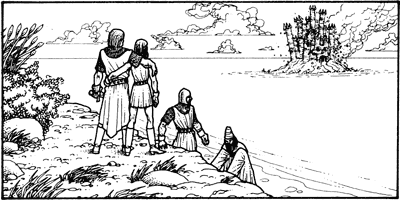
A campaign premise is different from the campaign setting. It is based on the concept of a series premise, which is also different from a series setting. Here's an example of two series premises -- both set in the same, er, setting:
- Buffy the Vampire Slayer: a young woman attending a small town high school discovers that she is the latest in a line of Slayers -- young women chosen by fate to battle against vampires, demons, and other forces of darkness. Aided by a Watcher (guide, teacher, trainer and source of useful exposition), and a circle of loyal (though not entirely normal) friends, she faces off against these creatures drawn or spawned by the Hellmouth.
- Angel: A vampire whose human soul was restored to him as a punishment -- tormented with guilt and remorse -- works as a private detective in Los Angeles, California. Along with a variety of associates they "help the helpless" and "save the powerless", normally doing battle with evil demons or demonically allied humans who are increasingly affiliated with a supernaturally evil law firm Wolfram & Hart.
Same setting, different unifying concept that plausibly (or implausibly in some causes) rationalizes the monster of the week that plagues this type of show.
So how is this useful for D&D-type campaigns?
For people like me who want some kind of plausibility and perhaps continuity in a campaign, I like to think in terms of campaign premises because it helps me address several issues that often challenge plausibility and continuity, such as:
- "How many of these things are there?" - assuming it's not a mega-dungeon and you've got sufficient time and skill to go through a dungeon in a single gaming session, after several months you (or your players) may begin to wonder exactly how many of these dungeons got the countryside, how they keep happening upon missions and rumors about them, and how they might be able to earn money as a dungeon construction company;
- "I'm his sister, Red Dougal." - PCs tend to die without hope for resurrection, necessitating fresh PCs to reinforce the party, and it's not necessarily fun to role-play the sometimes in-dungeon meet-and-greet. I mean, would you really trust some creature that suddenly appears -- fully decked out in adventuring gear -- during your adventure?
- "No one's heard from them since!" - A total party kill means another group of adventurers must show up and go through the dungeon as well. How do they know about it, and why weren't they hot on the heels of the last party, and good thing there are a lot of adventurers just waiting to go out on these expeditions immediately after the last one failed to return. If the party was trying to complete a series of quests to stop some evil overlord thing -- so much for all the clues and continuity built up with the last group!
A good campaign premise can address some, if not all of these problems. And while they may seem hokey, to me that's better than no attempt at plausibility at all! Here are some off the top of my head (gleefully ripped off from various media):
The Goons of the Invincible Overlord
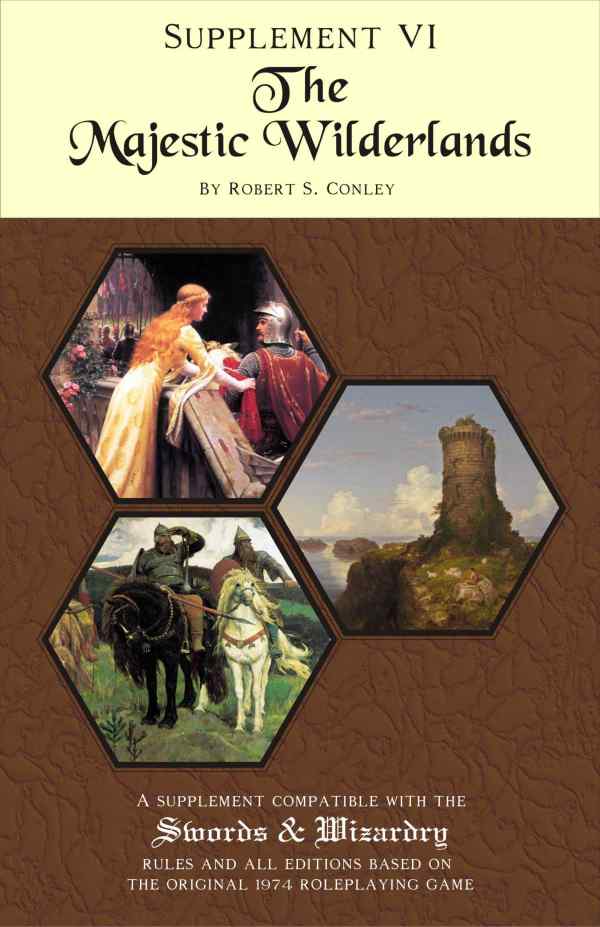
But a small group of adventurers are awarded/punished with the "short-straw" missions -- clearing out humanoid infestations along the borderlands, securing rumored caches of fiercely-guarded locations of ancient treasure, investigating rumors of unusual deaths in outlying towns and villages, and the ever-popular "it may be nothing, but it doesn't hurt to check if there really is a tomb of a lich there, and yes you have to pay for everything for this expedition yourself".

Also remember that -- early on in the X-files series -- Fox Mulder was granted access to the X-files casework because of his excellence in serial killer profiling. The reward for a job well done may well be that characters can eventually pick their own missions. Just like their superiors are probably doing.
Settings that seem easily adaptable to this concept would be the CityState of the Invincible Overlord and the Majestic Wilderlands.
Port of Call

Travel to new locations can be over land as part of a caravan, or via sea trading routes. Powerful political factions with their own agendas can also set themselves up in the city and cause trouble, resulting in occasional city-based adventures. Established patrons may be able to tie loose strands of rumor and fact together and urge the party out with specific missions -- and handsome rewards.
Freeport seems like a nice fit for this type of campaign premise.
Triskadekaturions

Great for campaigns that want an excuse to roll out world backstory exposition quickly, but with the occasionally annoying "need to know basis" stonewall from superiors. Tends to raise the question: who's bankrolling these operations and why do they really want us to recover and eliminate all this stuff? Resolving that question tends to make a great transition into another type of campaign premise.
Both Greyhawk and Mystara (because of the Blackmoor and Immortal/Gods elements) seem particularly apropos for lots of ancient artifact retrieval.
Earthdawn

Now that the stars are no longer exactly "right", but still "right enough" for the lesser outsiders and elder beings to exist in a greatly weakened fashion, the remnants of various empires and powers are sending out people to investigate, reclaim, and cleanse the glories of the past.
Thursday, April 1, 2010
Resources for "Sandbox" Creation
Labels:
game planning

I'm not entirely certain about the origins, though I believe that it may have originated from the IT term for an isolated server or workspace within a server that is effectively segregated from everything else in the network -- you can do whatever you want in it and it won't affect anything outside it.
In modern gaming parlance, the sandbox apparently refers to -- and I'm doing this purely from context clues -- a style of play where players are dumped into a campaign setting that can be as small as a dungeon or as large as a world map and are free to pursue whatever agendas they wish.
Furthermore, it seems to be used as the opposite of 'story-driven' play -- which, in many OSR blog posts, seems to be used synonymously with GM 'railroading' (a more commonly used term that has seen longer and more widespread usage in gaming circles).
In any case, I've decided to find out more about this old/new style of play and am hunting down posts concerning sandbox creation. Here are a couple of excellent meta-posts from A Bat in the Attic.
Fantasy Sandbox Creation
Traveller Sandbox Creation
Tuesday, March 30, 2010
A Bit of Old News
Labels:
RPG news
In my effort to collate the recollections of many old school gamers from their blogs, I ran across a 2008 review of a Free RPG on the Free RPG Blog and found that the RPG in question had been developed by GM Dariel!
GM Dariel was, of course, interviewed at the game table some time back. He is, of course, hard at work on a top secret RPG (in between work and other hobbies, of course).
GM Dariel was, of course, interviewed at the game table some time back. He is, of course, hard at work on a top secret RPG (in between work and other hobbies, of course).
Saturday, March 27, 2010
Piecemeal History of Gaming #2
Labels:
RPG history
Well, there's an interesting site that I must recommend: Greg Stafford's Chaosium Page. What's this page about? Here's what he says it's about:
Chaosium, Inc. is one of my proudest accomplishments.


Chaosium was one of the original companies for the Hobby Game Industry, and was famous for its innovative and professionally produced product.
I founded it in 1975 and ran it, as president, from then until 1998.
Here is a collection of articles, reminiscences and other stories about my time there.It's not complete, but it's got a bunch of interesting articles. Here are the most interesting to me:
Piecemeal History of Gaming #1
Labels:
RPG history

Here's the first set of links in my attempt to collect them all.
Various Links
- James Maliszewski's excellent series of 'retrospectives' on his blog [link]
- Jeff Grubb's "Secret Origin" of TSR's Marvel Super-heroes RPG [link]
- Jeff Grubb's Secret History of the Forgotten Realms [link]
- An RPG.net thread with newsclippings showing how the D&D/Satanism hoopla played out back in the 70s and 80s [link]
- All eighteen (18) articles from Shannon Appelcline's "A Brief History of Game" [link]
- An article on D&D and its relatively recent Old School Renaissance [link]
- A Brief History of Champions and the HERO System [link]
- An article on non-Tolkien fiction that inspired D&D [link]
- An article on Larry DiTillo -- the guy who wrote Masks of Nyarlathotep [link]
- An article on Steve Long -- the man behind the rebirth of HERO games [link]
- An article on Marc Miller -- the man behind the first successful science fiction RPG: Traveller [link]
Interesting Posts on GMing!
A post on adding themes into the games you're GMing from Trollsmyth.
MobUnited says that "The Story is So Over."
Former WOTC game designer posts his philosophy and views on intro RPGs.
MobUnited says that "The Story is So Over."
Former WOTC game designer posts his philosophy and views on intro RPGs.
Monday, March 22, 2010
The Right Way to Roleplay
Labels:
players,
roleplaying
Everyone knows that old adage: if your group is having fun, then your way of roleplaying is the right way of roleplaying.
Time after time, however, discussions and opinions emerge about the right way to roleplay. Discussion and arguments tend to gravitate around these issues:
In my personal opinion, the issues mentioned above aren't a black & white thing (you either are, or you aren't crap). Normally, there are gradations along a continuum along with other mitigating circumstances that complicate them.
Will try to tackle each of these issues one-by-one to see how the possible histories and nuances of these issues may have come about, and how the may be resolved at the game table.
Time after time, however, discussions and opinions emerge about the right way to roleplay. Discussion and arguments tend to gravitate around these issues:
- Player knowledge vs. character knowledge - some people believe that as a role-playing exercise, the integrity of the experience is compromised if a character acts on knowledge that he/she cannot possibly have. This includes the location of secret doors and traps, the weaknesses of certain monsters, and creating gunpowder in a campaign where the tech level just doesn't support it. Other believe that since it's a game, past meta-gaming experience should inform current gameplay -- otherwise we're just gonna keep getting killed in the same damn area by the same badly-designed killer dungeon.
- Player skill vs. character skill - if you are naturally charming and cunning, then your skill at bargaining, lying, and seducing people at the gaming does not stem from your character's abilities but from your own. Some styles of play support this, and encourage otherwise not-so outgoing players to stretch themselves a bit. On the other hand, if your character is clearly a stupid oaf in conception, coming up with an uncharacteristically brilliant idea also stretches credulity.
- Character-is-me vs. character-isn't-me - some people create characters that are slightly better/worse/different versions of themselves, while others create very different characters each time character creation rolls around. The former are sometimes looked down upon for being not very original, while the latter run the risk of being labeled drama-hogs and frustrated thespians. Both tend to incur this type of loss of respect if their role-playing habits or personalities (real of affected) rub other players the wrong way a lot.
- Roll-playing vs. Role-playing - seemingly the opposite of the first two issues, this centers around a player (and sometimes GM) reliance on the dice to determine everything, regardless of the skill, decisions and gameplay involved.
In my personal opinion, the issues mentioned above aren't a black & white thing (you either are, or you aren't crap). Normally, there are gradations along a continuum along with other mitigating circumstances that complicate them.
Will try to tackle each of these issues one-by-one to see how the possible histories and nuances of these issues may have come about, and how the may be resolved at the game table.
Sunday, March 21, 2010
Catholic Girls, I mean, Catalyst Games in trouble
Labels:
RPG news

The official word from their website is as follows:
"While we wish the review had only uncovered positive news, we also discovered our accounting procedures had not been updated as the company continued to grow. The result was that business funds had been co-mingled with the personal funds of one of the owners. We believe the missing funds were the result of bad habits that began alongside the creation of the company, which was initially a small hobby group. Upon further investigation, in which the owner has willingly participated, the owner in question now owes the company a significant balance and is working to help rectify the situation."
The unofficial word from the interweb is as follows:
"OK, as you may well have been able to surmise from release schedules, Catalyst Game Labs is in a bit of a financial pickle, and it is somewhat unlikely that they will retain the license to make Shadowrun products. This is not because Shadowrun hasn’t been selling enough to cover expenses, but merely because a significant quantity of money is missing outright. Reliable sources put this figure at roughly $850,000. Which sounds like a lot, and it is. It is roughly 40% of Catalyst’s entire sales for last year, missing over a three year period. There will of course be lawsuits, and there are already people drawing up legal documents accusing..."
So what does this mean for all you die-hard Shadowrun fans out there? Well, if you liked all the 4th edition material you've gotten so far, you may see a change in quality as various members of the writing / editing staff depart the company.
And if you want to panic buy -- just in case Catalyst Games Labs does disappear -- go right ahead. They need the money. Just make sure it goes to the right people, chummer.
Monday, March 15, 2010
Game Table Interview: GM Adam
Labels:
game table

Here are his responses to the questionnaire:

You mean besides "Play Pretend" as a child? I remember being about 8 or 9 and playing with a kid who lived across the street from my grandmother. He always got the newest toys first and had the Dungeons and Dragons boxed set. Once we played, I was completely hooked. I returned home, I sought out the varying boxed sets and taught all my neighborhood friends how to play. Eventually the hardbacks for "Advanced" Dungeons and Dragons came out and I got each of those.
What was it about the hobby that made you want to continue playing?
One thing that has drawn me to RPGs is the ability to create drama for anyone. I have been involved with theatre most of my life and I really find RPGs to be a form of theatre. Normally, when we watch TV or a movie, we see others having adventures and creating stories. Role-playing games puts all of that in the hands of the player and allows them to be both performer and audience all in one.
What was it about the hobby that made you want to run RPGs?
I've always enjoyed creating stories and casts of unusual characters. When I'm running a game, I don't just create and play one character like players do. I get to create dozens with little personality traits, goals and abilities. When you GM, you get to be the rest of the world the players have to explore and interact with.
I also love watching how players can suddenly take a story in a direction you never conceived it going towards. Scrambling to figure out what will happen when the main character does something totally unique can give a much more rewarding story and experience. Comparing it to online games, you generally are limited to boxed in area that has been created. Deciding what happens when characters take a jack hammer and pulverize one of those walls that weren't supposed to be able to is a lot of fun.
What 3 novels have most inspired the games you run? Why?
Everything I've ever read has had some influence. One series that has had a lot of influence over my fantasy worlds was the Prydain Chronicles by Lloyd Alexander. It's a series about a young orphan who eventually becomes the hero of a kingdom and more. The Disney movie The Black Cauldron is based on one of the books but didn't even come close to the original story. It's based very much from Welsh mythology and the Arthurian tales which have always appealed to me. One thing I drew from here is that NPCs are not always what they seem and every hero needs a good bad guy.
Geoffrey Monmouth's History of the Kings of Britain certainly has to be cited as a source of inspiration, directly and indirectly. Written to be a historical work (though many historians question its veracity), it is the first written account of Arthur and Merlin. In his tale, Gawain was the mightiest knight and Arthur single-handedly fought battles with hundreds of giants and won. All of the Arthurian tales we know of started here. So when I read TH White, Mallory, and others, I often think of Monmouth. One thing this has always reminded me in an RPG, is that while the players can have other heroic characters and an intricate world around them, the story (if it's going to be good) must be about them. If it's a classic good vs. evil story, this means that they must be necessary to defeat the evil.
For the third, let me pick the Mistress/Servant/Daughter of the Empire series by Jannie Wurts and Raymond Fiest. This is about Mara of the Acoma Clan and her ascent into power of a feudalistic fantasy Asian Empire. Considering one of my most recent campaigns was a Legend of the Five rings game; this series was invaluable as a source of inspiration and understanding how to run a game of political intrigue in a setting of Bushido based honor.
Overall though, I'd say inspiration can come from any book. Many good science fiction stories are actually fantasy stories or political beliefs wrapped in science fiction trappings and vice versa. Using inspiration from one type of story and seeing how it would work in a completely different type of setting can result in some great tales. I even once ran a super hero campaign based loosely on Old Possum's Book of Practical Cats.
What 3 TV shows have most inspired the games you run? Why?
Farscape was a wonderful show. It was very character driven and many episodes revolved as much around how the characters interacted with one another as it did with them interacting with any outside threats. This is a great example of how to make and play with a group dynamic within a party.
As a teen, I watched everything to do with GI JOE. One thing that's interesting about this show from a Gming perspective is how they had dozens of "Joes" but they were each powerful in their own way. They each had a niche to fill and each had their occasional moments of character development and time in the spotlight. A lot is made in games about "game balance." While game balance is important, it's really just a tool to drive towards characters getting their time to shine in their own way.
I'll add Kindred: The Embraced as the third since it was probably the first real TV show (not counting the Saturday morning cartoons) actually based on a role-playing game. Certainly you could learn a lot wbout White Wolf's world and the dramatic tensions in that world from the show. But the most important lesson of the show was that RPGs were, in fact, cool and they really could inspire success in a mainstream audience (a lesson that the video game industry has learned from quite well).
What 3 movies have most inspired the games you run? Why?
Star Wars has to be at the top of this list (the original trilogy, of course). It has such wonderful characters and inspired my love of spirit and belief in trying to do what's right. It also echoes what I said about the Prydain Chronicles and the need for a great villain. It also inspired a couple of campaigns in the excellent WEG d6 system. The soundtracks created by John Williams are a must have for any gamer.
The Princess Bride has inspired so many gamers I think it must be mentioned whenever talking about movies. The structure of the plot, and weaving the group together along with the clever situations and dialogue in this movie add to its charm. It provides a blueprint to adventure and comedy that every gamer can use to add to their game.
Finally, I would have mention Superman. This is one of the first comic book movies and could arguably be said to have inspired the rest of the comic book movies that have come after it. One thing this move does demonstrably well is showing our hero beating up on a couple of "average" opponents to get him used to his powers as well as showing us how powerful he really is. The first time we see the "S," he saves Lois (as always), catches a cat-burglar halfway up the side of a sky-scraper, rescues a kitten from a tree, and catches some other random robbers. This reminds us to give the heroes time to feel badass before we introduce the villains (Luthor and Zod) that will give them a real challenge which builds the dramatic tension. Let your heroes have small battles every now and then to remind them that they are the heroes.

Probably DC Heroes by Mayfair games, sometimes referred to as "Mayfair's Exponential Game System" or MEGS. I used to read comic books a lot during college (I worked part time in a comic shop during college and was paid only in store credit -the guy running the shop was smart). So during this time, I enjoyed running games based on comics. When using this as a tool to introduce people to RPGs, I found similar success to the current glut of comic book movies and TV shows.
At first, I was running Marvel Super Heroes by TSR (which is another really good system). Generally, I could ask people if they could have any super power, what would it be? Give them a character with that power and let them get a feel for the game. Marvel's system was good, but very random and very simplistic. DC could do most of the things the Marvel system could do, but also gave people detailed control over their own character. It also did "Batman" types much better than Marvel did. DC also implemented a number of techniques that were revolutionary at the time which are carried over in many RPGs today that gave players cinematic abilities to recover at dramatically appropriate moments, subplots, and generally was one of the first systems that significantly encouraged playing the role of the character as opposed to just blasting whatever got in your way.
What is your favorite published game supplement or adventure of all time, and why?
I don't usually use pre-fabricated adventures, preferring to make up my own. That being said, I think one of the greatest series of supplements was the Otosan Uchi set and the Winter Court books by AEG for their Legend of the Five Rings line. They basically introduced the main characters and locations within the place and proposed varying different potential ways to use those settings. Some you might use, others you might ignore.
In these books, they introduced a wonderful series of hooks in a "Challenge, Focus, Strike" format. Sometimes I call this the "Bait, Hook, Strike" format. The Bait or Challenge portion is a scenario that may draw the PCs interest in the situation, for example the PCs could see NPC X wandering the halls at night outside NPC Y's quarters suspiciously. The Focus (Hook) section usually details more of the background that the PCs will only know if they take the bait, NPC X is secretly in love with NPC Y and has been delivering poems to her as a secret admirer. Then the Strike portion has details of how a GM might handle potential fallout if the PCs get involved and details that may impact that fallout. NPC X's uncle betrayed NPC Y's father 20 years ago and he has not trusted anyone of that clan since. He would be much happier if someone else were courting his daughter. Whether the PCs help X win over the father or they woo Y in place of X helps give them enemies and friends for the future. One thing that was especially handy about this is you could realistically drop out the bait to several potential subplots at once and have each of them progress realistically with or without the PC's intervention.

I've played in Con games and tournaments of Shadowrun but I've never gotten to play in a full campaign. I've always wanted to explore this system more since it seems to have a lot of potential and possibilities. It seems like a very fun game. Also, one of my friends in college ran a legendary Shadowrun campaign (he even contributed to a couple of modules), but my schedule never seemed to match the times/days he was running.
What upcoming RPG releases are you looking forward to seeing?
Naturally, I'm looking forward to the 4th edition of Legend of the Five Rings with bated breath. I hope that it will include some stuff for the 7th Sea setting since the main rules are supposed to be more "setting generic" and allow for expansions like Burning Sands without re-writing the main rules.
Also, John Wick recently announced he's working on an entirely new samurai based game system. That will be interesting to see. I still think his first edition of L5R is one of the best editions.
One thing I'm looking forward to that isn't necessarily an "RPG Release" but I think will greatly impact the way we (especially I) play table-top RPGs is the iPad and the Microsoft Courier and the rest of the e-reader/web-browser hybrids. The problem with the current e-readers is that they don't do PDF well or color. With this next generation of readers, PDF format will be much more accessible at a gaming table. It will be nice to store my entire gaming library in a digital, portable device.
Saturday, March 13, 2010
You Gotta Have Character!
Labels:
game planning,
roleplaying
Useful to me as a player, a GM, and a writer!
Character Creation overall: The Characterization Puzzle
Character Creation Aid #1: Thumbnail Method
Character Creation Aid #2: Inversion Principle
Character Creation overall: The Characterization Puzzle
Character Creation Aid #1: Thumbnail Method
Character Creation Aid #2: Inversion Principle
Science Fiction Games I Wanna Play
There's no shortage of interesting games that I want to play at least once for various reasons: the setting, the system, the possible stories, etc. While these things tend to bounce around across various genres, I decided to build a list of RPGs I'd like to try out and limit it to one genre for focus: science fiction.
I've played in and run the following games: Star Frontiers, Traveller, West End Games's Star Wars RPG, Cyberpunk, and Fading Suns.
As for games I'd like to try out the following:
 Starblazer Adventures - not so much for the setting, but for the game system. It seems to be a far more narrative-oriented system in terms of game mechanics (essentially the same family of FATE rules as Spirit of the Century), but I can't quite wrap my mind around them by mere reading. As for the setting -- I've never read these comics, but they seem extremely pulpy and sadly not my type of pulp science fiction. If I had to run it, I'd have to tweak any and all of the settings to some thing more to my science fiction tastes.
 X-Plorers - partially for the setting, partially for the system, partially for the novelty! X-Plorers is a "what-if" RPG, one that asks "what if the first RPG had not been influenced by fantasy novels of the era, but by science fiction novels of the era?" Not quite imperial science fiction, not totally hard science fiction, and definitely not pulp science fiction, and it's got character classes and levels, but skills as well. Free to download, too.
 Eclipse Phase - wanted to try out transhuman science fiction gaming ever since GURPS Transhuman. Eclipse Phase, with its fantastic production values, and its "Revelation Space meets Global Frequency" pitch and percentile-based game system have piqued my interest as well.
Here's hoping I get the chance in the next year or so.
I've played in and run the following games: Star Frontiers, Traveller, West End Games's Star Wars RPG, Cyberpunk, and Fading Suns.
As for games I'd like to try out the following:
 Starblazer Adventures - not so much for the setting, but for the game system. It seems to be a far more narrative-oriented system in terms of game mechanics (essentially the same family of FATE rules as Spirit of the Century), but I can't quite wrap my mind around them by mere reading. As for the setting -- I've never read these comics, but they seem extremely pulpy and sadly not my type of pulp science fiction. If I had to run it, I'd have to tweak any and all of the settings to some thing more to my science fiction tastes.


Here's hoping I get the chance in the next year or so.
Wednesday, March 10, 2010
Useful Campaign Links #2
Labels:
game planning
Essential Skills for Running RPGs: Writing and Acting
Techniques for Running RPGs: Prep and Play
Fantastic Source of RPG Monsters: RPG Creatures
References for City Building: City Economics
Techniques for Running RPGs: Prep and Play
Fantastic Source of RPG Monsters: RPG Creatures
References for City Building: City Economics
Tuesday, March 9, 2010
Setting Mashup Source #4: Fading Suns

This, of course, is taken from the RPG Fading Suns by Holistic Games, currently being kept on the market by redbrick limited. Here's a short setting description:
It is the dawn of the sixth millennium and the skies are darkening, for the suns themselves are fading. Humans reached the stars long ago, building a Republic of high technology and universal emancipation—and then squandered it, fought over it, and finally lost it.
A New Dark Age has descended upon humanity, for the greatest of civilizations has fallen and now even the stars are dying. Feudal lords rule the Known Worlds, vying for power with fanatic priests and scheming guilds.
The reasons I want to nab this aspect of the game are many:
(1) the classic cleric and paladin classes seem to owe much to the monotheistic holy warriors of the crusades, which feeds off this Fading Suns vibe;
(2) I'm fond of revisiting the various sects and dogmas that splintered the Catholic faith, and Fading Suns has a lot of echoes of them;
(3) I want to have saints stand in for the various god portfolios prevalent in fantasy rpgs, which Fading Suns has as well;
(4) Karameikos has a nice Thyatian Church (Byzantine Empire's official religion) vs. Traladaran Church (syncretic and pantheistic belief system that welcomes the new Church's beliefs -- until it became a competition) vibe that can create twists;
(5) I think that the Jumpgate cross and its many incarnations make nice religious symbols;


(6) the entire Blackmoor backstory can be made to dovetail with the Fading Suns Second Republic -- an incredibly advanced Science Fiction republic that uses Theurgy (clerical abilities) and other abilities that seem to be magic and psychic abilities -- and its subsequent fall;
(7) allows me to re-frame the Immortals, and the cosmology of evil in a different light.
Sunday, March 7, 2010
And the Characters Trickle In
As the Labyrinth Lord characters (partially built -- ranging from character concept stage to "I've done everything except the equipment list" stage), trickle in for my Play-by-post game, my thoughts begin to split along two paths: the actual dungeon adventure and the PCs themselves.
 Actual dungeon adventure - While I'm really tempted to inflict either Michael Curtis's Stonehell Dungeon or James Edward Raggi IV's Death Frost Doom on the players, I haven't bought either (yet), and I'm on a strict budget for the next couple of months.
Furthermore, my old D&D modules are all boxed up, leaving only stuff from Goodman Game's Dungeon Crawl Classics to experiment with on my players. I've already selected one, and we'll see how it challenges the players.
If they read it, that's okay as long as they don't metagame or kill the fun for the others. I mean, it's kinda cheating yourself, right? And if some of them do use player knowledge sneakily -- I guess that's part of the old school experience right?
The PCs themselves - So far one player wants to be a fighter or a thief, while two players have already rolled up Elves. For purposes of role-playing, I may want to find more material on the elves of Karameikos so that they can get a handle on what elves have to deal with in this setting.
Hope someone gives some thought to a cleric -- PC or NPC. Healing can be real important on these dungeon crawls.
Saturday, March 6, 2010
Halflings are hard-core!
Labels:
Game: dungeons and dragons,
nostalgia
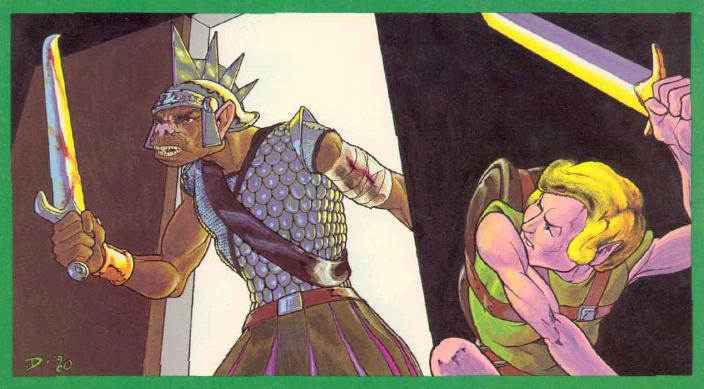
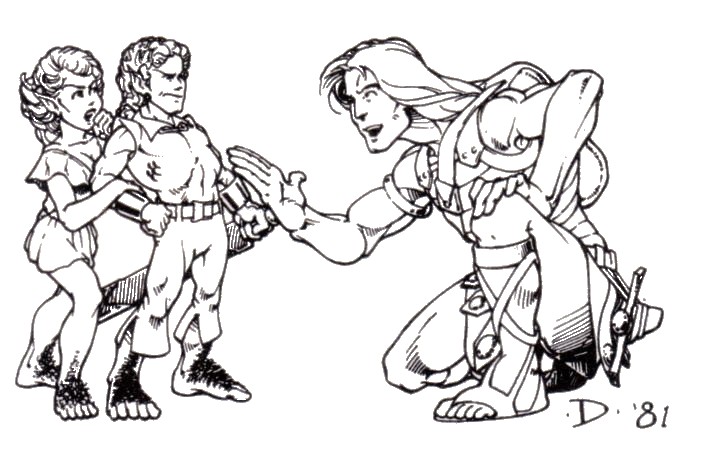
I realized early on in my gaming career that not everyone though halflings were a cool race to play in D&D. And indeed, as I began to re-read my Lord of the Rings at the age of 15 I realized that while Merry and Pippin were pretty formidable at the end of the trilogy -- they weren't anywhere near that butch throughout most of the trilogy.


 Hm. How to make the halflings hard core combat machines that I remember?
So where'd I get this idea about halflings being a hard core combat fighting race?
Jeff Dee.



Subscribe to:
Posts (Atom)